Gold soars towards $5,600 as Trump rattles sabre over Iran
Gold prices have gained more than 27 per cent this year following a 64 per cent jump in 2025.
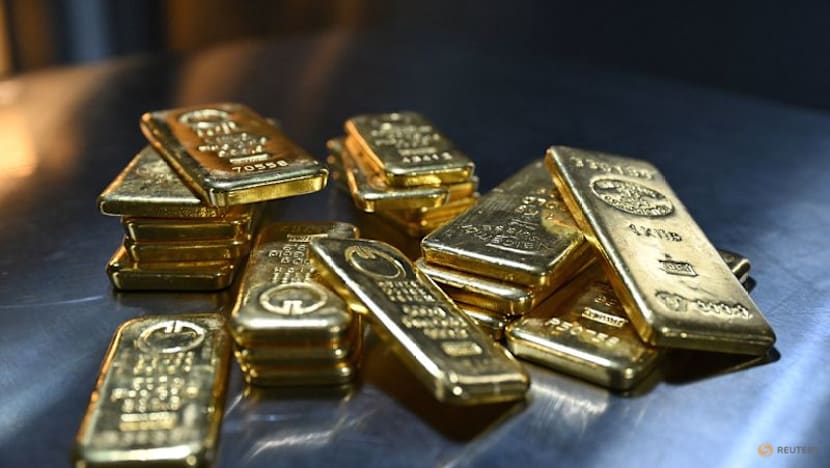
Gold bars of various values are stored in a safe deposit room in Munich, Germany, January 28, 2026. REUTERS/ Angelika Warmuth
Gold prices soared to a fresh record near US$5,600 on Thursday (Jan 29), while oil rallied after Donald Trump ramped up geopolitical tensions with his threatened military strike on Iran.
The surge in safe-haven precious metals also saw silver hit another peak and has also been helped by a softer dollar sparked by speculation that the US president is happy to see the world's reserve currency weaken.
An uneventful policy announcement by the Federal Reserve did little to inspire buying, though observers said traders are optimistic that interest rates will come down this year as Trump prepares to name his pick as the next governor.
Bullion piled on more than US$300 at one point to top US$5,595 after Trump said Tehran needed to negotiate a deal over its nuclear programme, which the West believes is aimed at making an atomic bomb.
"Hopefully Iran will quickly 'Come to the Table' and negotiate a fair and equitable deal - NO NUCLEAR WEAPONS - one that is good for all parties. Time is running out, it is truly of the essence!" he wrote on his Truth Social platform.
"The next attack will be far worse! Don't make that happen again," he added, referring to American strikes against Iranian targets in June.
A US naval strike group Trump described as an "armada", led by aircraft carrier the USS Abraham Lincoln, is now in Middle East waters, with the president saying it was "ready, willing and able to rapidly fulfill its mission, with speed and violence, if necessary".
CNN said he was mulling an attack after nuclear talks failed to advance.
Iran's foreign minister Abbas Araghchi warned on Wednesday that Tehran would respond immediately and forcefully to any US military operation - adding that its forces have their "fingers on the trigger" - but did not rule out a new nuclear deal.
Gold has gained more than 27 per cent this year following a 64 per cent jump in 2025.
"Gold is no longer just a crisis hedge or an inflation hedge; it is increasingly viewed as a neutral, and a reliable store of value asset that also provides diversification across a wider range of macro regimes," OCBC analysts said in a note.
"INVERSE OF CONFIDENCE"
Analyst Stephen Innes said the surge in gold indicated deeper structural concerns.
"After blowing through US$5,500 in early Asia, bullion is no longer trading like a commodity. It is trading like a referendum. Not on inflation. Not on rates. On trust," he wrote.
"Gold is the inverse of confidence. When belief in policy coherence weakens, gold ceases to behave like a hedge and instead acts as an alternative. That is what we are watching now. This is not fear of recession. There is doubt about fiat stewardship."
Rising tensions sent oil prices up more than 1 per cent - with WTI at its highest since September and Brent at levels not seen since July - amid supply worries.
On equity markets Hong Kong, Shanghai, Singapore, Mumbai and Seoul rose, while Tokyo was flat.
Sydney, Wellington, Taipei and Bangkok dropped.
London and Frankfurt edged up at the open but Paris fell.
Manila sank as data showed the Philippines economy grew last year at its slowest non-pandemic rate since 2011.
Jakarta tanked 8 per cent, prompting a temporary halt and extending Wednesday's collapse that came after index compiler MSCI called on regulators to look into ownership concerns. Stocks later pared those losses to sit around 3 per cent lower.
MSCI also said it would hold off adding Indonesian stocks to its indexes or increasing their weighting, while there are concerns it could announce a downgrade from emerging market to frontier market, which could spark an outflow of foreign capital.
"I think this sharp downward pressure may last one or two days," said Hans Kwee, a stock analyst at PasarDana. "It was yesterday and today; at most, tomorrow it starts to move sideways.
"Then next week the market should be more normal."
The dollar remained under pressure, even after Treasury Secretary Bessent told CNBC that "the US always has a strong dollar policy", a day after Trump appeared to welcome its recent weakness.
The Fed's latest policy meeting ended with few surprises as boss Jerome Powell said officials were keeping tabs on data.
But Matthias Scheiber and Rushabh Amin at Allspring Global Investments said attention was now on who Trump would tap to take the helm when Powell steps down in May.
"The big focus will remain on the announcement of the new Fed chair, with the race wide open though a general expectation of someone more dovish to succeed Jerome Powell," they wrote in a commentary.
Hong Kong-listed property stocks surged on the back of a report saying Chinese leaders had rowed back on stringent measures aimed at reining in borrowing, which helped spark a chronic debt crisis in the country's real estate sector that is still weighing on the economy.
Troubled developers soared, with Country Garden up around 17 per cent, Sunac rocketing 30 per cent and Agile Group 15 per cent higher.