HSBC chair says Middle East peace deal needed to restore global energy flows
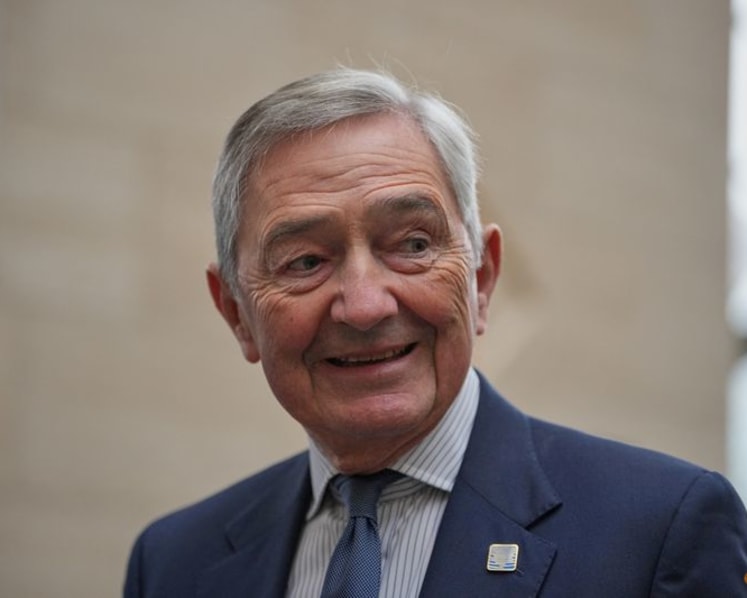
FILE PHOTO: HSBC Group Chairman Brendan Nelson attends the UK-China Business Forum held at the headquarters of the Bank of China (BOC) in Beijing, China, January 30, 2026. Kin Cheung/Pool via REUTERS/File Photo
HONG KONG, April 14 : HSBC Holdings Chair Brendan Nelson said on Tuesday that a Middle East peace deal was essential to ensure a substantial resumption of global energy flows, with oil-driven inflation looming as a major risk to the world economy.
Nelson, speaking at the HSBC Global Investment Summit in Hong Kong, added that as long as uncertainty persists, energy prices would remain elevated.
Oil prices have surged since the Iran war began, and prices remain nL1N40W14D close to $100 a barrel as investors position themselves for prolonged tensions around the crucial Strait of Hormuz, through which a fifth of global oil and gas typically passes.
Nelson warned that current global growth, trade and inflation projections should be "approached with considerable caution" given that the impacts of the Iran conflict are yet to be fully understood.





"The longer the disruption continues, the more the indirect effects from higher energy costs will lift inflation and depress growth," Nelson said.
With a swift reopening of the strait looking unlikely, Nelson said he expected interest rates to be held steady in the U.S., Europe and Britain this year as a rise in short- and long-term market rates had tightened financial conditions.
The U.S. Navy began a blockade nL1N40U07M of the strait on Monday, following the breakdown of weekend talks to end the six-week-long war.
ANZ analysts estimate nL1N40W154 about 10 million barrels per day of crude supply have been effectively removed from the market, adding that a prolonged U.S. blockade could curb an additional 3 million to 4 million barrels per day.
TOUGHER ENVIRONMENT
Along with the war in Iran and rising geopolitical tensions more generally, tariff concerns and volatility in private credit markets, investors are faced with a difficult environment, said Christopher Sheldon, KKR & Co's global co-head of credit and markets.
"Increasing defaults, increasing downgrades, spreads, tightening - that's a tough recipe as an investor," Sheldon said on a panel about private credit during the summit. "So what you should be doing there is diversifying."
Richard Oldfield, chief executive of asset manager Schroders, said on the same panel that he is worried about the boom in data centres.
"I think there's quite a lot of obsolescence in the system given the amount of time that it takes to get a data centre up and running," he said.
"There's a rush to build capacity ... and like any gold rush, there's always a little bit of misallocation of capital."