







Nasdaq confirms correction, bond prices fall as Iran crisis pushes oil to $108
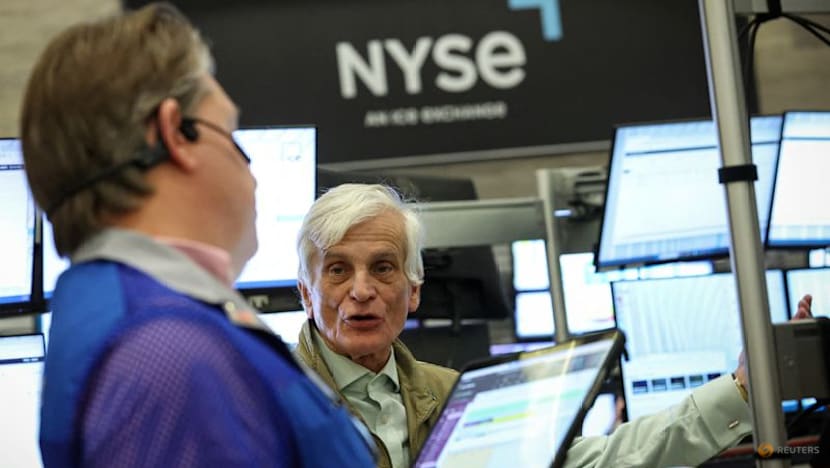
FILE PHOTO: Futures-options traders work on the floor at the New York Stock Exchange's NYSE American (AMEX) in New York City, U.S., March 17, 2026. REUTERS/Brendan McDermid/File Photo
NEW YORK/LONDON, March 26 : Stock indexes fell sharply on Thursday, with the Nasdaq dropping more than 2 per cent to confirm a correction, and Brent oil jumped to more than $105 a barrel as hopes diminished for a quick resolution to the nearly one-month-old Middle East war.
U.S. President Donald Trump said Iran must make a deal or face a continued onslaught, while a senior Iranian official told Reuters on Thursday that a U.S. proposal for ending the fighting is "one-sided and unfair."
Global debt markets also sold off, pushing yields higher, while safe-haven buying boosted the U.S. dollar.
On Wall Street, the Nasdaq Composite dropped 2.4 per cent, leaving the tech-heavy index down nearly 11 per cent from its record-high close on October 29 and confirming it has been in a correction - typically defined as a fall of 10 per cent to 20 per cent - since then. The day also marked the biggest one-day decline for the Nasdaq and the S&P 500 since January 20.





Stock futures trimmed losses after the bell as Trump said he was pausing attacks on Iran's energy plants for 10 days until April 6 at the Iranian government's request.
“This war has really been punishing investor psyches," said Ryan Detrick, chief market strategist at Carson Group. The move in the Nasdaq "is further confirmation that the weakness we've been seeing across the board continues."
Prospects of a prolonged war in the Middle East fanned worries about energy supply disruptions. Oil and European natural gas rose, with Brent futures settling at $108.01 a barrel, up $5.79. U.S. crude CLc1> settled at $94.48.
The war, triggered by U.S.–Israeli strikes on Iran, has rattled global markets and effectively shut the Strait of Hormuz, a conduit for a fifth of global oil and liquefied natural gas flows.
"Unfortunately, we're in a market that's being driven by oil prices. The rhetoric back and forth is continuing, and until talks begin, the market is going to be subject to the price of oil," said Peter Cardillo, chief market economist at Spartan Capital Securities in New York.
The Dow Jones Industrial Average fell 469.38 points, or 1.01 per cent, to 45,960.11, the S&P 500 fell 114.74 points, or 1.74 per cent, to 6,477.16 and the Nasdaq Composite fell 521.74 points, or 2.38 per cent, to 21,408.08.
MSCI's gauge of stocks across the globe fell 15.90 points, or 1.60 per cent, to 979.56.The pan-European STOXX 600 index fell 1.13 per cent.
The Philippines held an unscheduled central bank meeting due to the turmoil, while Germany's central bank head said a European Central Bank rate hike next month was "an option." Germany's two-year bond yield, sensitive to ECB rate expectations, rose. Bond yields move inversely to prices.
Worries about persistent inflation also drove U.S. Treasury yields higher. The benchmark U.S. 10-year Treasury yield was last up 7.8 basis points at 4.404 per cent. The two-year note's yield was last up 8.6 bps at 3.967 per cent.
Earlier, the yield on Japan's two-year government bond hit its highest level in 30 years at 1.33 per cent, as traders cemented bets on another Bank of Japan rate hike as early as next month.
In currencies, the U.S. dollar rose against most major currencies, reviving its safe-haven appeal.
Fears of a 2022-style inflation shock have seen traders fully price out any chance of a Federal Reserve rate cut this year, further supporting the dollar.
In afternoon trading, the dollar index, which measures the greenback against a basket of currencies including the yen and the euro, rose 0.3 per cent to 99.92, with the euro down 0.24 per cent at $1.1529. Against the Japanese yen, the dollar strengthened 0.19 per cent to 159.75.
Gold fell. U.S. gold futures for April delivery settled 3.9 per cent lower at $4,376.30.





