







Oil rises, as US-Iran strikes risk limiting already impaired supplies
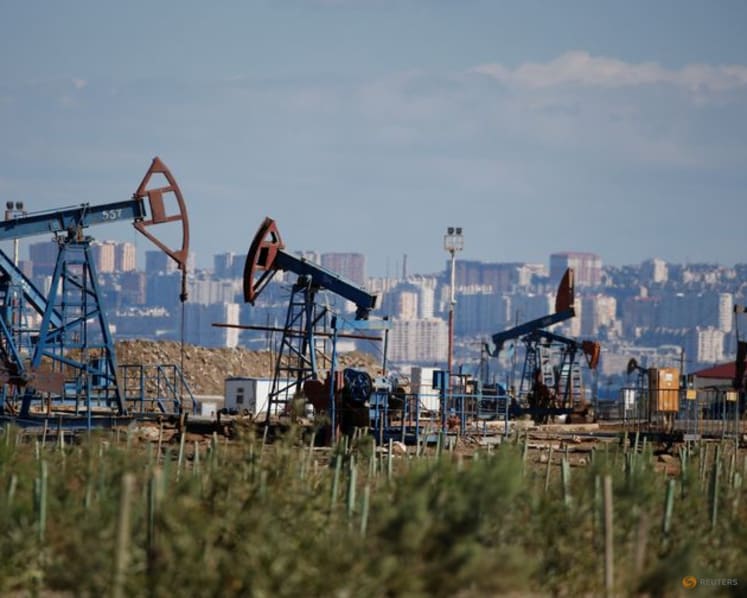
Pump jacks pump oil at an oil field on the shores of the Caspian Sea in Baku, Azerbaijan, October 5, 2017. REUTERS/Grigory Dukor
HOUSTON, Sept 2 : Brent crude prices were marginally higher in a volatile session on Wednesday, driven by renewed military strikes between the United States and Iran that have restricted world oil supply.
The U.S.-Iran war is now in its seventh month, with the recent attacks representing the biggest exchange of fire between Tehran and Washington since July. U.S. forces struck Iran's southern coast and Iran fired on American bases across the region.
Brent crude futures rose 25 cents to $94.90 a barrel by 10:48 a.m. ET (1448 GMT), while U.S. West Texas Intermediate crude futures were up 10 cents at $90.32.
The two benchmarks swung between gains of as much as $2 a barrel and losses of $1 a barrel throughout the session. The earlier gains pushed both benchmarks to their highest levels since July 24.





The ongoing war, which kicked off with joint U.S.-Israeli strikes on Iranian targets in late February, resulted in the effective closure of the Strait of Hormuz, a critical waterway that carried about a fifth of global oil and LNG consumed before the conflict.
"While the increase in conflicts will slow transit through the Strait of Hormuz in the near term, the market has absorbed the fact that workaround crude oil supplies can still make it to the market eventually," said Dennis Kissler, senior vice president of trading at BOK Financial.
Nations worldwide have relied on their reserves, which have also dwindled.
The Islamic Revolutionary Guard Corps said the U.S. attacks would further restrict traffic through the strait.
However, U.S. Secretary of Energy Chris Wright claimed on Tuesday that 17 million barrels of oil transited the Strait of Hormuz on Monday, which he said was the largest volume of crude to pass through the waterway since the Iran war began.
However, four commodity vessels transited the Strait of Hormuz on Tuesday, down from 10 a day earlier and below the 10-day average of around 13, preliminary Kpler shipping data showed on Wednesday. Two oil tankers hit sea mines and were disabled while attempting to transit the strait, Iran's Revolutionary Guards said on Wednesday in a statement shared by state media.
Iraq boosted its oil exports in August, with September shipments also set to climb, as wide profits and Iranian approval for its tankers to pass through the Strait of Hormuz have encouraged buyers, according to industry sources and shipping data.
OPEC+ is likely to keep its oil output policy unchanged for October at a meeting on Sunday, three sources close to the matter told Reuters, as the producer group completes the unwinding of one layer of production cuts this month and turns its focus to 2027 quota negotiations.
Elsewhere, Russia carried out a heavy missile and drone attack on energy infrastructure in Ukraine's southern region of Odesa overnight, transmission system operator Ukrenergo said on Wednesday.
In the U.S., crude oil inventories fell by 4.5 million barrels last week, the Energy Information Administration said on Wednesday, compared with analysts' expectations in a Reuters poll for a 1.1 million-barrel draw.





