Oil prices tumble by 15% after Trump predicts Middle East de-escalation
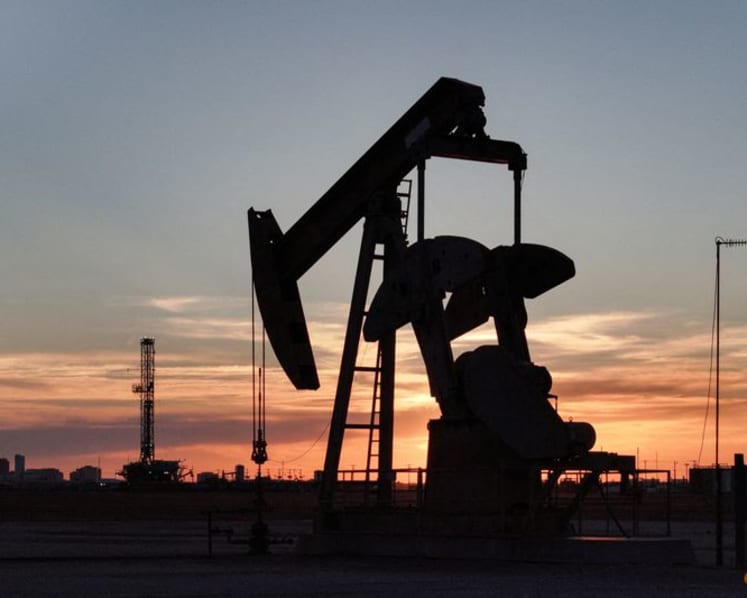
FILE PHOTO: A drone view of a pump jack and drilling rig south of Midland, Texas, U.S. June 11, 2025. REUTERS/Eli Hartman//File Photo
NEW YORK, March 10 : Oil prices plunged by about 15 per cent on Tuesday, a day after soaring to their highest levels since 2022, pressured after U.S. President Donald Trump predicted the war with Iran could end soon, which should minimize oil supply disruptions.
Brent futures fell $14.23, or 14.5 per cent, to $84.73 a barrel at 2:01 p.m. EDT (1801 GMT). U.S. West Texas Intermediate (WTI) crude fell $14.46, or 15.5 per cent, to $80.31.
Prices were even lower at midday, after U.S. Energy Secretary Chris Wright wrote on X that the American military had facilitated a shipment of oil out of the Strait of Hormuz.
"President Trump is maintaining stability of global energy during the military operations against Iran," Wright posted at 1:02 p.m. local time before the post appeared to be removed.





"The U.S. Navy successfully escorted an oil tanker through the Strait of Hormuz to ensure oil remains flowing to global markets," Wright said.
Trump's Republicans will soon be campaigning to retain control of U.S. Congress in November midterm elections, with many voters worried about rising energy prices.
“This is the market reacting to the possibility that the Strait of Hormuz could reopen," said Andrew Lipow, founder of Lipow Oil Associates. "From the administration’s perspective, the move also carries clear optics: lower oil and gasoline prices help ease consumer pain."
On Monday, both crude benchmarks surged to a session high above $119 a barrel, their highest since June 2022, as supply cuts by Saudi Arabia and other producers stoked fears of major disruptions to global supplies.
Prices settled with more modest gains on Monday, then retreated in late trade and into Tuesday after Trump and Russian President Vladimir Putin had a call and shared proposals aimed at a quick settlement to the war, according to a Kremlin aide.
In addition, Trump said on Monday in a CBS News interview that he thought the war against Iran was "very complete" and Washington was "very far ahead" of his initial four- to five-week estimated time frame.
"Clearly Trump's comments about a short-lived war have calmed markets. While there was an overreaction to the upside yesterday, we think there is an overreaction to the downside today," said Suvro Sarkar, energy sector team lead at DBS Bank.
Israel's foreign minister said Israel is not seeking an endless war with Iran and will coordinate with the U.S. on when to end the fighting.
OIL SUPPLIES WILL NOT RETURN QUICKLY
Even if the war ends, oil supplies will not immediately rebound, said Simon Flowers, chairman and chief analyst at Wood Mackenzie.
"When the conflict ends, cranking up the supply chain won't be swift," Flowers said. "Product barrels in storage at refineries or in port might be moved on vessels quite quickly. But if wells are shut-in for a prolonged period, restarting production to full output could take weeks or even longer."
In response to Trump, Iran's Islamic Revolutionary Guard Corps said Tehran would not allow "one litre of oil" to be exported from the region if U.S. and Israeli attacks continued, state media reported on Tuesday.
Meanwhile, Trump was considering easing oil sanctions on Russia related to Moscow's war in Ukraine, and releasing emergency crude stockpiles to help curb spiking prices, according to multiple sources.
"Discussions around easing sanctions on Russian oil, comments from Donald Trump hinting that the conflict could eventually de-escalate, and the possibility of G7 (Group of Seven) countries tapping strategic oil reserves all pointed to the same message - that oil barrels will somehow continue to reach the market," Priyanka Sachdeva, a Phillip Nova analyst, said in a note.
G7 energy ministers stopped short of agreeing on a release of strategic oil reserves on Tuesday and instead asked the International Energy Agency to assess the situation before acting.
THE WAR GOES ON
The U.S. and Israel pounded Iran on Tuesday with what the Pentagon and Iranians on the ground said were the most intense airstrikes of the war, even as global markets bet that Trump will seek to end the conflict soon.
Saudi Arabia's Aramco, the world's top oil exporter, said there would be "catastrophic consequences" for global oil markets if the Iran war continues to disrupt shipping in the Strait of Hormuz.
Nearly 1.9 million barrels per day of crude refining capacity in the Gulf has been shut in due to the U.S.-Israeli war on Iran, consultancy IIR said.
"Policy measures may have limited impact on oil prices unless safe passage through the Strait of Hormuz is assured, given the potential losses of up to 12 million bpd over the next two weeks," JPMorgan said in a note.
In the latest disruption to global supplies, Abu Dhabi state oil giant ADNOC has shut its Ruwais refinery, a source said on Tuesday, after a fire broke out at a facility within the complex following a drone strike.
Goldman Sachs said that because the situation remains fluid, it was not changing its oil price forecast for Brent at $66 per barrel in the fourth quarter and WTI at $62 per barrel.