







Oil prices little changed but set for steepest monthly and quarterly losses since 2020
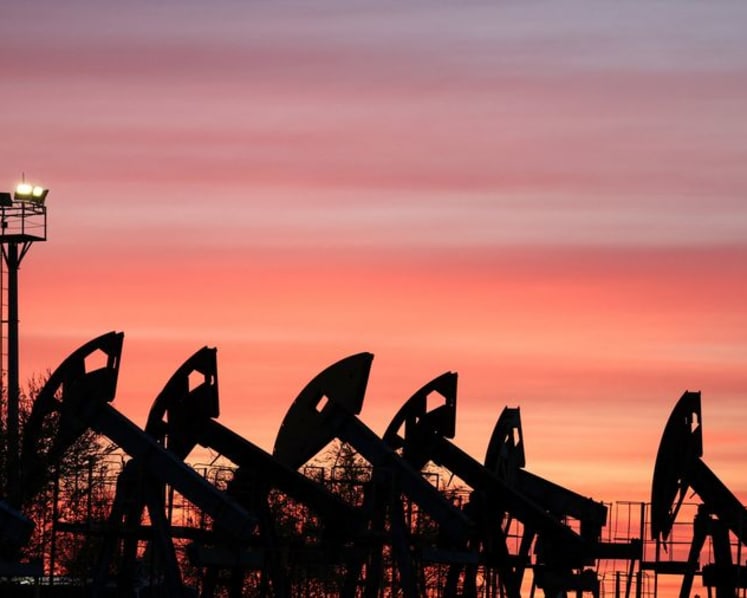
Sunset clouds glow over pump jacks at the Airankol oil field operated by Caspiy Neft in the Atyrau region, Kazakhstan, April 21, 2026. REUTERS/Pavel Mikheyev
June 30 : Oil prices were little changed on Tuesday but were headed for their biggest monthly and quarterly losses since the COVID-19 pandemic in early 2020, with investors eyeing potential U.S.-Iran talks in Doha amid a strained interim ceasefire in the four-month-long war.
Brent futures fell 23 cents, or 0.3 per cent, to settle at $72.92 a barrel, while U.S. West Texas Intermediate (WTI) crude fell $1.25, or 1.8 per cent, to settle at $69.50 a barrel. Brent futures for August delivery expired on Tuesday and will be replaced by the September contract, which is trading around $73.31 a barrel.
Both crude benchmarks were close to where they were trading on February 27, the day before the start of the U.S.-Israeli war on Iran, when Brent closed at $72.48 a barrel and WTI closed at $67.02.
"I wouldn't say the market has priced out a risk premium, but previously stranded ships have become available with the increase in ships moving out of the Gulf, creating a temporary wave of new supply," UBS analyst Giovanni Staunovo said.





Morgan Stanley said it now models an implied global oil market surplus of 4.8 million barrels per day in 2027.
Top U.S. envoys who arrived in Doha will not hold a high-level meeting with Iran, a Qatari official said on Tuesday, casting doubt on the progress of efforts to bring a lasting halt to the Iran war and fully reopen the Strait of Hormuz. About 20 per cent of global oil supplies passed through the strait before the war.
Instead, there will be technical talks this week on issues including regional security that could later be elevated to senior level, Qatar's Foreign Ministry spokesperson Majed Al Ansari told a media briefing.
The arrival of U.S. President Donald Trump's son-in-law Jared Kushner and envoy Steve Witkoff in Doha on Tuesday followed exchanges of fire over the weekend that tested the June 17 interim accord between the United States and Iran.
The 14-point pact allowed 60 days for the two sides to negotiate a permanent truce and to resolve thorny issues including the future of Iran's nuclear program.
FUTURES MILESTONES
Tuesday's lack of price movement kept both crude benchmarks in technically oversold territory with Brent for 13 days in a row and WTI for 11 consecutive days.
For the month, Brent was down about 21 per cent in June after dropping some 19 per cent in May. That was its biggest monthly decline since falling by a record 55 per cent in March 2020 due to COVID demand destruction.
Brent was down about 38 per cent in the second quarter after soaring 94 per cent in the first quarter. That was its biggest quarterly decline since falling by a record 66 per cent in the first quarter of 2020. Last quarter's 94 per cent gain was the highest since futures soared by a record 142 per cent in the third quarter of 1990.
Supply of the five North Sea crude oil grades underpinning the dated Brent benchmark in August will not include Brent crude for the first time since at least 2021.
In the U.S., crude oil production rose to a monthly record of 13.93 million barrels per day in April, monthly data from the Energy Information Administration showed on Tuesday, as producers ramped up output in response to higher oil prices owing to the Iran war.
U.S. OIL INVENTORIES
The oil market awaited weekly storage reports from the American Petroleum Institute trade group later on Tuesday and the U.S. Energy Information Administration on Wednesday.
Analysts estimated energy firms pulled 4.5 million barrels of crude from storage during the week ended June 26.
If correct, that would be the first time energy firms pulled crude out of storage for 10 weeks in a row, tying a record set in January 2018. It compares with an increase of 3.8 million barrels in the same week last year, and an average decline of 5.5 million barrels over the past five years (2021 to 2025). [EIA/S]





