Wall Street rallies, oil stays higher as investors hope for US-Iran resolution
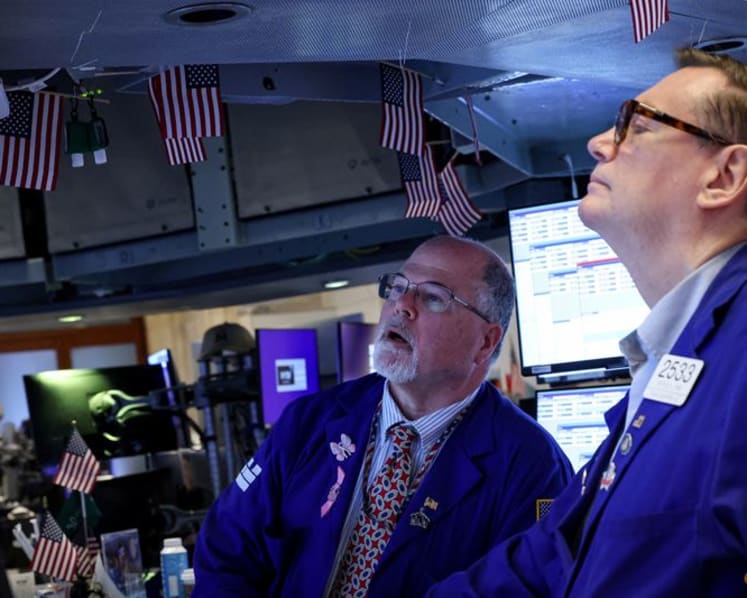
Traders work on the floor at the New York Stock Exchange (NYSE) in New York City, U.S., April 13, 2026. REUTERS/Brendan McDermid
NEW YORK, April 13 : Wall Street stocks rose and oil retreated from highs above $100 a barrel on Monday as the U.S. said it continued to engage with Tehran to make a deal even as it blocked Iran's ports after the collapse of peace talks over the weekend.
A fragile ceasefire that halted six weeks of U.S. and Israeli air strikes still hung in the balance. President Donald Trump said 34 ships had passed through the Strait of Hormuz, which handles about 20 per cent of global oil and liquefied natural gas flows.
Stocks firmed during the day's trading, reversing earlier losses, although volume was light.
By Monday's close, the S&P 500 had erased all the losses it racked up since the war started. The blue chip index gained 1.02 per cent, to end at 6,886.24, 0.1 per cent above its February 27 finish.





The Dow Jones Industrial Average rose 0.63 per cent, to 48,218.25 and the Nasdaq Composite gained 1.23 per cent, to 23,183.74.
"There seems to be some desensitization around these back and forth talks with negotiations on, negotiations off, especially in the midst of this ceasefire, which seems to be holding for the moment," said Mark Luschini, chief investment strategist at Janney Montgomery Scott in Philadelphia.
Investors fear "that if we have a resolution come together quickly, that the market could rally significantly and they'd be left on the sidelines," Luschini added.
Tehran threatened to retaliate against its Gulf neighbours' ports but Pakistani Prime Minister Shehbaz Sharif, whose country hosted the eventually unsuccessful talks at the weekend, also said efforts were still underway to resolve the conflict.
Brent crude oil futures settled up $4.16 or 4.37 per cent at $99.36 a barrel. U.S. crude settled $2.51 or 2.6 per cent higher, at $99.08 a barrel. The benchmarks had risen $8 and more than $9 respectively earlier in the session.
Analysts still expected pressure on risk assets.
"There has been a de-escalation in the armed conflict but the scale of the de-escalation and lack of clarity on when trade flows will resume leaves us broadly still in the same place - status quo - from an economic perspective," said Benjamin Jones, global head of research at Invesco.
Goldman Sachs https://www.reuters.com/legal/transactional/goldman-sachs-posts-higher-profit-strength-dealmaking-equities-trading-2026-04-13/ beat analyst expectations for quarterly profit, but weaker revenue from its fixed income, currencies and commodities division dragged shares down as much as 4 per cent and weighed on peers Morgan Stanley and JPMorgan.
DOLLAR SLIDES ON OIL
In foreign exchange trade, early gains in the dollar faded along with oil prices.
The dollar index, which measures the greenback against a basket of currencies, including the yen and the euro, fell 0.69 per cent to 98.41.
The dollar has tended to climb in step with rising tensions between Iran and the U.S., due to its status as a safe haven and the fact the U.S., as a net energy exporter, is relatively insulated against inflation from that direction.
Chicago Federal Reserve President Austan Goolsbee said oil futures markets are pricing in an expectation the surge in oil related to the war will be short-lived, and that as long as this is the case, the impact on the U.S. economy may be limited.
Rising energy prices have prompted investors to prepare for the possibility that central banks will lean towards raising rates. Money markets show traders see less than a 20 per cent chance of the Federal Reserve cutting rates this year.
All of this is a sharp reversal from expectations prior to the war for rate cuts or a prolonged pause.
A watershed election in Hungary unseated https://www.reuters.com/world/europe/orban-ousted-after-16-years-hungarians-flock-pro-eu-rival-2026-04-12/ nationalist leader Viktor Orban in favour of a pro-EU rival pushing the Hungarian forint nL1N40W01F to multi-year highs on the dollar and euro.
The result is likely to pave the way for European Union funding nL1N40Q0A6 to flow to Hungary and Ukraine.
(Additional reporting by Sinead Carew in New York, Niket Nishant and Avinash P in Bengaluru, Amanda Cooper and Dhara Ranasinghe in London and Tom Westbrook and Scott Murdoch in Sydney; Editing by Kevin Buckland, Jan Harvey, Nick Zieminski and Lincoln Feast.)