







WTI, June Brent crude futures settle down on reports that Iran may be ready to end war
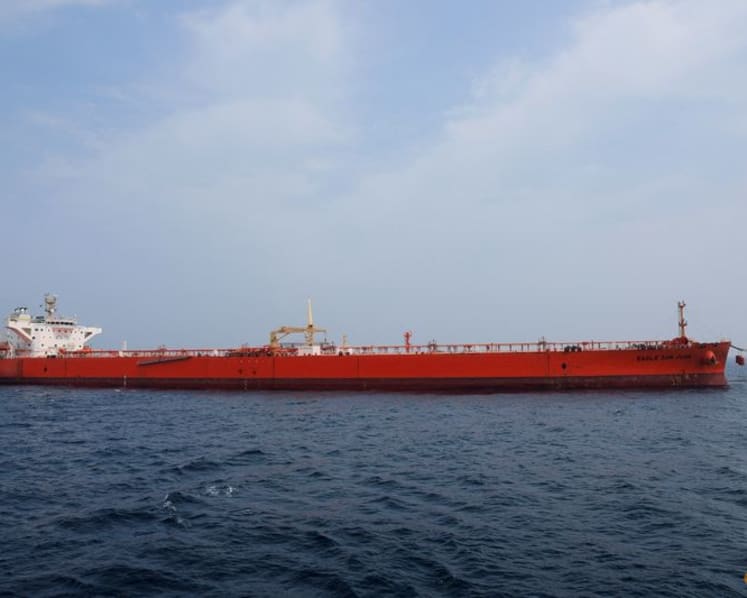
FILE PHOTO: A crude oil tanker EAGLE SAN JUAN, sailing under the flag of Singapore and carrying crude oil from the U.S., offloads at Cnergyico's Single Point Mooring (SPM), Pakistan's first and only floating port, located near Hub coast in Balochistan, Pakistan, March 18, 2026. REUTERS/Akhtar Soomro/File Photo
HOUSTON, March 31 : Brent futures for June delivery settled down more than $3 on Tuesday following unconfirmed media reports that Iran's president said the country was ready to end the war, assuming some guarantees were put into place.
The Brent May contract was on track for a record monthly gain but it expired on Tuesday, with liquidity dropping as investors move their exposure to the more liquid June contract. Traded volumes for May futures were 18,652 lots, some 30 times lower than June.
The Brent June contract settled down $3.42 at $103.97 per barrel, dropping after media reports, including from Bloomberg, that Iranian President Masoud Pezeshkian said Iran is ready to end the war but wants guarantees.
Brent crude futures for May settled up $5.57, or 4.94 per cent, at $118.35 per barrel, while U.S. crude futures settled down $1.50 or 1.46 per cent at $101.38.





Front-month Brent futures hit a record monthly gain of 64 per cent in March, according to LSEG data dating back to June 1988. U.S. benchmark West Texas Intermediate has gained around 52 per cent in the month, its biggest jump since May 2020.
"Once again the trap door under this market opened up with the alleged statement from the Iranian president, if there is an immediate end to hostilities then we know the Strait (of Hormuz) can be reopened and supply will come back on to the market, taking out a lot of the risk premium that has been built up in prices," said John Kilduff, partner at Again Capital.
The international benchmark has steadily risen over the last four weeks as the Iran war has escalated, with attacks across energy infrastructure throughout the Gulf that have resulted in the worst-ever oil-and-gas supply disruption.
OPEC's oil output plunged in March by 7.3 million barrels per day on a month-over-month basis to 21.57 million bpd, its lowest level since the height of the COVID-19 pandemic in June 2020, a Reuters survey found, amid forced export cuts.
The market has vacillated throughout the month, with a series of dips each time U.S. President Donald Trump suggests the military operation may be de-escalated - only to resume its upward path due to the supply impairment caused by Iran's threats against vessels transiting the key Strait of Hormuz, the artery used to ship one-fifth of the world's oil and gas.
Trump has suggested other countries should intervene to open the strait, a move European nations have not wanted to take until hostilities cease. The U.S. has removed sanctions on barrels from Russia and pledged reserve releases with a group of other nations, but those measures will only offset the supply loss for a limited period of time.
"With the oil market's remaining buffers gradually being consumed, the market's vulnerability to a prolonged closure of (Hormuz) means that we are moving closer to physical oil shortages across a wider geographic scope, and the upward momentum for oil prices is likely to strengthen further," said Lin Ye, a vice president for commodities markets and oil at Rystad Energy.
VOLATILE TRADE AS FRONT-MONTH EXPIRES
Trading on Tuesday was volatile, with front-month Brent futures swinging in a range of up 5.7 per cent to down 1.3 per cent from Monday's close.
U.S. Defense Secretary Pete Hegseth warned that if Iran did not make a deal to end the war, the U.S. would continue the conflict with more intensity, telling a briefing on Tuesday that the next few days could be decisive.
The Islamic Revolutionary Guard Corps hit back with a new threat, saying U.S. companies in the region will be targeted as of Wednesday in retaliation for attacks on Iran, listing Microsoft, Google, Apple, Intel, IBM, Tesla and Boeing among 18 firms.
On Monday the Wall Street Journal reported that Trump told aides he is willing to end the military campaign against Iran even if the strait remains largely closed, leaving its reopening for a later date.
"While diplomatic signals remain mixed, the ground reality suggests that uncertainty will persist," said Sugandha Sachdeva, the founder of SS WealthStreet, a New Delhi-based research firm.
"Even in the event of de-escalation, restoring damaged infrastructure will take time, keeping supply tight."
Kuwait Petroleum Corp on Tuesday said its fully loaded crude oil tanker Al Salmi, capable of carrying up to 2 million barrels, was struck by an Iranian attack at a Dubai port.
Officials also warned of the risk of oil spills in the area.
U.S. crude oil inventories jumped last week, while gasoline and distillate stocks fell, market sources said, citing American Petroleum Institute figures.
Crude stocks rose by 10.26 million barrels in the week ended March 27, the sources said on condition of anonymity. Gasoline inventories fell by 3.21 million barrels, while distillate inventories fell by 1.04 million barrels from a week earlier, the sources said.





