Yields, dollar rise, stocks ease after solid US jobs report
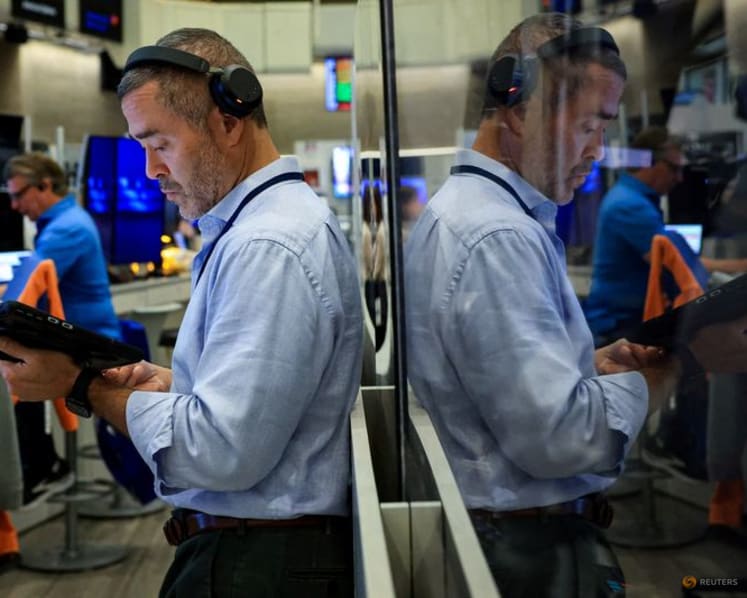
FILE PHOTO: Futures-options traders work on the floor at the New York Stock Exchange's NYSE American (AMEX) in New York City, U.S. July 16, 2026. REUTERS/Brendan McDermid/File Photo
NEW YORK, Sept 4 : Treasury yields and the dollar rose, while stocks fell on Friday after stronger-than-expected U.S. job growth data boosted bets on a September interest rate hike by the Federal Reserve.
All three of the major U.S. stock indexes ended lower in a broad selloff ahead of a three-day holiday weekend. A global stock index declined as well.
Nonfarm payrolls rose by 162,000 jobs last month after an upwardly revised rise of 21,000 in July. Economists polled by Reuters had forecast an increase of 56,000 after a previously reported drop of 23,000 in July. The unemployment rate held steady.
Two-year yields, which are particularly sensitive to changes in monetary policy, led the rise in Treasuries and were last up 4 basis points at 4.37 per cent. The yield briefly peaked at 4.4246 per cent, its highest since January 2025. The yield on 10-year Treasury notes was up nearly 2 basis points around 4.78 per cent, after reaching a peak of 4.812 per cent following the data.





"In the Fed’s eyes, the labor market is holding up, which means inflation remains the bigger problem," said Bret Kenwell, U.S. investment analyst at eToro in New York.
He said investors will pay close attention to next week's consumer prices report ahead of the Fed's mid-September decision.
Just after the jobs report, short-term interest-rate futures implied about a 65 per cent chance for a hike at the Fed's September meeting, up from about 55 per cent before the report. By New York afternoon trade, that was back down to 57 per cent.
Producer price inflation data is due on Thursday, and the consumer price inflation report is scheduled for Friday next week. Economists expect the core CPI to ease to 2.4 per cent on the year, from 2.5 per cent in July.
OIL PRICES, DOLLAR UP
Renewed attacks in the U.S.-Iran war this week have sparked a jump in oil prices, adding to existing worries about higher costs.
Oil prices rose and ended higher for the week. Brent crude futures settled at $92.68 a barrel, up 76 cents, or 0.8 per cent. West Texas Intermediate crude futures finished at $91.48 a barrel, up 18 cents, or 0.20 per cent.
For the week, Brent crude rose 7.6 per cent while U.S. crude gained nearly 10 per cent, as supply routes in the Middle East remain impaired due to the war.
Adding to the day's weakness on Wall Street, Adobe dropped 6.7 per cent following its announcement that longtime CEO Shantanu Narayen will be succeeded by insider Anil Chakravarthy.
The Dow Jones Industrial Average fell 271.86 points, or 0.51 per cent, to 53,414.25, the S&P 500 fell 29.11 points, or 0.38 per cent, to 7,718.60 and the Nasdaq Composite fell 77.07 points, or 0.29 per cent, to 26,506.99.
MSCI's gauge of stocks across the globe fell 1.09 points, or 0.09 per cent, to 1,153.65. The pan-European STOXX 600 index rose 0.12 per cent.
The dollar jumped after the jobs data but gave up some of its early gains. The dollar index, which measures the greenback against a basket of currencies including the yen and the euro, rose 0.21 per cent to 99.17, with the euro down 0.12 per cent at $1.1611.
Against the Japanese yen, the dollar strengthened 0.26 per cent to 156.19. The yen has surged this week, however, as traders boost bets on more or faster Bank of Japan interest rate hikes, and it is testing the 155.21 level, which was its high after last month's U.S.-Japan intervention. If it breaks through that, it will reach its strongest level since May 6.
Spot gold fell 1.2 per cent to $4,419.09 per ounce.