







South Korea Justice Minister reassures investors on corporate governance reform
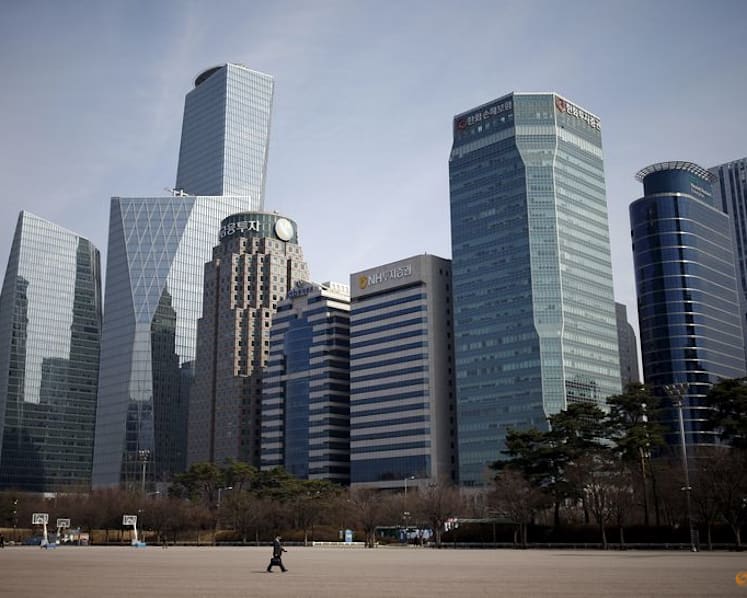
FILE PHOTO: A man walks in a park at a business district in Seoul, South Korea, March 23, 2016. REUTERS/Kim Hong-Ji/ File photo
GWACHEON, South Korea, April 10 : South Korean Justice Minister Jung Sung-ho said the country's regulations will remain transparent for investors, stressing that President Lee Jae Myung's government would continue to take on corporate governance reform despite stiff opposition from businesses.
Since Lee took power last year, the ruling party has passed a series of stock market reforms aimed at addressing the "Korea Discount" — the tendency for local companies to have lower valuations than global peers, partly reflecting the opaque structures of the country's dominant, family-owned conglomerates.
Jung said recent amendments to commercial law — including stronger board accountability, mandatory treasury share cancellation and new independent director requirements — reflected changes investors had sought for nearly two decades.
"When we amended the commercial law... there was enormous opposition from the business community," Jung told a small group of reporters on Thursday. "But ultimately, doesn't raising a company's governance raise its value?"





Still, Jung said balancing reform with local corporate culture remained necessary, noting that founding family members at chipmakers Samsung Electronics and SK Hynix, two of South Korea's largest companies, had taken investment risks professional managers might not have.
"When SK acquired Hynix, everyone said why are they doing this... But that's what SK lives on now."
South Korea's stock market, led by Samsung and SK Hynix, surged nearly 50 per cent in early 2026, driven by an AI chip boom and market-friendly reforms, before high volatility in March due to Middle East conflict.
"The issue is not breaking up the ownership structure itself... Maximising investment returns is the purpose of investment," Jung said, adding that the issue is about improving the current system to make the most profit for people when they invest in Korea.
"STRUCTURAL RISKS"
When asked whether minority shareholders could rely on Korean regulators to act impartially against powerful conglomerates, Jung pushed back against the notion that government-business collusion remained a structural risk.
The era of the state directing corporate outcomes had effectively ended, he said, adding that scandals under President Park Geun-hye were an aberration, rather than the norm.
South Korea has been involved in several investor-state disputes, which some critics have seen as an outcome of foreign investors experiencing challenges from South Korea's country-specific regulatory framework.
"Foreign investors are watching every move of this government. They don't miss a thing," Jung said.
The country achieved victories in three cases against U.S. private equity fund Lone Star, U.S. hedge fund Elliott Management, and Swiss elevator maker Schindler, and was formulating new regulation to coordinate future strategy for such cases across the government, Jung said.
"Elliott has succeeded in defending against South Korea's attempt to entirely set aside its more than $100 million arbitration Award in the High Court in London. The matter will now be remitted to the Tribunal of Permanent Court of Arbitration... for further consideration," a spokesperson for Elliott said.
Lone Star and Schindler did not immediately respond to requests for comment.





