South Korea to carry out bond buyback, raise fuel price cap to cushion blow from Iran conflict
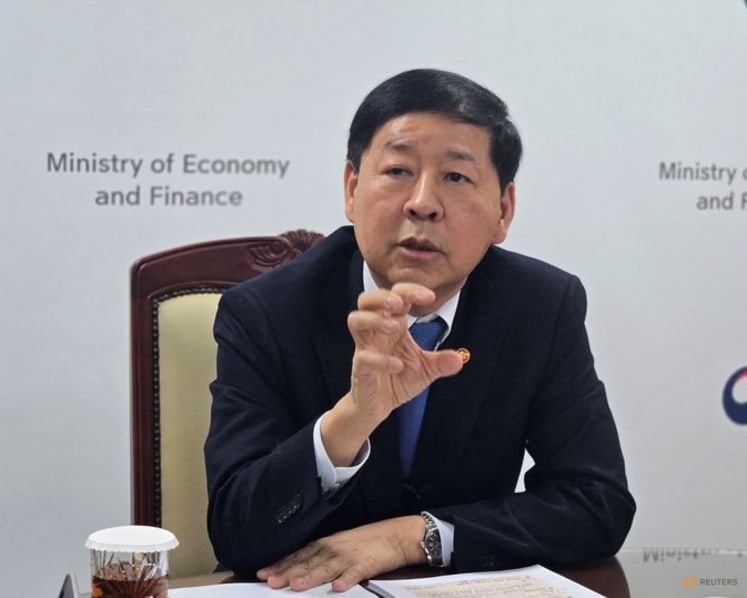
South Korea’s Deputy Prime Minister for Economic Affairs Koo Yun‑cheol speaks during an interview with Reuters at the government complex in Seoul, South Korea, January 16, 2026. REUTERS/Dogyun Kim
SEOUL, March 26 : South Korea on Thursday said it will carry out a 5 trillion won ($3.32 billion) emergency bond buyback and expand fuel tax cuts starting Friday to protect the economy from a global market rout triggered by the U.S.-Israeli war on Iran.
The bond buyback will be conducted in two tranches, 2.5 trillion won on March 27 and another 2.5 trillion won on April 1, to add liquidity to the local bond market and cap rising yields after three-year treasury bond yields surged to the highest point since mid-2024.
The move was paired with an increased price cap on fuel, effective Friday at midnight, and an expansion of fuel tax breaks to prevent local retailers from passing on the effects of sudden international oil spikes to consumers.
After the announcement was made, three-year notes rebounded.





Thursday's measures are the latest policy responses from Asia's fourth-largest economy to cushion the fallout from the U.S.-Israeli war on Iran, which sparked a sharp bond selloff.
Korean consumers and bond market participants have been hit hard due to the country's heavy reliance on imported oil, with markets now penciling in more than 100 basis points of interest rate hikes over the next 12 months.
The operating rate for nuclear power plants will be raised to above 80 per cent and the seasonal cap on coal power plants will be scrapped, Finance Minister Koo Yun-cheol said.
"As the Middle East war that began in late February enters its fourth week, the economic impact such as higher prices, supply disruptions and heightened volatility in the foreign and financial markets are increasingly evident," Koo said.
The government is prepared to use available resources to deal with "a grave situation" and could take additional action, he said.
South Korean President Lee Jae Myung held a high-level economic meeting to discuss a response to what he said was an "unpredictable situation" that together with a complex global supply chain made remedies difficult to formulate.
South Korea faces a particular vulnerability due to its heavy reliance on energy imports passing through the Strait of Hormuz, which has been effectively closed since early March.
It is set to unveil a new cap on fuel prices two weeks after introducing the ceiling to rein in pump prices, which was initially based on supplies and global oil prices before the conflict broke out.
In order to further cushion the energy price shock, fuel-tax cuts will be expanded to 15 per cent from 7 per cent on gasoline and to 25 per cent from 10 per cent on diesel, Koo said.
A new export control on naphtha products will go into effect at midnight on Friday as disruptions have hit hard the material that fuels South Korea's large petrochemical industry, half of which is imported through the Strait of Hormuz.
The government also plans to step up monitoring of foreign capital inflows after South Korean bonds' inclusion in the world government bond index next month, it said.
($1 = 1,506.1000 won)