







Stocks fall; oil prices off highs amid renewed hopes for Middle East negotiations
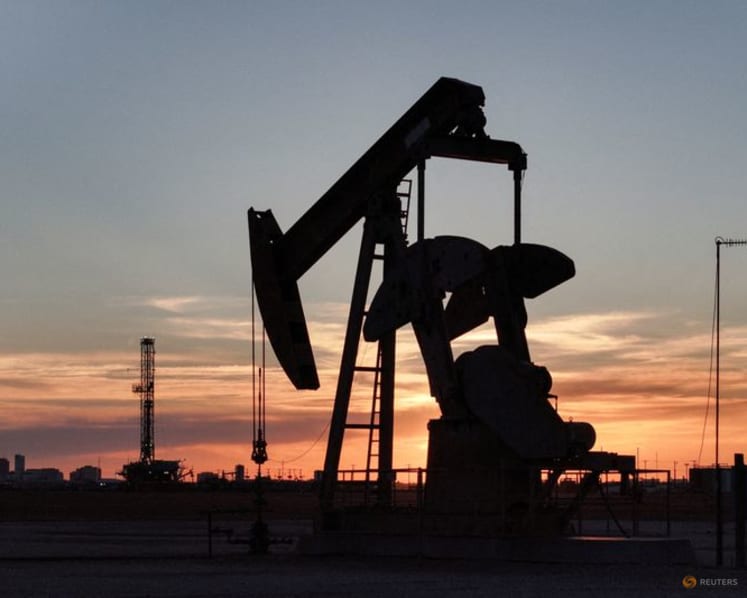
FILE PHOTO: A drone view of a pump jack and drilling rig south of Midland, Texas, U.S. June 11, 2025. REUTERS/Eli Hartman/File Photo
NEW YORK/LONDON, Sept 28 : Major stock indexes fell on Monday, as oil edged higher and Treasury yields extended their recent rise ahead of more expected interest-rate hikes from the Federal Reserve in coming months.
The Nasdaq led Wall Street lower, even as shares of Nvidia rose after the chipmaker boosted its share buyback authorization by a record $150 billion, eclipsing Apple's $110 billion plan it set out in 2024. Nvidia rose 1.7 per cent, closing off earlier highs.
Oil prices gave back some earlier gains, with Qatari mediators set to hold talks with both the US and Iran to try to broker an elusive peace agreement in the seven-month-old US-Israeli war on Iran that has pushed up energy costs. U.S. crude rose 19 cents to settle at $92.60 a barrel and Brent gained 96 cents to settle at $105.28.
At one point Monday, oil prices were up more than $4 a barrel after US President Donald Trump rejected a proposal from Iran that would reopen the crucial Strait of Hormuz.





Markets now imply a roughly 70 per cent chance the Fed will hike for a second straight meeting in October, according to CME FedWatch. The Fed raised rates earlier this month for the first time since 2023 in an effort to combat higher inflation.
Yields on 30-year Treasury bonds hit their highest levels since mid-May 2004, while 10-year Treasury yields touched their highest since mid-June 2007 before paring gains.
"Right now the market narrative is about higher yields for longer and that is putting pressure on equities," said Oliver Pursche, senior vice president and advisor for Wealthspire Advisors in Westport, Connecticut.
"You've got to look at economic data. You've got to look at the unemployment picture. You've got to look at corporate earnings. And as long as those stay robust, current yields shouldn't be overly disruptive."
With US growth and corporate earnings booming, Wall Street and the broader economy have been able to digest higher borrowing and energy costs, for now. Markets get another look at the current trajectory for jobs and inflation with this week's scheduled releases of September US payrolls report and the monthly personal consumption expenditures price index (PCE).
However, the increasing cost of capital is emerging as a key risk to AI-linked companies, particularly the so-called hyperscalers, whose billions of dollars in borrowing and spending have powered stock markets everywhere.
The S&P 500 fell 59.72 points, or 0.8 per cent, to 7,683.69 and the Nasdaq Composite fell 248.34 points, or 0.9 per cent, to 26,820.38. The Dow Jones Industrial Average fell 0.7 per cent.
TREASURY YIELDS RISE
US Treasury yields slowed their advance after hitting multi-year highs. The 30-year bond yield rose to 5.5704 per cent from 5.502 per cent late on Friday. The yield on benchmark U.S. 10-year notes was up 6.98 basis points at 5.251 per cent, from 5.181 per cent late on Friday.
Two-year Treasury yields, which are the most responsive to shifts in expectations for rates and inflation, have shot up more than 50 basis points so far in September, their largest monthly rise since February 2023, in anticipation of more Fed hikes.
This rise has narrowed the 2-year yield's discount to benchmark 10-year yields to around 31 bps from around 40 bps a month ago, a dynamic known as a flattening of the yield curve.
The 2-year note yield rose to 4.937 per cent Monday, up from 4.864 per cent on Friday.
MSCI's gauge of stocks across the globe fell 8.76 points, or 0.76 per cent, to 1,139.47. The pan-European STOXX 600 index ended flat.
Gold prices fell. Spot gold fell 3.61 per cent to $4,131.53 an ounce.
The recent spate of upbeat figures has boosted the US dollar, with the euro down 0.21 per cent at $1.1367.
Against the Japanese yen, the dollar strengthened 0.11 per cent to 157.43. Earlier, Japan's top currency diplomat Atsushi Mimura, in an interview with Reuters, issued another warning to any would-be sellers over excessive weakness in the currency.





