







US yields, dollar edge up; investors eye Fed rate cut this week
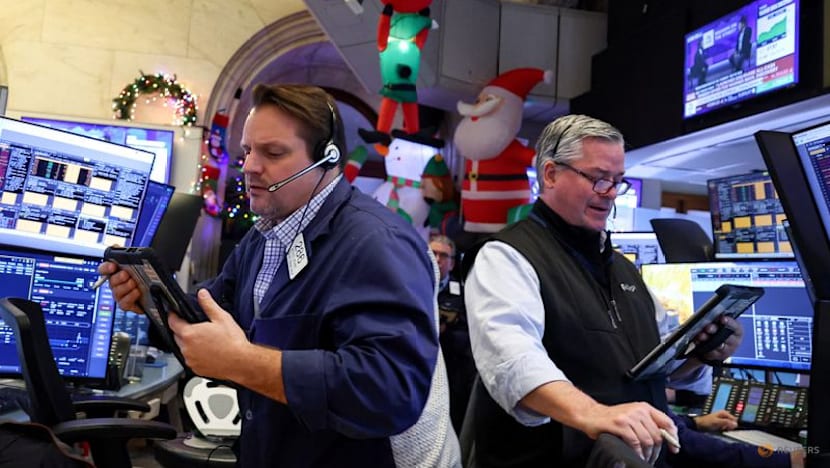
Traders work on the floor at the New York Stock Exchange (NYSE) in New York City, U.S., December 8, 2025. REUTERS/Brendan McDermid
NEW YORK, Dec 8 : U.S. Treasury yields and the dollar gained on Monday as investors prepared for this week's Federal Reserve meeting, with investors widely expecting an interest rate cut, while major stock indexes were lower.
Investors also assessed the potential impact of a powerful magnitude 7.6 earthquake that shook Japan's northeast region. It prompted orders for about 90,000 residents to evacuate and tsunami warnings that hours later were downgraded to advisories.
The iShares MSCI Japan exchange-traded fund fell 0.6 per cent. The dollar rose 0.3 per cent against the yen.
Key this week will be the Fed's announcement on Wednesday. While a rate cut is expected, some strategists think the Fed's policy committee could be sharply divided.





Some investors speculated that the meeting could be one of the most fractious in recent memory. The Federal Open Market Committee has not had three or more dissents at a meeting since 2019, and it has happened just nine times since 1990.
Investors braced for signals of a milder easing cycle than expected. Expectations that the Fed will cut its policy rate by 25 basis points stand at 87.4 per cent, according to CME Group's FedWatch Tool. Markets had been pricing in less than a 30 per cent chance of a cut until comments from Fed officials in recent weeks spurred a reversal in expectations.
"The market might be anticipating the Fed may indicate that after this rate cut there might be a pause in the first quarter of 2026, although I don't subscribe to that," said Peter Cardillo, chief market economist at Spartan Capital Securities in New York.
JAPAN RATE DECISION DELAY?
The dollar rose against the yen after news of the earthquake in Japan. Depending on the extent of the earthquake's damage, the Bank of Japan could delay an expected rate hike next week, analysts said. The U.S. dollar index also was higher.
The next BOJ monetary policy meeting is scheduled for December 18-19, 2025, with the policy decision and statement expected on the second day.
Japan's economy contracted faster than initially estimated in the three months through September, the Cabinet Office said on Monday, primarily due to new data dragging down capital spending figures, though economists said the change is not enough to sway the central bank.
U.S. Treasury yields also rose on the earthquake news. The yield on the benchmark U.S. 10-year Treasury note was last up 3.1 basis points at 4.17 per cent after reaching 4.192 per cent, its highest level since September 26, and was on track for a third straight session of gains.
On Wall Street, all major S&P 500 sectors were lower except for technology.
"The market really sold off in basically the second half of November, and since then, we've just seen a very strong rally," said Tim Ghriskey, senior portfolio strategist at Ingalls & Snyder in New York.
"Today we've come off a little, but I don't see anything out there that is going to really derail this market."
The Dow Jones Industrial Average fell 215.67 points, or 0.45 per cent, to 47,739.32, the S&P 500 fell 23.89 points, or 0.35 per cent, to 6,846.51 and the Nasdaq Composite fell 32.22 points, or 0.14 per cent, to 23,545.90.
The S&P 500 remains up about 16 per cent for the year to date.
Paramount Skydance's hostile bid to buy Warner Bros Discovery grabbed some investor attention as it aimed to outbid Netflix. Netflix shares were down 3.4 per cent.
MSCI's gauge of stocks across the globe fell 2.69 points, or 0.27 per cent, to 1,008.04. The pan-European STOXX 600 index fell 0.07 per cent.
Central banks in Canada, Switzerland and Australia also meet this week and all are poised to hold rates steady. The Swiss National Bank might like to ease again to offset the strength of its franc, but it is already at 0 per cent and reluctant to go negative.
A run of hot economic data has led investors to abandon any hope of another easing from the Reserve Bank of Australia and even to price in a rate hike for late 2026.
In energy, U.S. crude oil fell $1.20 to settle at $58.88 a barrel, after Iraq restored production at one of its oil fields that accounts for 0.5 per cent of world oil supply. Brent futures fell $1.26 to settle at $62.49.





