Stocks slip, dollar strong as Iran conflict pushes oil prices higher
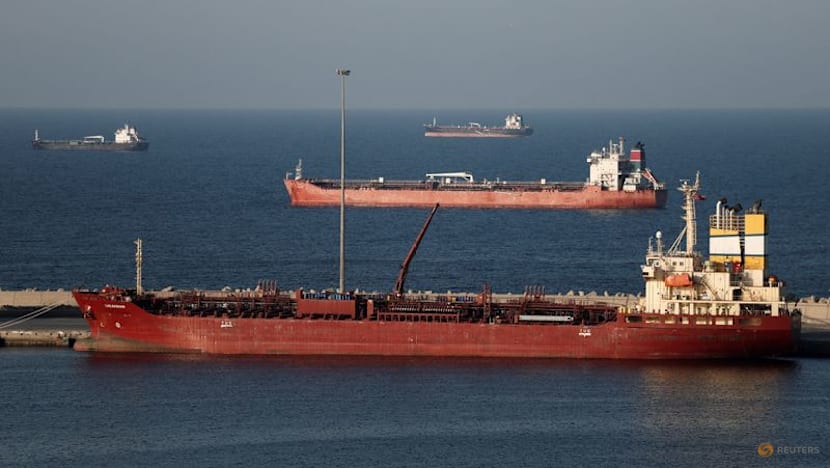
FILE PHOTO: Luojiashan tanker sits anchored in Muscat, as Iran vows to close the Strait of Hormuz, amid the U.S.-Israeli conflict with Iran, in Muscat, Oman, March 7, 2026. REUTERS/Benoit Tessier/File Photo
BOSTON/LONDON, March 13 : Stocks fell and the U.S. dollar strengthened on Friday as uncertainty over the Iran war continued to disrupt energy supplies, heightening concerns over fuel prices and interest rates.
The price of oil crossed $100 per barrel even as an Indian tanker sailed out of the Strait of Hormuz and the U.S. put forth measures to try to ease supply concerns.
All three major U.S. stock indexes logged daily and weekly declines. The Dow Jones Industrial Average finished Friday down 0.25 per cent, the S&P 500 fell 0.6 per cent and the Nasdaq Composite dropped 0.9 per cent.
European shares extended their declines as well, with Europe's STOXX 600 down 0.5 per cent on Friday. MSCI's gauge of stocks across the globe fell 0.9 per cent.





The dollar has become the safe haven of choice during the tumult, putting most other currencies under pressure. The U.S. currency gained for the second consecutive week, up 0.8 per cent on the day against a basket of currencies.
OIL PRICE DRIVING MARKET
President Donald Trump said the U.S. was going to be hitting Iran "very hard over the next week," shortly after issuing a partial 30-day waiver for purchases of sanctioned Russian oil, hoping to ease prices.
Front-month WTI crude futures settled at $98.71 per barrel, up 3.11 per cent. Brent rose 2.67 per cent to $103.14, settling above $100 per barrel for the first time since August 2022.
Traders are trying to predict how long the disruption to oil supplies will last.
"Headlines are coming at the market like water from a fire hose, which is impacting the price of oil, and consequently, financial markets," said Mitch Reznick, group head of fixed income at Federated Hermes.
With Iran stepping up attacks across the Middle East as its new Supreme Leader Mojtaba Khamenei vowed to keep the Strait of Hormuz shipping lane closed, investors are bracing for a prolonged conflict and higher oil prices.
The spectre of rising inflation has led markets to rapidly reprice what they expect from central banks this year, with traders now anticipating just 20 basis points of easing from the Federal Reserve compared to 50 bps of cuts priced in last month.
Two-year Treasury yields, which typically move in step with Fed interest rate expectations, hit a six-month high on Thursday.
Elsewhere, the Personal Consumption Expenditures index, the Federal Reserve's preferred inflation gauge, rose 0.3 per cent in January on a monthly basis, in line with economists' estimates.
At the same time, U.S. economic growth slowed more sharply than initially thought in the fourth quarter amid downward revisions to consumer spending and business investment, government data showed on Friday.
"With markets laser-focused on oil prices and geopolitics, today’s numbers may mostly fly under the radar," Ellen Zentner, chief economic strategist for Morgan Stanley Wealth Management, said in an email.
"Despite signs of economic softening, more sticky inflation data simply strengthens the idea that the Fed will remain on the sidelines."
SHIFTING RATES OUTLOOK
Interest rate futures that had been priced for two quarter-point cuts by the end of the year before the conflict began are now barely pricing in one.
For U.S. government bond trading on Friday, the two-year note yield fell 3.3 bps to 3.73 per cent after hitting its highest level since August 22 on Thursday. U.S. 10-year notes ticked up to 4.283 per cent.
Investor focus will switch to a slate of policy meetings next week, with the Fed, the Bank of Japan, the European Central Bank and the Bank of England all due to meet, with most expected to keep rates unchanged.
In currencies, the euro fell 0.8 per cent to $1.1417, while the yen hit its weakest since July 2024 at 159.66 per U.S. dollar on Friday as Japan warned it was ready to take action to protect against yen declines.
Analysts said the bar for intervention is higher this time around, as any action now could prove futile in the face of relentless dollar buying.
Gold was 1.27 per cent lower at $5,014 per ounce on Friday, capping a drop on the week. [GOL/]