Wall St indexes fall after failed US-Iran peace talks unsettle investors
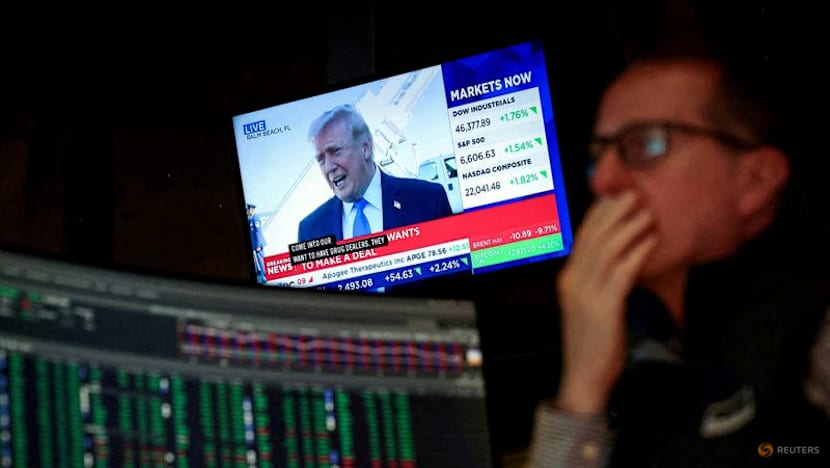
FILE PHOTO: FILE PHOTO: A trader works on the floor at the New York Stock Exchange (NYSE) in New York City, U.S., March 23, 2026. REUTERS/Brendan McDermid/File Photo/File Photo
April 13 : Wall Street's main indexes slipped on Monday after weekend talks between the U.S. and Iran failed to deliver a deal nL6N40V09S to end the war, threatening a nascent recovery in equities and risking a renewed bout of volatility.
The declines indicate that any relief nL6N40T16E from the ceasefire reached last week could be fleeting, underscoring the risks of leaning too heavily into bullish bets when the geopolitical environment remains uncertain.
Adding to the uncertainty was the U.S. military blockade of all maritime traffic entering or leaving Iranian ports and coastal areas, a move aimed at increasing pressure on Tehran.
The CBOE Market Volatility Index, the market's fear gauge, climbed to 20.61 points.





"We expect renewed pressure on risk assets and upward moves in oil early this week," said Benjamin Jones, global head of research at Invesco.
"There has been a de-escalation in the armed conflict but the scale of the de-escalation and lack of clarity on when trade flows will resume leaves us broadly still in the same place - status quo - from an economic perspective."
GOLDMAN DROPS AFTER EARNINGS
Hopes of relief on the earnings front were dashed after Goldman Sachs shares fell 4.1 per cent due to weakness nL4N40W0SE in its fixed income, currencies and commodities division.
"We don't see the market really paying too much attention to the earnings beat. And it's all because of prospects of higher inflation, weaker economic activity and a Fed that may be forced to stay on hold for a long, long time," said Peter Cardillo, chief market economist at Spartan Capital Securities.
Attention now turns to commentary from Goldman executives, for clues on how the Middle East conflict, now in its seventh week, is impacting the economy and capital markets.
Financial stocks declined 0.6 per cent.
As of 09:40 a.m. ET, the Dow Jones Industrial Average fell 356.14 points, or 0.72 per cent, to 47,572.11, the S&P 500 dropped 22.25 points, or 0.33 per cent, to 6,794.64 and the Nasdaq Composite slipped 81.74 points, or 0.36 per cent, to 22,821.15.
The shift in sentiment was also visible across other asset classes, with investors gravitating toward nL6N40W0BU the safe-haven U.S. dollar while trimming exposure to equities across geographies nL4N40W0EA.
Oil prices jumped back above nL1N40V07F $100 a barrel, aggravating inflation worries after data last week showed that a record surge in the cost of gasoline and diesel prompted the biggest increase in U.S. consumer prices in nearly four years in March.
Chevron, Exxon Mobil and ConocoPhillips climbed 1.8 per cent, 1.2 per cent and 2 per cent, respectively, pushing energy stocks 1.2 per cent higher and making it the only major sector in positive territory.
Travel-related stocks dropped, with carriers such as Delta Air Lines and JetBlue Airways down 2.9 per cent and 2.4 per cent, respectively, on concerns that higher oil prices might push up fuel costs.
Industrial supplies distributor Fastenal's shares fell 2.6 per cent after earnings. Sandisk added 4 per cent as the memory chipmaker was on track to join the Nasdaq-100 index on April 20.
Later in the day, data is due on existing home sales in the U.S., and Federal Reserve Governor Stephen Miran is scheduled to speak.
Declining issues outnumbered advancers by a 2.43-to-1 ratio on the NYSE and by a 1.7-to-1 ratio on the Nasdaq.
The S&P 500 posted 6 new 52-week highs and 11 new lows while the Nasdaq Composite recorded 30 new highs and 51 new lows.