Bonds, stocks climb on oil's pullback; yen jumps after Japan's currency intervention
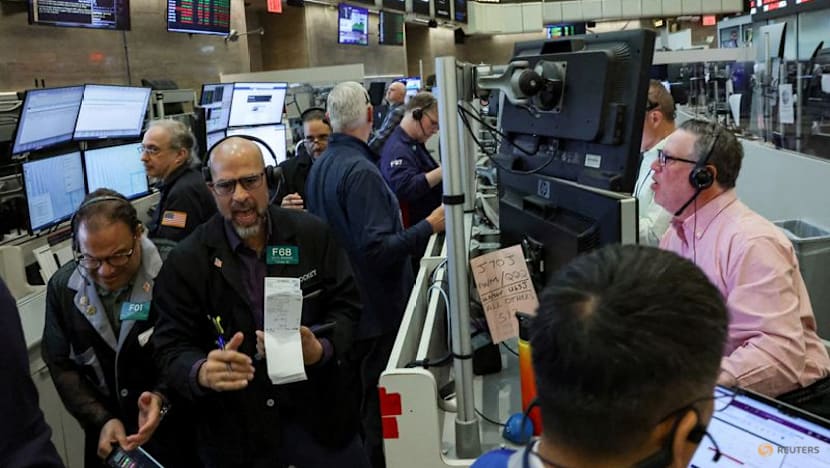
FILE PHOTO: Futures-options traders work on the floor at the New York Stock Exchange's NYSE American (AMEX) in New York City, U.S., April 17, 2026. REUTERS/Brendan McDermid/File Photo
NEW YORK/LONDON, April 30 : Global bond prices and stocks rose on Thursday as oil prices retreated from four-year highs, while the yen jumped after sources said Japan intervened to prop up the currency.
Global benchmark Brent crude futures rose as high as $126.41 a barrel but did not hold those gains, settling down $4.02, or 3.4 per cent, at $114.01. U.S. crude fell $1.81 to settle at $105.07.
The oil markets have been in a period of heightened volatility since joint U.S.-Israeli strikes against Iran kicked off a conflict in the Middle East in late February. The war has severely limited transit through the Strait of Hormuz, used for shipping one-fifth of the world's oil and gas. Oil prices have been on a steady upward climb over the last several days as an agreement to reopen the waterway has not materialized.
The Middle East conflict showed no sign of abating on Thursday, with Iran warning of retribution if the United States abandons its ceasefire and renews its attacks, suggesting that efforts to negotiate a peace deal have hit an impasse. Top U.S. military leaders were expected to brief U.S. President Donald Trump on potential military action in Iran, a U.S. official told Reuters.





The day's oil declines buoyed some risk assets, however, and stocks were stronger on the back of earnings from AI-focused tech giants like Alphabet, which rose 10 per cent following a record quarter for its cloud unit. After the closing bell, shares of Apple were up more than 3 per cent after the company forecast sales that beat expectations, even as it said it expected to continue to face chip supply constraints.
With earnings, "occasionally, you know, they get a bit of a hiccup, and but I'd say, overall, they they are delivering," said Tim Ghriskey, senior portfolio strategist at Ingalls & Snyder in New York.
After a poor March following the outbreak of war, April has been a strong month for equities. The S&P 500 and the Nasdaq logged their biggest monthly gains in years as investors look past the steady rundown of oil inventories that has raised prices.
The Dow Jones Industrial Average rose 790.33 points, or 1.62 per cent, to 49,652.14, the S&P 500 rose 73.06 points, or 1.02 per cent, to 7,209.01 and the Nasdaq Composite rose 219.07 points, or 0.89 per cent, to 24,892.31.
MSCI's gauge of stocks across the globe rose 9.54 points, or 0.89 per cent, to 1,077.10, and had its biggest monthly percentage gain since 2020. The pan-European STOXX 600 index rose 1.38 per cent.
"We're in an extremely resilient market," said Adam Sarhan, chief executive of 50 Park Investments in New York. Equities could go even higher, unless there is another big spike in oil prices or a supply shock, he said.
ECB, BOE KEEP RATES STEADY
The ECB and the Bank of England kept rates steady. On Wednesday, there was a hawkish shift in tone from the Federal Reserve as it left rates on hold. Three of the U.S. central bank's board members voted to drop the easing bias in its policy statement in the most divided decision since 1992.
Japan intervened to prop up the yen, its first official intervention in nearly two years, two sources familiar with the matter told Reuters, sending the currency up sharply against the dollar.
The sources, one government and another a market source, spoke on condition of anonymity as they were not authorized to speak to the media.
The dollar fell by as much as 3 per cent against the yen to 155.5 yen, the largest single-day drop since late December 2024. It was last down 2.4 per cent at 156.51 yen. Against the Japanese yen, the dollar was down 2.5 per cent in late afternoon to 156.33.
In Treasuries, the 2-year note yield, which typically moves in step with Fed interest rate expectations, was last down 4.9 basis points at 3.883 per cent. The yield on benchmark U.S. 10-year notes fell 2.8 basis points to 4.388 per cent. Prices move in the opposite direction of yields.
Earlier, 2-year UK gilt yields dipped below 4.5 per cent, while 2-year German yields - which are sensitive to near-term ECB rate changes - snapped an eight-day rise.
On Wednesday, outgoing Fed Chair Jerome Powell confirmed he would stay on as a governor for now to defend the institution's independence as his successor Kevin Warsh, picked by low-rate advocate Trump, moves toward confirmation.
In other commodities, spot gold was up 1.7 per cent at $4,618.67 per ounce.