







Commentary: Singapore films win international awards - they need to win over the local audience too
If we want a sustainable cinema culture, we must make local films that Singaporeans want to watch, says filmmaker Phillip Lim.

While other large scale events or viewings have returned to pre-COVID levels, cinema attendance has yet to recover. (Photo: iStock)

This audio is generated by an AI tool.


SINGAPORE: A neighbour once apologised to me out of the blue while we were in the lift. He knew I was a filmmaker and told me he had gone to the cinema to support a Singapore film that had won several international awards.
But he struggled to understand why it had received so much attention. "I'm sorry," he said, almost embarrassed.
This was not the first time I had heard something like this from friends or acquaintances. More Singapore films are receiving recognition overseas, yet many tend to struggle to attract audiences at home.
There are only a few exceptions, such as Anthony Chen's 2013 film Ilo Ilo, lauded at the prestigious Cannes Film Festival and the Golden Horse Awards, which grossed about S$1.2 million (US$0.95 million) in Singapore.





Figures from the Infocomm Media Development Authority in recent years showed that domestic films account for only a small single-digit share of Singapore's annual box office receipts.
These days, it can feel like a film must be validated externally to be considered successful first – festival selections, awards and the idea of "flying the national flag" – before bringing something “good” home.
These international achievements matter. But they should not replace a basic question: Why are Singaporeans not watching our own films?

NOT JUST FOR A FILM FESTIVAL JURY
Film is mass media. It was never intended as a private conversation between creators and juries, but as shared experience.
That connection today appears increasingly fragile.
Certainly, the disconnect between critical acclaim and popular reception is not unique to Singapore: Many international festival-winning films also struggle to convert trophies to tickets.
Singapore audiences continue to go to the movies, turning up in large numbers for Hollywood releases and regional hits.
What they are not doing, in meaningful numbers, is buying tickets for Singapore films.
This has practical consequences. Cinemas are not abstract cultural spaces; they are businesses.
When domestic films underperform, showtimes are reduced, runs are shortened and they become less viable as mainstream programming over time. This, in turn, reinforces long-standing stereotypes and becomes a self-fulfilling prophecy for the next domestic movie.
TOO SMALL A MARKET?
There is often an argument that Singapore is too small a market and that our films should therefore prioritise international audiences.
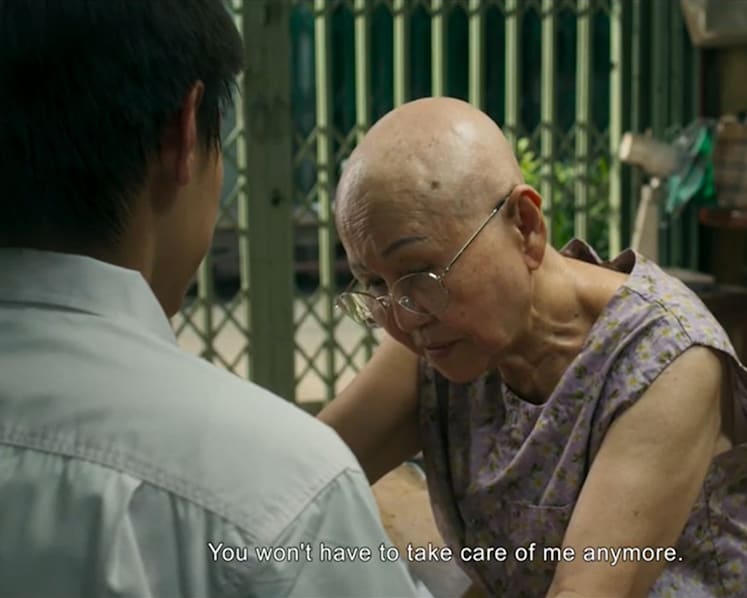
A recent example challenges this assumption. The Thai film How to Make Millions Before Grandma Dies grossed nearly S$5.4 million in Singapore in 2024.
Most Singapore films struggle to reach even a few hundred thousand dollars in ticket sales.
The Thai film's premise was modest and familiar, yet it resonated strongly. The story could easily have worked as a television movie here.
Yet, Singapore films that do well at the domestic box office also draw cynicism. Recent commercial successes such as Money No Enough 3 (S$4.49 million) and the Ah Boys To Men spin-off Ah Girls Go Army (S$2.1 million) drew flak for formulaic stories and caricatural portrayals of ordinary Singaporeans.
Such success cannot be solely chalked up to "dumbing down". There must still be attention to pacing, clarity, emotional payoff and momentum, for the audience to feel that their time, attention and ticket price were respected.
The problem is not that audiences lack sophistication. They are open to nuance, emotion and complexity – but only when a story speaks to them.

PAYING FOR SINGAPORE PRODUCTIONS
At a certain point, this raises a necessary question: Who is paying for the production?
Filmmaking is expensive. It requires years of development, months of production and significant investment across cast, crew, equipment, marketing and distribution.
While film is undoubtedly an art form, it is first and foremost a business. Ignoring this reality makes sustainability impossible.
Public funding and institutional support play an important role, but they cannot be the sole foundation of an industry.
Nor can we rely indefinitely on appeals to "support local". It may persuade someone to buy a ticket once, but it does not create long-term demand.
Ultimately, in Singapore, we all pay for the films – either directly at the box office or indirectly as taxpayers.
Even if this is taken as a strategic investment to nurture the homegrown talent and ecosystem rather than making films that recoup costs, that still makes the ability to engage audiences not a secondary concern, but a central one.
Treating filmmaking as a business does not mean abandoning artistic ambition.
It means accepting responsibility to audiences, exhibitors, funders and the wider ecosystem. Commercial awareness does not dilute creativity; it disciplines it, forcing clarity of intention and sharper storytelling.

MAKING COMMERCIAL FILMS ISN'T SELLING OUT
This also raises questions about how we educate and mentor the next generation of filmmakers.
Much of the conversation today centres on film as an art form, personal expression and passion projects. Again, these are important.
But there needs to be equal emphasis on teaching them how to make commercial films – films that people will pay to watch, talk about and recommend to others.
It is not about being a sell-out or making compromises. Commercial storytelling is a skill that can be learned.
If filmmaking is to be a viable career rather than a short-term pursuit, young filmmakers need to master the craft, understand audiences, distribution and the economics of cinema beyond the film festival circuit – not just intent and passion.
Unless films find audiences, they cannot help create shared cultural experiences. Without that, Singapore cinema risks being admired by a few, but disconnected from the wider public whose stories it is trying to tell.
Phillip Lim is a veteran Singapore filmmaker, producer and writer with more than three decades of experience across film and television that includes The Teenage Textbook and Homecoming.




