China's LandSpace fails to complete reusable rocket test
China's first domestically developed reusable orbital rocket, if successfully brought to market, would accelerate Beijing's growth in space, allowing for a quicker cadence of missions and lower launch costs.
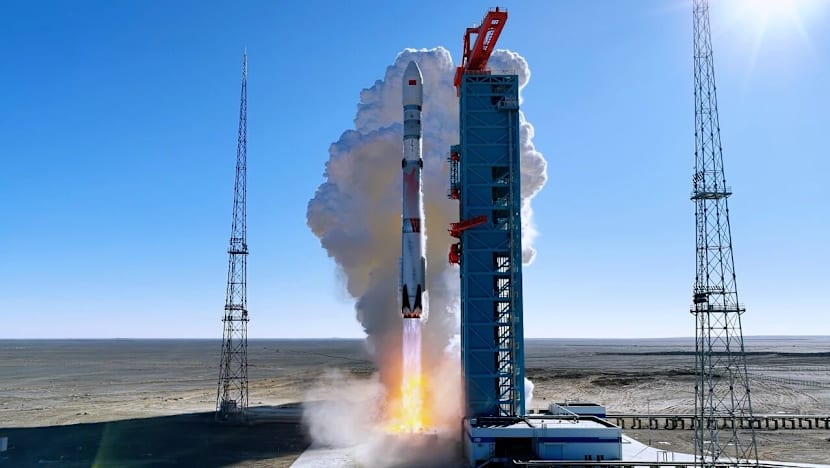
Chinese firm LandSpace's next-generation Zhuque-3 reusable rocket launches from Jiuquan Satellite Launch Centre in northwest China, Dec 3, 2025. (Photo: WeChat/LANDSPACE蓝箭航天)
BEIJING: The maiden test of LandSpace's next-generation Zhuque-3 ended in failure on Wednesday (Dec 3), dashing the Chinese firm's hopes of becoming the third company after Elon Musk's SpaceX and Jeff Bezos' Blue Origin to successfully test a reusable spacecraft.
The rocket was not able to complete the crucial controlled landing following an initial launch, state news agency Xinhua reported.
"An abnormal combustion event occurred during the process, preventing a soft landing on the recovery pad," Xinhua said. "The recovery test failed and the specific cause is still under further analysis and investigation."
Zhuque-3's failed landing attempt highlights the difficulty of developing a rocket that can be recovered and reused after being launched into orbit. LandSpace said in a statement that it would use data collected during the flight to optimise its rocket recovery.





China's first domestically developed reusable orbital rocket, if successfully brought to market, would accelerate Beijing's growth in space, allowing for a quicker cadence of missions and lower launch costs as the country pushes to deploy large satellite constellations to rival SpaceX's Starlink.
"As low-orbit constellation deployment accelerates, Zhuque-3 will continue to ... progress from recovery demonstrations to routine reuse and toward airline-style operational cadence, contributing to China’s space-power objectives," LandSpace said.

CHASING SPACEX
SpaceX pioneered commercial rocket reusability about a decade ago with its workhorse Falcon 9, disrupting an established US launch industry that relied primarily on expendable boosters that are discarded in the ocean or remain in space after their mission.
The reusable Falcon 9 core stage allowed SpaceX to start launching its Starlink satellites in 2019 far faster than its rivals, becoming the world's largest operator the following year and disrupting the global satellite communications industry.
In October, Musk praised Zhuque-3's design, saying on X that the Chinese rocket could even beat Falcon 9. LandSpace said on Wednesday that once mature, Zhuque-3 can be reused at least 20 times and carry a payload of multiple satellites weighing 18 tonnes.
But the gap is still wide and there is no guarantee that LandSpace will catch up. SpaceX had its first successful Falcon booster landing in 2015 after two failed attempts. Much of the global rocket industry has since gradually sought to mimic the company's reusability model.
Nevertheless, Zhuque-3's maiden flight puts LandSpace ahead of domestic rivals like iSpace, Galactic Energy and Deep Blue Aerospace, which are working on smaller or less mature systems. And it marks the first time that a Chinese firm has come close to a Falcon 9-class reusable vehicle.
A HIGH BARRIER TO ENTRY
Reusable rockets require complex, high-energy manoeuvres and so far, only SpaceX has carried them out routinely.
After stage separation, the booster has to turn around in space, fire its engines to slow down, survive a supersonic fall through hot air and then restart its engines just seconds before reaching water or a landing pad.
The engine firings must be timed to within thousandths of a second by onboard software that is constantly correcting the rocket's path. Small mistakes in the rocket's angle or engine timing can make the booster spin out of control, miss the landing site or burn up on the way down.
In the face of those complexities, SpaceX is still the only company to have fully proven reusable rocketry, regularly landing and flying its Falcon 9 boosters again.
More than a decade of landings and dozens of boosters flown up to 20 times have given the company a near-monopoly in reusable orbital launches and the world's highest annual launch rate.
The gap in experience and data is a major obstacle for would-be rivals.
Firms in China, Europe, India and the US are developing their own reusable rockets, but they lag behind SpaceX's record of flights and its manufacturing scale built up over hundreds of launches, leaving the company dominant in the global market for medium- and heavy-lift missions.