‘Very troublesome’: Shenzhen’s e-scooter clampdown before APEC summit disrupts routines, exposes gaps
Often dubbed China’s “city of scooters”, Shenzhen’s sweeping crackdown on its ubiquitous electric two-wheelers ahead of a key regional forum is exposing tensions between safety and mobility.
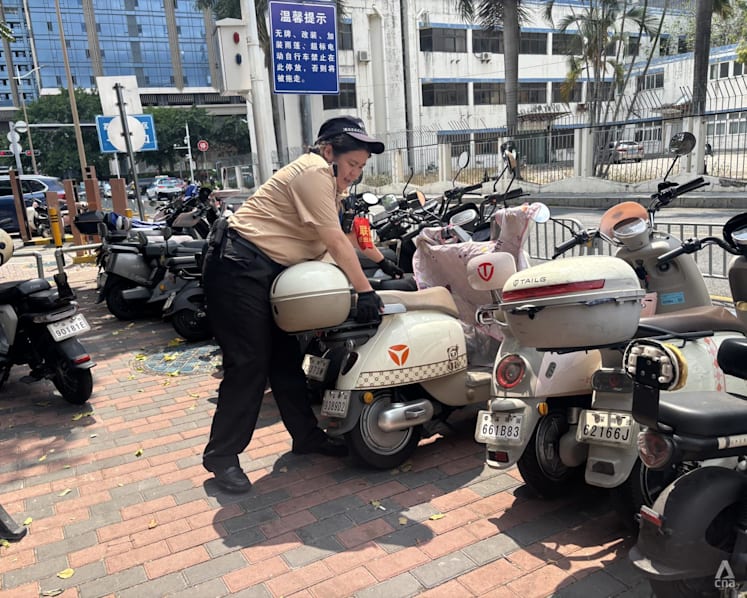
A warden moves an e-scooter into a designated parking bay in Nanyou, Shenzhen, following new city restrictions that took effect on Apr 1, 2026. (Photo: CNA/Melody Chan)

This audio is generated by an AI tool.


SHENZHEN: The electric scooter’s canopy came within inches of Simon Li’s neck.
The 26-year-old Shenzhen resident was walking along a pedestrian path when the modified vehicle sped past him.
“It came very fast and almost scraped my neck,” he told CNA.
Close calls like this have become increasingly common in Shenzhen, a dense city of about 18 million people.





With more than 6 million registered electric two-wheelers - outnumbering cars on its roads by about 1.27 million - the Chinese tech hub is often dubbed the country’s “city of scooters”.
The boom has also driven a rise in traffic violations and safety concerns as riders cut across lanes, mount pavements and weave through traffic.
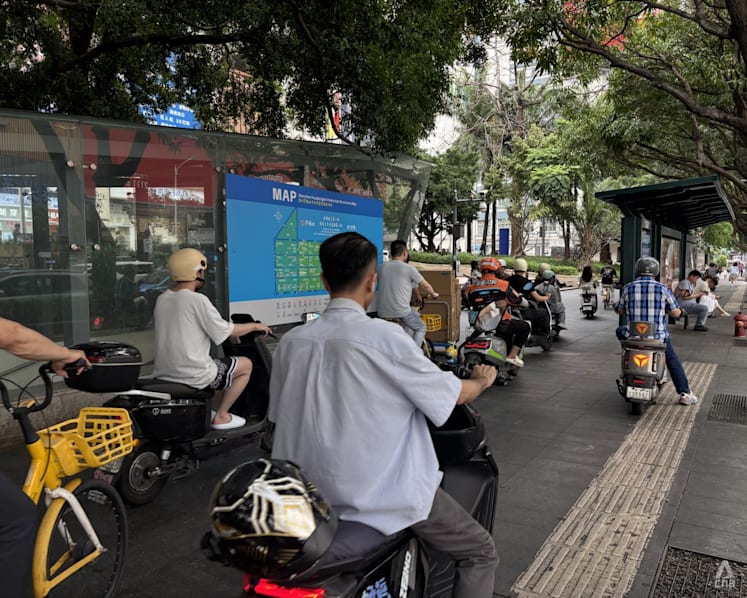
Authorities are now making a concerted effort to bring order to the streets as Shenzhen gears up to host the Asia-Pacific Economic Cooperation (APEC) summit in November, one of the region’s most important economic forums.
Updated citywide rules regulating e-scooters took effect on Apr 1, with fines of up to 2,000 yuan (US$290) for violations.
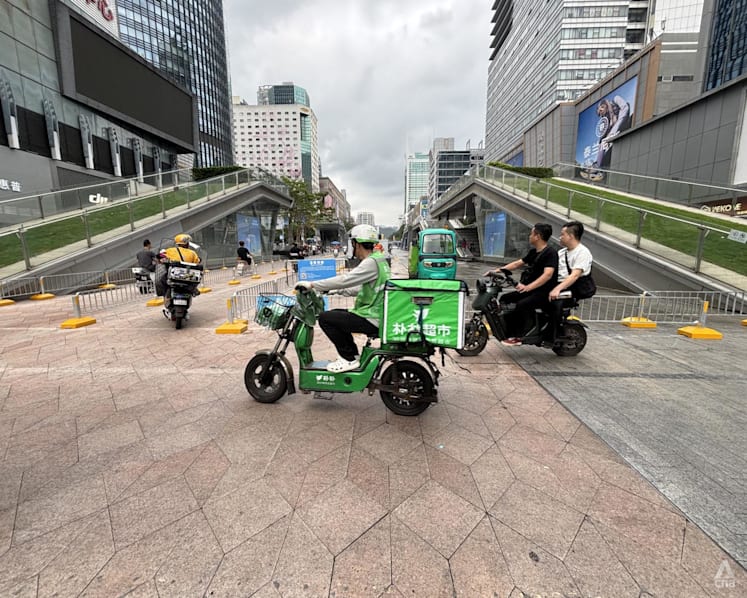
In addition to longstanding bans on highways, tunnels and elevated roads, the updated rules extend restrictions to pedestrian areas and limit access on certain roads to registered vehicles serving essential sectors such as delivery and courier services.
But such a push is far from straightforward in a city heavily reliant on this mode of transport.
As riders grouse about the disruption to daily routines and work, analysts say the crackdown has exposed deeper gaps in infrastructure and the need for longer-term solutions beyond enforcement.
CRACKDOWN ON BUSY DISTRICTS
Few places capture Shenzhen’s e-scooter culture more vividly than Huaqiangbei, the sprawling district that hosts one of the world’s largest markets for electronic components.
The area draws about 750,000 visitors a day and handles huge volumes of small-parcel deliveries, making electric scooters essential for moving goods through its narrow streets.
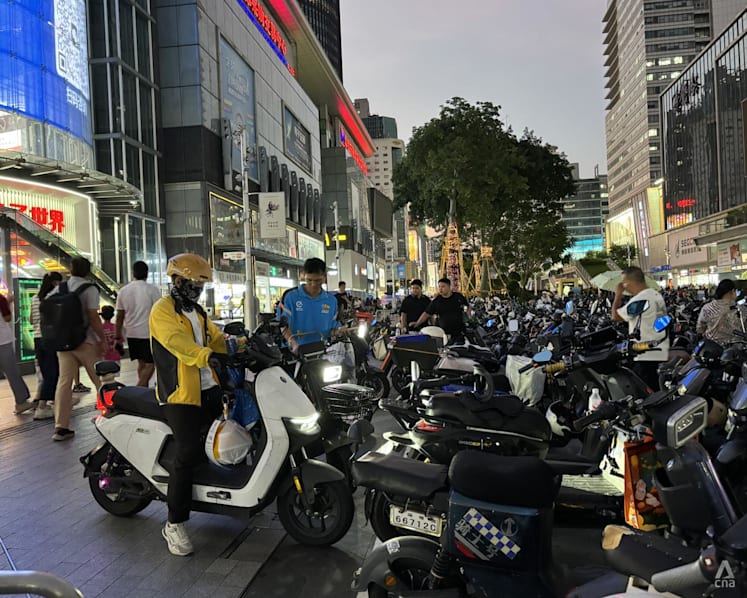
Components are constantly shuttled between warehouses, repair counters and retail stalls, often strapped to the back of e-scooters navigating the district’s busy lanes.
But this familiar hum is now being reined in.
Enforcement is being tightened in areas where restrictions had previously been loosely applied, such as Huaqiangbei Pedestrian Street, the district’s main shopping thoroughfare.
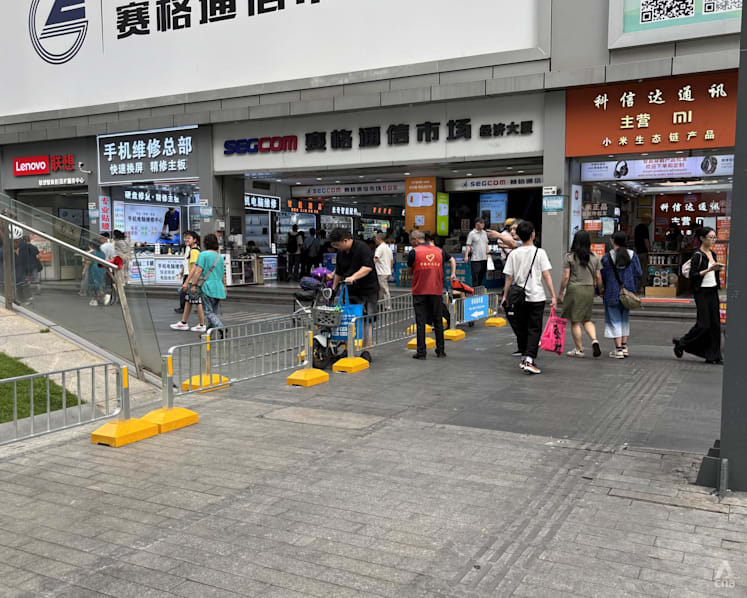
Metal barriers now line the road, separating pedestrians from scooters and directing riders into a narrow lane down the centre, CNA observed during a visit to the area.
Loudspeakers nearby blare the new rules on repeat: the central stretch of Huaqiangbei Pedestrian Street now restricts non-motorised vehicles. Delivery and courier riders may stop briefly for up to 30 minutes, while other vehicles are barred from parking.
Delivery rider Chen Mingli came to an abrupt stop halfway down the street.
He hoisted his e-scooter over the barrier, then got back on and continued towards a nearby shop to deliver electronic parts.
“It’s very troublesome,” Chen told CNA. “I can make far fewer trips now.”
While the city has launched periodic crackdowns on e-scooters over the years, the latest campaign is among the most extensive so far, with stricter rules, heavier penalties and more coordinated citywide enforcement.
The Huaqiangbei subdistrict office said the measures aim to improve traffic order and road safety as Shenzhen prepares to welcome foreign leaders, business delegations and international visitors in the lead-up to the APEC meeting in November.
The citywide restrictions are also being enforced alongside a broader campaign known as “Thunder 01”, a large-scale traffic enforcement drive launched by Shenzhen police on Mar 10 as part of a year-long provincial operation targeting motorcycle and electric bike violations.
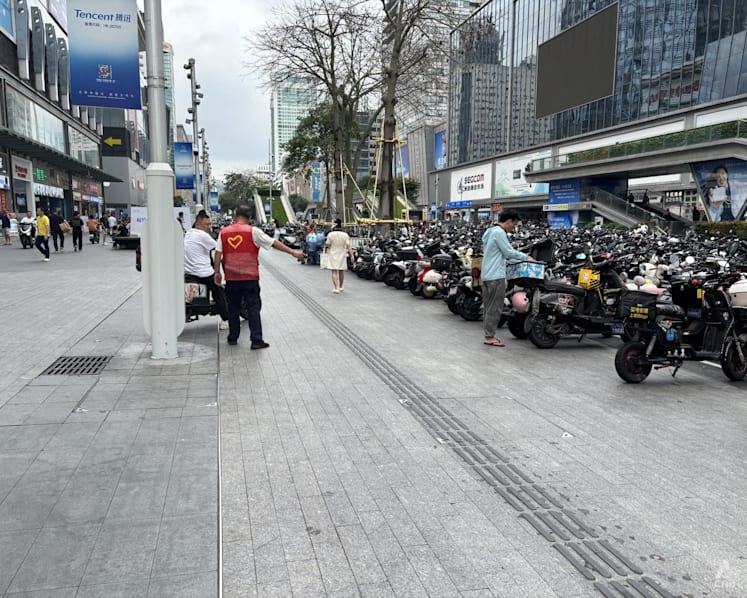
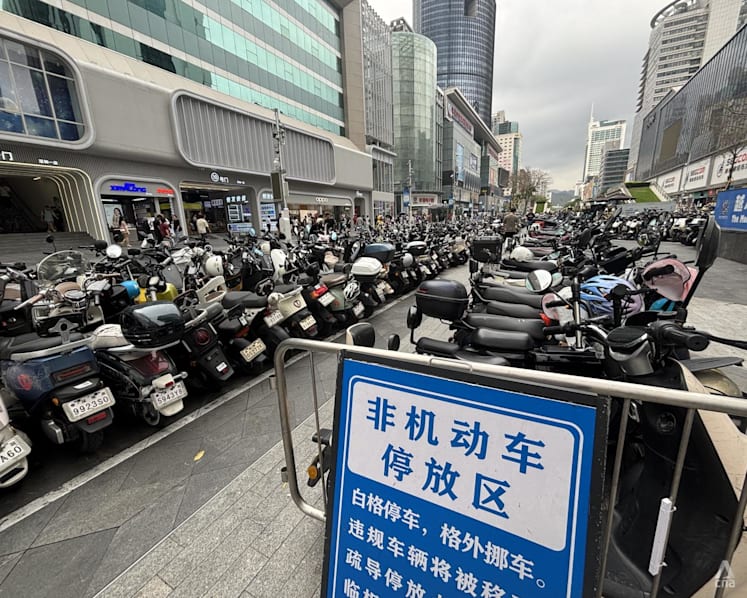
Similar changes are unfolding elsewhere in the city.
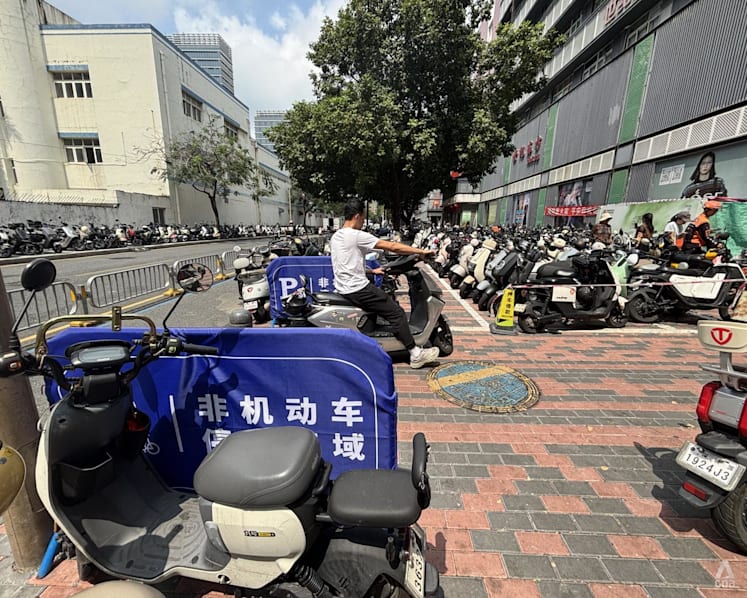
In Nanyou, a clothing wholesale district once crowded with e-scooters, classified as a Tier 2 restricted area, the streets now move to a different rhythm.
Security guards and wardens stand every few dozen metres, waving riders into designated areas or stopping them to reposition bikes left out of place. Loudspeaker announcements play on repeat, reminding riders of the new rules.
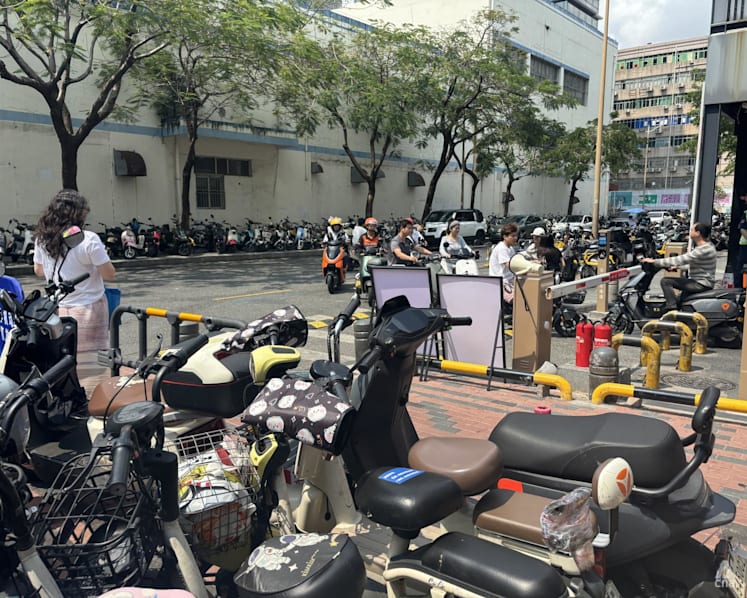
Brand-new blue barriers cut through the streets, separating scooters from pedestrian walkways. Along the roadside, e-scooters are lined up neatly inside clearly marked parking boxes - a sharp contrast to the rows of haphazardly parked bikes that once spilt onto pavements.
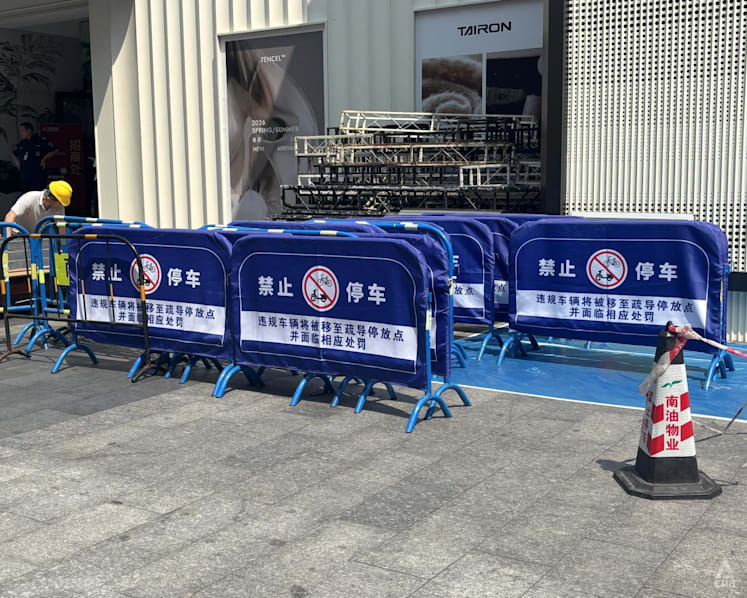
If a scooter is left outside the designated area, wardens step in, asking riders to move it or helping to shift it back into place.
Unlicensed e-scooters are quickly loaded onto flatbed trucks by traffic police or enforcement teams and impounded at designated lots, and can only be retrieved later through a QR code system.
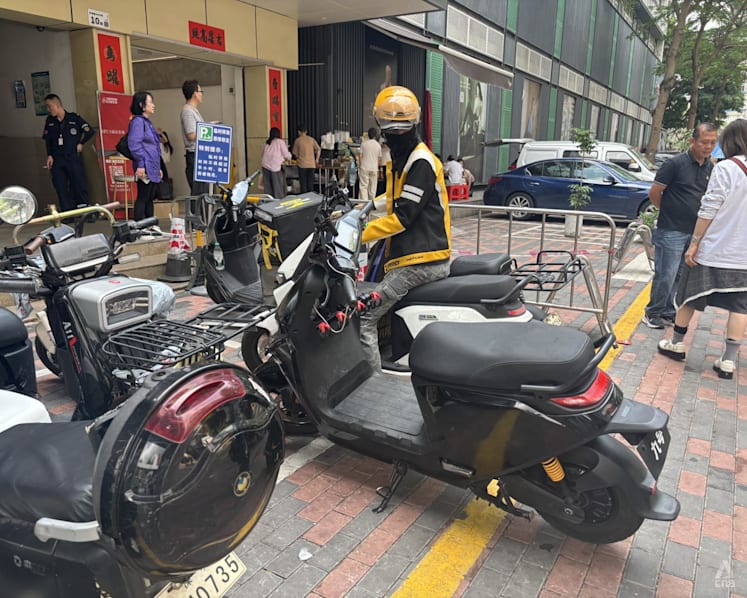
Delivery riders are allowed to stop briefly, usually for up to 30 minutes - but only within the marked boxes that are often in short supply.
“We used to park right outside the store, pick up the goods and leave immediately,” said one rider surnamed Xu.
“Now we have to park in designated areas … they’re smaller and further away, and sometimes we get blocked in when others park outside.”
“CITY OF SCOOTERS”
E-scooters are the backbone of short-distance travel in Shenzhen and many other Chinese cities.
Urban transportation consultant Wang Yuanyuan, general manager of Shanghai-based Easy Traffic Consulting, said they became widespread across China during its rapid urbanisation over the past decades.
“Electric bicycles filled the gap between people’s growing mobility needs and the expansion of urban space,” he told CNA.
Factories, office clusters and urban villages are often located beyond convenient reach of metro stations and buses, making scooters a convenient link between homes, workplaces and public transport in many Chinese cities.
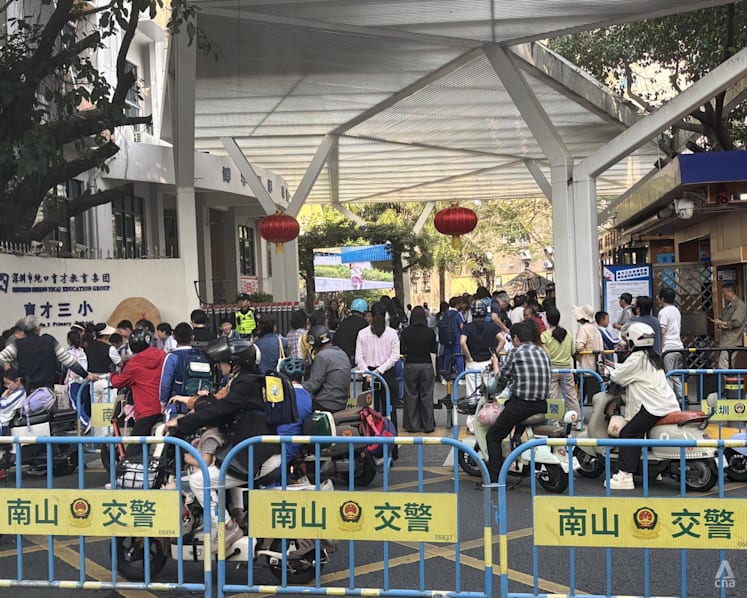
Shenzhen stands out for the sheer scale of usage and the central role of e-scooters in fast-moving commercial hubs like Huaqiangbei, where they are widely used for both commuting and goods transport.
The tally of electric two-wheelers in Shenzhen has boomed past six million, compared to about 800,000 in 2013, according to local transport authorities.
Wang Jianguo, a 58-year-old equipment repair shop owner in Huaqiangbei, said e-scooters are widely used for commuting and moving goods. He also relies on one himself.
“Normally, it takes about half an hour to get here (from home) by electric bike,” Wang Jianguo, a 58-year-old equipment repair shop owner in Huaqiangbei, told CNA.
“If you switch to other transport (such as the metro), it can take an hour.”
The relative affordability of e-scooters also makes them widely accessible. In Shenzhen, a basic model typically costs between 1,500 and 4,000 yuan, placing them within reach for delivery riders, migrant workers and commuters.
SAFETY CONCERNS
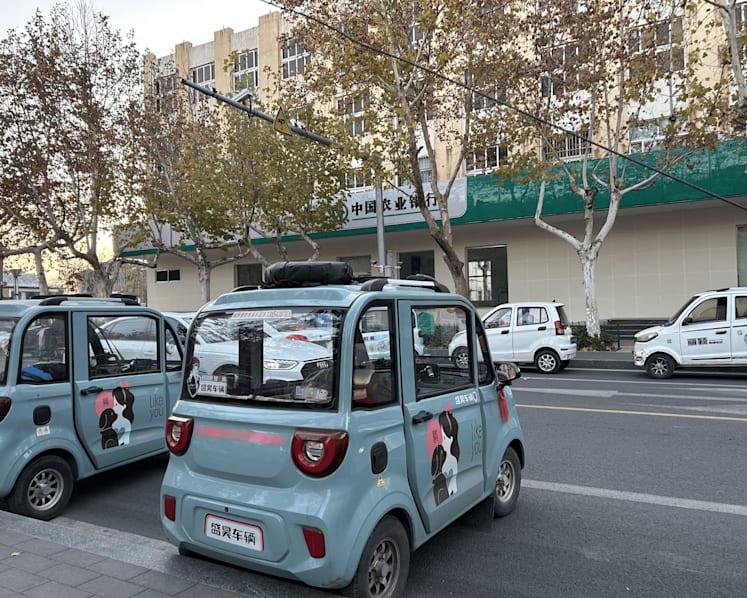
But the rapid growth of these nimble two-wheelers has far outpaced the development of dedicated lanes and parking infrastructure, while also raising safety concerns.
Last year, electric bikes were involved in 62 per cent of traffic accidents and 75 per cent of fatal accidents in Shenzhen, according to local traffic police data.
Dedicated lanes for e-scooters, bicycles and other non-motorised vehicles cover only about 36 per cent of Shenzhen’s roads, compared with more than 90 per cent in major cities such as Beijing and Shanghai, according to official municipal data.
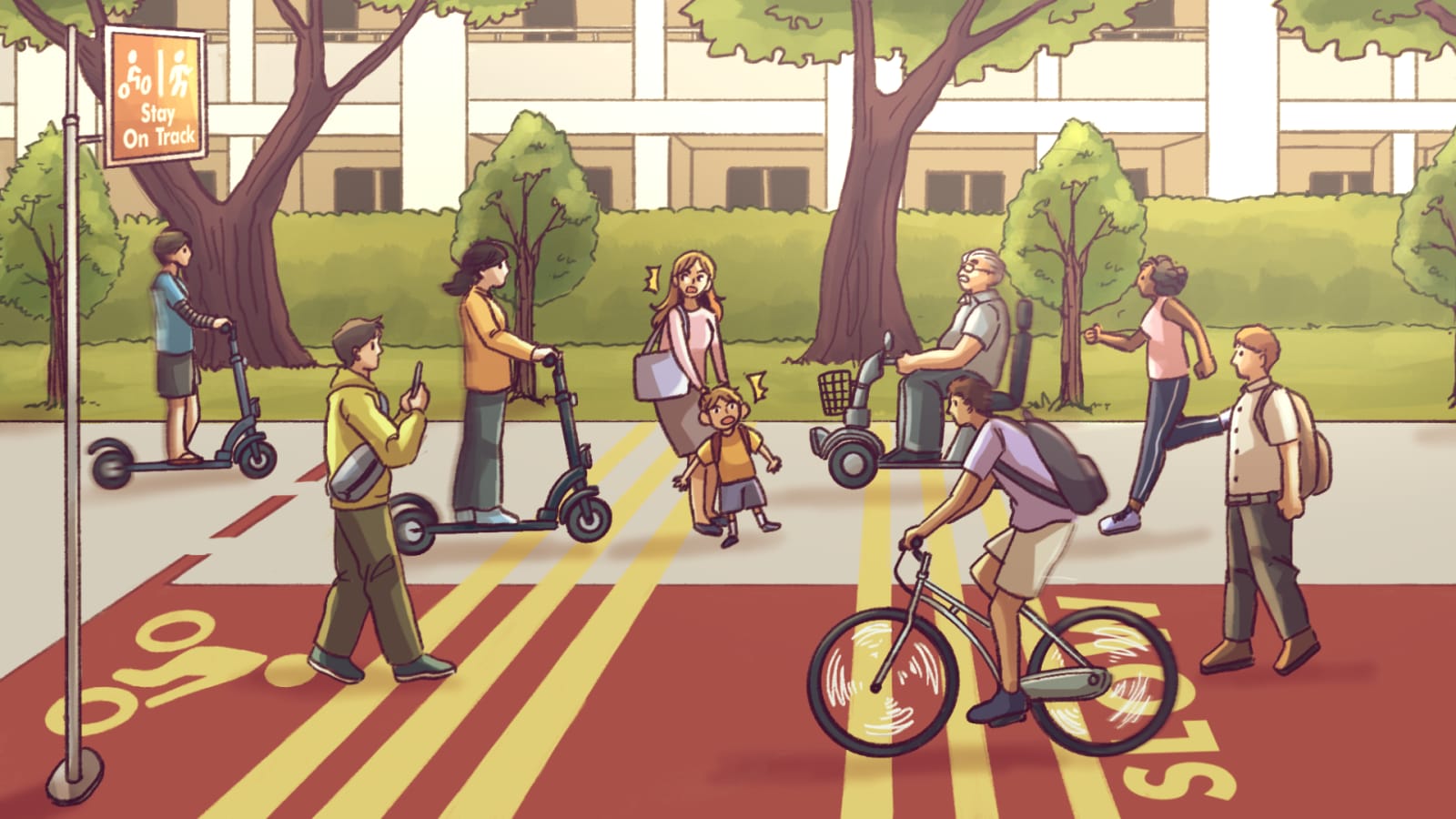
With many roads lacking clearly separated lanes, e-scooters are forced to compete for space with both cars and pedestrians.
Analysts said the latest restrictions are likely to be a phased measure aimed at restoring traffic order, rather than a permanent blanket ban, though it remains unclear how long the stricter enforcement will remain in place.
“To achieve balance, the first step is allocating road space properly,” said Wang Yuanyuan, the urban transportation consultant.
“Then you need clearer traffic rules and sustained management.”
Sustaining improvements will require expanding space for non-motorised vehicles, Wang further pointed out.
Yang Xia, an associate professor at Shenzhen Technology University who studies urban transport, said the large-scale restrictions are intended to give the city room to improve infrastructure and rethink how road space is allocated.
“The aim is to reduce accidents and restore traffic order while creating a window to improve infrastructure, including dedicated lanes, parking and charging facilities for non-motorised vehicles,” she told CNA.
For residents like Li, who had a close call with an e-scooter, stricter enforcement may help make crowded streets safer.
But in a city where scooters have become deeply woven into daily life, many said bringing order to their use remains difficult.
Back in Huaqiangbei, delivery rider Chen continued his afternoon rounds on his trusty e-scooter, moving goods through the district’s dense commercial maze.
“It’s troublesome now,” Chen said.
“But we still need (e-scooters) to work.”