







China's third aircraft carrier, the Fujian, enters service
The Fujian has electromagnetic catapults for take-offs, making it potentially far more powerful than China's first two Russian-designed carriers.
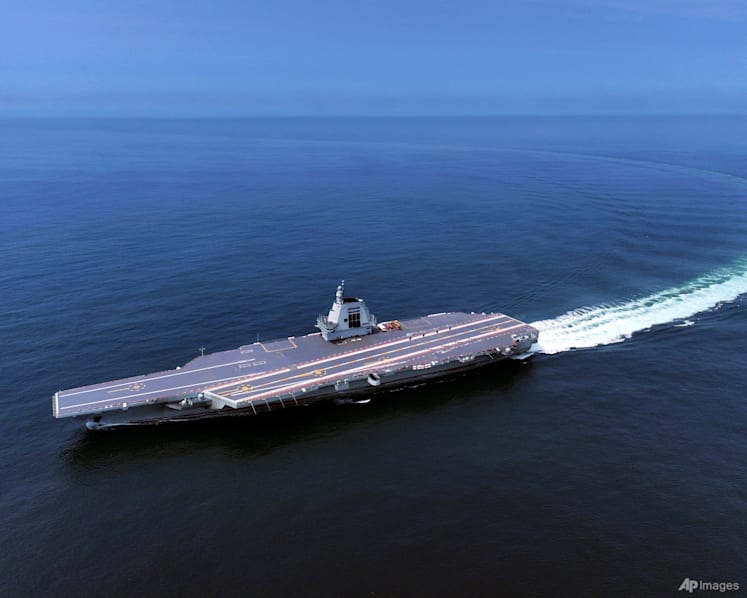
In this photo released by Xinhua News Agency, China's third conventionally powered aircraft carrier, the Fujian, conducts a maiden sea trial on May 7, 2024. (File photo: Ding Ziyu/Xinhua via AP)
BEIJING: China's third aircraft carrier has entered service following a ceremony marking its handover to the navy, state news agency Xinhua reported Friday (Nov 7).
President Xi Jinping attended the commissioning and flag-presenting ceremony in Hainan province on Wednesday.
This marks a key milestone in Xi's drive to modernise the Chinese military and project maritime power in the region, against a backdrop of competing territorial claims in the South China Sea and persisting tensions with Taiwan.
"After the ceremony, Xi Jinping boarded the Fujian ... and learned about the development of the aircraft carrier system combat capabilities and the construction and application of the electromagnetic catapult system," Xinhua said.





Footage of the proceedings released by state broadcaster CCTV showed Xi and other top officials from the country's ruling Communist Party in attendance at the port.
Engaged in a naval rivalry with Washington in the fraught maritime region, China lags behind the United States in overall military prowess, said analysts.
But Beijing has directed billions of dollars into its military in recent years. The navy, in particular, has seen a massive expansion.
“Carriers are key to Chinese leadership’s vision of China as a great power with a blue-water navy,” or one that can project power far from its coastal waters, said Greg Poling, director of the Asia Maritime Transparency Initiative at the Center for Strategic and International Studies.
After conducting sea trials in recent months, the Fujian now joins China's two other carriers in active operation - the Liaoning and the Shandong.
Much of China's most advanced aircraft carrier remains shrouded in secrecy, although analysts have said that the Fujian boasts more advanced take-off systems, allowing the Chinese air force to deploy jets carrying larger payloads and more fuel.
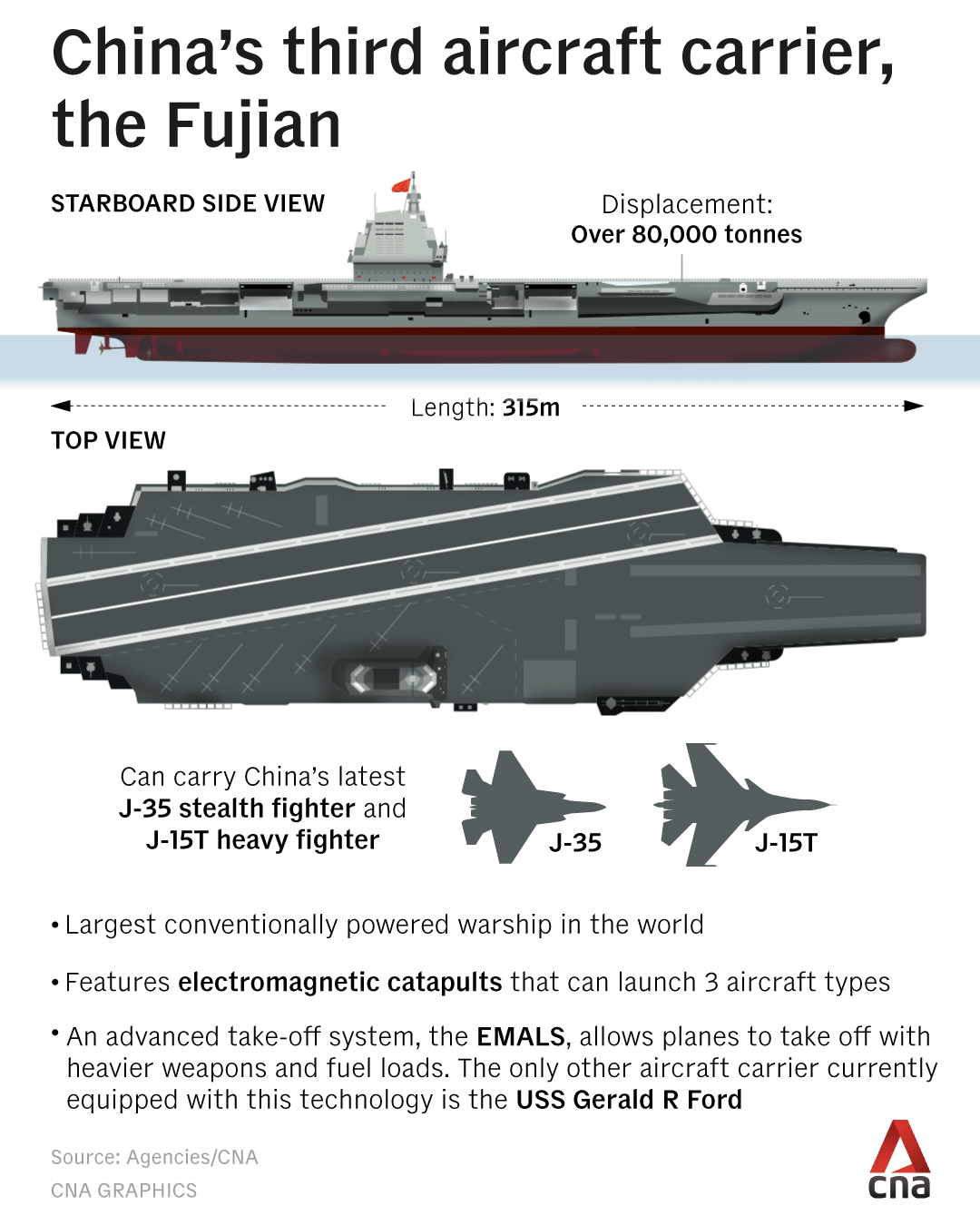
CHINA'S AIRCRAFT CARRIERS
The Fujian is equipped with an electromagnetic aircraft launch system (EMALS), a more efficient technology than conventional steam-powered methods.
Xinhua said Xi "personally decided" that the Fujian would adopt an EMALS system.
The only other aircraft carrier currently equipped with this technology is the USS Gerald R Ford.
The system causes less stress to the aircraft and the ship, allows for more precise control over speed and can launch a wider range of aircraft than the steam system.
These include heavier aircraft, with full fuel loads, like the KJ-600 early warning and control plane, which China successfully tested during its sea trials.
China's latest J-35 stealth fighter and J-15T heavy fighter were also launched from the Fujian, giving the new carrier "full-deck operation capability" according to the Chinese navy.
The ability to carry its own reconnaissance aircraft means, unlike its first two carriers, it won't be operating blind when out of the range of land-based support, giving it the ability to operate its most advanced aircraft far afield, including the Second Island Chain - where the US has important military facilities on Guam and elsewhere.
The Pentagon's annual report on China's military modernisation, released last December, noted that the Fujian and future similar carriers would boost China's ability to project military power, in part through deploying highly specialised electronic warfare and anti-submarine aircraft.
"This will increase the striking power of a potential People's Liberation Army Navy carrier battle group when deployed to areas beyond (China's) immediate periphery," it said.
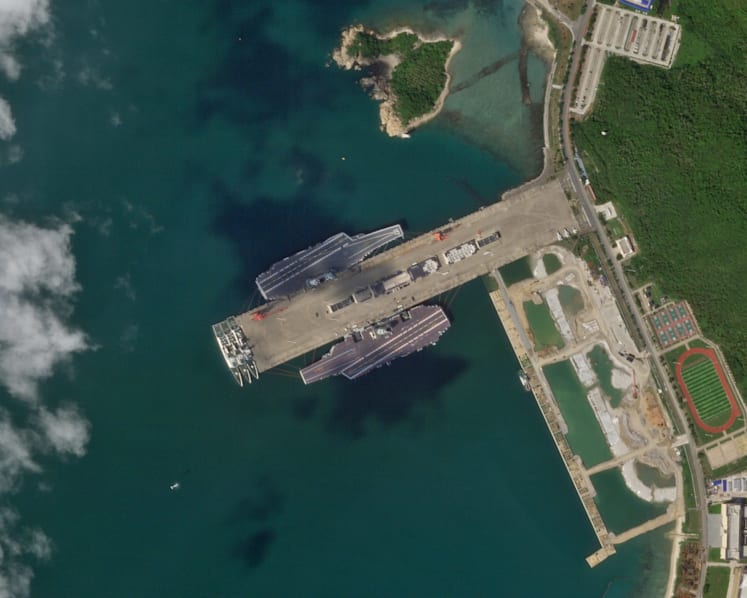
CHINA'S NAVY LAGS BEHIND THE US
Regional military attaches and analysts say they will be watching upcoming deployments, trying to gauge how quickly the Fujian is able to become combat-ready by monitoring flight operations and efforts to combine its operations with support ships and submarines.
"I think it will be at least another year before it reaches full operational capability," said Ben Lewis, founder of open source data platform PLATracker.
"Despite nine sea trials this year, they are working with almost entirely new platforms top to bottom," Lewis said ahead of Friday's announcement.
An analyst noted that China's navy lags behind the US in several significant ways.
Numerically, China only has three carriers compared to the US Navy's 11, and while China's carriers are all conventionally powered, the US' are all nuclear powered, which means they can operate almost indefinitely without being refuelled - dramatically increasing their range.
China also lags behind the US in guided missile cruisers and destroyers, which are critical in providing air and submarine defence and support for larger naval groups, as well as nuclear-powered submarines.
The US is ahead in vertical launching system cells, though China is increasing that capacity, said Brian Hart, deputy director of CSIS’s China Power Project.
China also lacks the network of overseas bases that the US has, which are critical for resupplying carriers and also providing alternative runways should aircraft not be able to return safely to the carrier.
The country is working on expanding its foreign bases, however, and has a nuclear propulsion system for a carrier in development.
There’s also evidence that China is already building another carrier. Chinese shipyards have the capabilities to build more than one at once and have also been churning out other new vessels at a pace the US can’t currently come close to matching.
“Really across the board, China’s closing the gap,” Hart said.
“They’re fielding and building more aircraft carriers, they’re fielding more nuclear-powered subs, they are fielding more, larger destroyers and other vessels that carry a larger number of missiles. So they’re really catching up.”






