South Korea shouldn't take sides in China, Japan spat: President
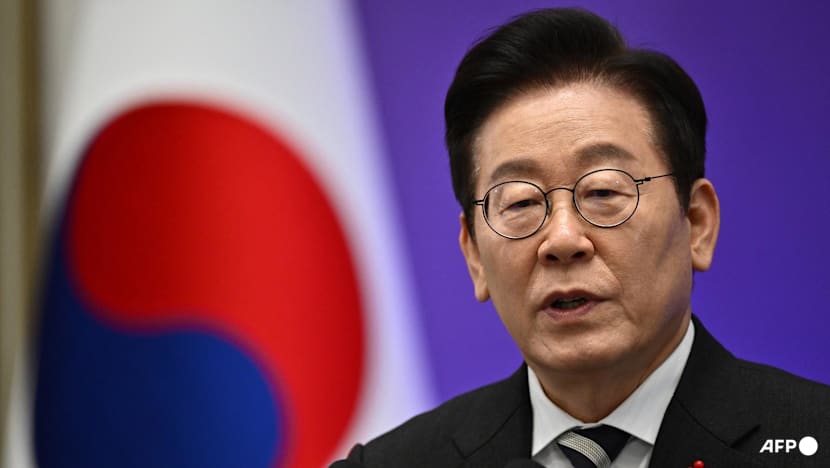
South Korea President Lee Jae Myung holds a press conference at the Blue House in Seoul on Dec 3, 2025, the first anniversary of the declaration of martial law by ousted president Yoon Suk Yeol. (Photo: AFP/Anthony Wallace)
SEOUL: South Korea's leader said on Wednesday (Dec 3) that his country wouldn't take sides in an escalating war of words between Japan and China, calling for the two sides to "coexist".
Tokyo and Beijing have been locked in a dispute after Japanese Prime Minister Sanae Takaichi suggested that Tokyo could intervene militarily should China invade Taiwan.
The comments triggered a sharp diplomatic backlash from Beijing, which has urged its citizens to avoid travelling to Japan.
Speaking in Seoul, President Lee Jae Myung told a news conference that taking sides would only worsen tensions.
"The ideal approach is to coexist, respect one another, and cooperate as much as possible," he said, describing northeast Asia as a "highly dangerous region in terms of military security".
The spat has seen several cultural events disrupted, including a Japanese singer's performance in Shanghai, which was cancelled.
China regards self-ruled Taiwan as part of its territory and has not ruled out the use of force to bring the democratic island under its control.
Lee has sought to improve ties with China after years of a deep freeze under his predecessor Yoon, who cleaved close to Seoul's longtime security partner, the United States.

Lee and Chinese President Xi Jinping met last month on the sidelines of the APEC summit in the South Korean city of Gyeongju in what Seoul framed as an opportunity to reset ties.
Lee on Wednesday told journalists his talks with Xi had been "interesting" and said he hoped to visit China soon.
"He was, unexpectedly, quite good at making jokes," Lee said.
During the November talks, Xi gifted two Xiaomi smartphones to Lee, who quipped: "Is the communication line secure?"
Pointing at the devices, Xi replied: "You should check if there is a backdoor", referring to pre-installed software that could allow third-party monitoring.