Between justice and error: Why Taiwan remains divided over the death penalty
The island’s Constitutional Court ruled in 2024 that while the death penalty remains constitutional, it must be reserved only for the most serious crimes, among other conditions.
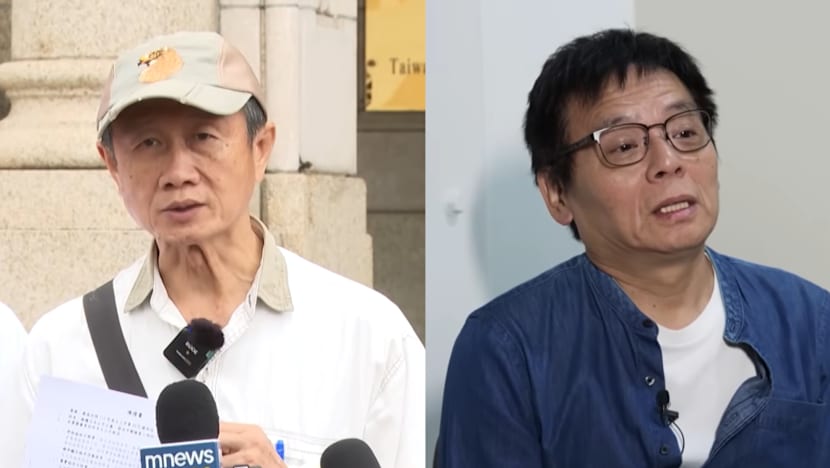
A composite image of Jerome Chang (left), the husband of a Taiwanese murder victim, and Hsu Tzu-chiang, a former death row inmate who was acquitted in 2015.

This audio is generated by an AI tool.




TAIWAN: More than a year ago, Taiwan’s top court upheld the legality of the death penalty but decided to limit its use.
The landmark ruling, delivered by the Constitutional Court in September 2024, reopened one of the island’s most divisive debates: Whether capital punishment delivers justice or risks irreversible injustice.
The court ruled that while the death penalty – which has been part of Taiwan’s legal system since 1949 – remains constitutional, it must be reserved only for the most serious crimes, among other conditions.
Those convicted of premeditated murder may still face execution. However, people with mental illness or other disabilities should be exempt.
The decision was widely described as a compromise – one that stopped short of abolition in a society where public support for the death penalty remains high, at over 80 per cent, while simultaneously making death sentences far harder to impose.
Just months after the ruling, Taiwan carried out its first execution in five years.
Huang Lin-kai, convicted in 2013 of the double murder of his ex-girlfriend and her mother, was put to death in Taipei in January 2025. In Taiwan, executions are carried out by shooting.
There are now 36 prisoners remaining on death row in Taiwan.
For families of victims, former death row inmates and legal scholars, the ruling has intensified, rather than settled, a long-running moral and legal struggle.
WOUNDS REOPENED
Among them is retired professor Jerome Chang, whose wife Chen Yue Mei was raped and murdered 11 years ago while on her way home from the market.
On the morning of the crime, Chen – then a retired teacher of 35 years – never made it home.
That evening, Chang found her car parked alone on a quiet street. Police officers later found her body inside the vehicle.
A court later ruled that her death was “a failed robbery that turned into an intentional killing” and sentenced the perpetrator, Liu Zhi Ming, to death.
But in May 2024, the High Court commuted the sentence to life imprisonment, citing the possibility of rehabilitation.
Two weeks after the Constitutional Court’s September ruling, the Supreme Court upheld the commutation, stating that the crime did not meet the threshold of the most serious kind of crime.
For Chang, now aged 73, the ruling reopened wounds he never expected to face again.
He had never spoken publicly against abolishing the death penalty until after Liu’s sentence was reduced.
“Why is a life sentence unacceptable to me? In Taiwan, life imprisonment doesn’t really mean life,” he told CNA.
“On average, people can apply for parole after 17.5 years. He committed the crime when he was 38 – he’d be out again before he’s even 60.
“I support the death penalty. I support it 100 per cent. The death penalty is justice. It’s not that executing the murderer will bring our loved one back from the dead, but at least it brings solace to us,” he added.

CALLS FOR ABOLITION
On the other side of the debate is Hsu Tzu-chiang, who spent 16 years on death row for a crime he did not commit.
Hsu was accused of participating in a 1995 kidnapping-for-ransom case that ended in the murder of a businessman. The court convicted him largely based on testimony from two co-defendants who were his acquaintances.
He was sentenced to death eight times by different panels of judges.
“When I heard ‘death sentence,’ my mind just went blank … Inside (my mind), there were only these words: ‘How could this happen?’” he recounted.
For more than a decade, Hsu lived with the constant fear that he could be executed at any moment.
“Back then, the execution time for death row inmates was always at 9pm. So every day, once it got past eight o’clock, you experienced mixed feelings. A part of you wanted them to just come and take you, to get it over with,” he said.
“But another part of you resisted – because I didn’t do it, and there was this sense of injustice. What weighed on me the most was my family … the thought of leaving them like that.”
The psychological toll of prolonged uncertainty on death row is a key argument cited by abolition supporters, alongside concerns over wrongful convictions and unequal access to legal representation.
In 2012, after spending more than eight years behind bars without a final verdict, Hsu was temporarily released under a new law that allowed certain long-running cases to be resolved without further detention.
Three years later, he was acquitted at the ninth retrial and the ruling was final.
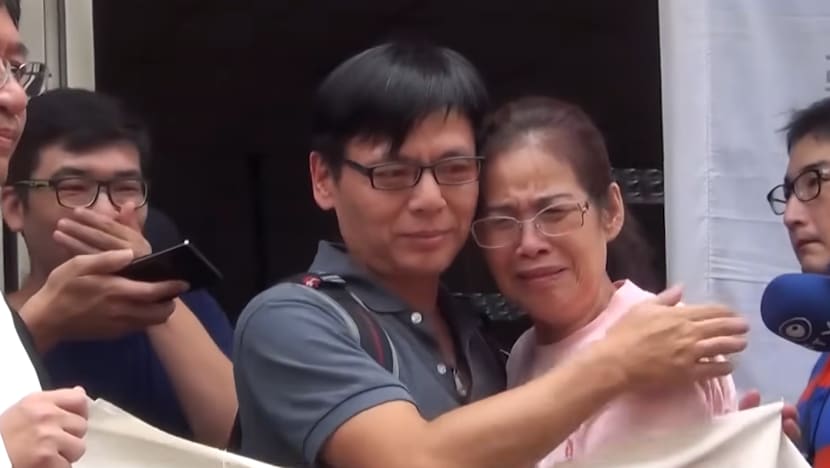
His case became one of Taiwan’s longest wrongful-conviction cases in modern history.
The 58-year-old now works at the Judicial Reform Foundation – the same organisation that helped fight for his freedom – where he meets families, students and others who want to understand the justice system and his case.
After his acquittal, he was awarded NT$28.12 million (US$900,000) in compensation for his wrongful conviction. The amount was calculated based on the more than 5,600 days he spent in detention.
He has repeatedly said that no amount of money can make up for the years he lost.

LONG ROAD TO DEMOCRACY AND DEBATE
Calls for the abolition of the death penalty have been growing louder since the 1990s when Taiwan democratised.
During the martial law era from 1949 to 1987, executions were permitted for a wide range of crimes under sweeping security laws.
Public debate around the death penalty then began to emerge after martial law ended.
Executions have been very rare, with none carried out between 2006 and 2009. But the issue remains politically charged.
The Constitutional Court’s September 2024 ruling was passed by 11 of the 12 justices, with Jan Sheng-lin the sole dissenter.
“The death penalty has existed for thousands of years, and countless people – maybe thousands or even tens of thousands – have been executed. Yet, crimes continue to be committed in the same way,” the former justice told CNA.
“So how can the death penalty possibly stop others from repeating the same offences?”
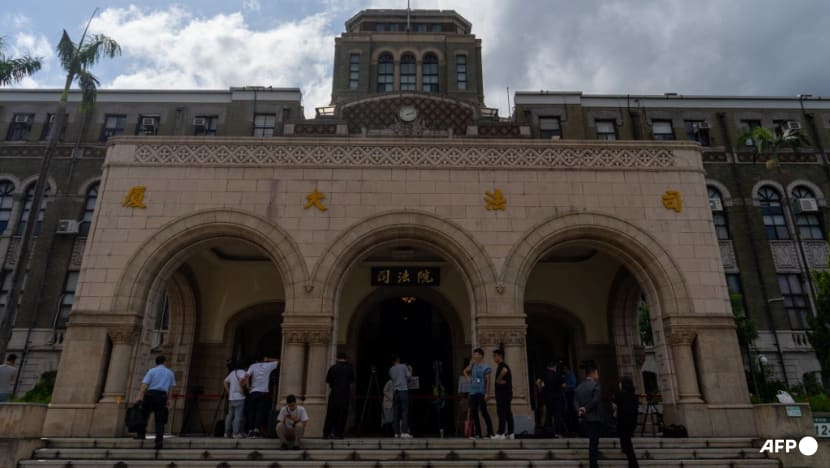
In its ruling, the Constitutional Court said that because lawmakers have adopted public sentiment in favour of retribution and deterrence as legislative goals, this has underpinned the death penalty’s constitutionality.
But critics say constitutional interpretation should not hinge on popular opinion.
Jan pointed out that the court’s final decision should come from the values and principles of the island’s Constitution.
He added: “‘Public opinion can be taken into consideration, of course, but the justices absolutely cannot say something like: ‘Since 85 per cent of the public supports it, how can the 15 of us go against 85 per cent of public opinion?’
“Thinking this way would mean losing the stature and responsibility that the justices are supposed to have.”
“A KIND OF TORMENT”
Legal scholars say while the court’s ruling upheld the legality of the death penalty, the strict safeguards now make death sentences extremely difficult to impose.
Bill Hsu, a criminal law scholar from Central Police University, noted that there must be intent and multiple casualties. All proceedings must also follow the strictest procedures.
Every capital case now requires a defence lawyer at every stage, and a death sentence can only be imposed if all judges unanimously agree.
But for those already on death row, the uncertainty continues.
“It is a kind of torment. If Taiwan adopts the United Nations Convention Against Torture, we must ask whether this long wait is cruel and inhuman. Some death row inmates say, ‘Just shoot me,’” said Bill Hsu.
On rare occasions, legal scholars or medical professionals may be allowed to observe an execution – usually for research or procedural review – to document whether safeguards are properly followed.
Executions in Taiwan, when carried out, are strictly confidential. Inmates are informed only on the day itself, while families are notified only after the execution has taken place.
Inmates may record a final voice or video message, up to 10 minutes long, which may be given to a designated person within 24 hours after the execution. A religious rite is allowed if requested.
“Once the sentence is final, you know it can happen anytime. If they told you three days in advance - imagine the mental toll. So, the current practice continues,” noted Bill Hsu.
STILL SEEKING CLOSURE
Today, Chang the widower spends his time teaching movement and breathing techniques to cancer patients, singing in a local choir, and completing the dreams his wife never got to fulfil.
One of these dreams was visiting Lake Louise in Canada, which he did with their two children.
“The things she never got to do, I do them for her. The places she never got to go, I go for her. That’s how I’ve made it through,” he said.

But closure remains elusive.
“My heart is dead. The courts did not give me back fairness and justice,” he said.
With the Constitutional Court’s decision to keep the death penalty, even if largely in name, Taiwan’s debate is far from over.
It remains a question of justice weighed against irreversibility, of public sentiment against constitutional principle - and of whether a society can ever fully reconcile punishment with humanity.