







Cycle Around Japan - Miyazaki: Through a Sunlit Land
Cyclist Paul Salisbury rides through Miyazaki’s warm coastal plains and forested mountains, meeting farmers, fishermen and artisans who embody the Kyushu spirit of living closely with the land.

This audio is generated by an AI tool.
A 350 kilometre cycling journey through sunlit Miyazaki uncovers tropical coasts, ancient forests and people who live in harmony with nature.
Japan’s southern island of Kyushu glows with a gentler light. Warm sea currents wash its coasts, palm trees sway along its roads and sunlight seems to linger longer here. In this sunlit chapter of the Cycle Around Japan series, Australian cyclist Paul Salisbury sets out to discover Miyazaki, a region famed for its blue seas, fertile soil and a culture shaped by its close connection with nature.
Landing at Miyazaki Airport, Paul greets the camera cheerfully, “Good morning! Here we are. We’ve arrived in beautiful Miyazaki.” Having lived and worked in Japan for many years, he is no stranger to the country’s roads. “I’m sure it’s going to be a fantastic journey,” he says. “Miyazaki is renowned all over Japan for having great sunshine, even in the middle of winter.”
His three-day, 350 kilometre route will trace the coast to Cape Toi, then climb inland to Aya’s primeval forest before ending in the sacred mountains of Takachiho.





From the airport, he pedals towards the sea. “Beautiful rows of palm trees,” he observes, as the road opens beside the Pacific. “It feels very, very tropical along here.” The mild air comes from the Kuroshio Current, which carries warmth from the equator and makes Miyazaki one of Japan’s most temperate regions. Even in winter, Paul notes, “You’d never think that this was the middle of winter.”
The coastline is marked by unusual rock formations. At a stop called the Devil’s Washboard, he stares at rows of wave-carved ridges stretching for eight kilometres. “Wow, look at the view,” he says. “I’ve never seen this sort of rock formation. It’s really unique.”
Further south, after forty kilometres, Paul reaches the town of Nichinan and notices bright yellow fruit glowing in the orchards. “I’ve never seen fruit as yellow as that,” he says, pulling over to ask about it. Farmer Hironori Iwakura tells him, “They’re hyuganatsu, a special Miyazaki citrus fruit.” He invites Paul to see his orchard, home to about 2,000 trees covering the hillside.
Iwakura shows him how to harvest the fruit. “You first cut it off the branch. Then another cut, as close as you can. Then lay it gently in the basket.” Paul laughs, “Like handling a baby?” “That’s right,” Iwakura replies. Later, tasting the citrus, Paul says, “It’s incredibly juicy. You’ve got the soft inside, and then the outside, which is a completely different sensation in your mouth, and then together it’s a great experience just eating the whole thing.”
Miyazaki’s name, he learns, literally means “the land that faces the sun”, and its long hours of winter light ripen the fruit to a deep golden hue.
Following the coast, Paul stops to speak with veteran fisherman Hiromichi Sato, who is repairing a net on the shore. Sato has fished for over fifty years, specialising in spiny lobsters and flounder. “Do you need to repair your nets often?” Paul asks. Sato nods, explaining, “I fish for lobster every day, and they rip on coral.” He smiles as he adds, “The repairing is harder than the fishing.” The sea air is warm even in February, and Paul remarks, “This sea breeze feels really good.” Sato agrees, “The Kuroshio Current keeps the water warm.”
At Cape Toi, Paul spends the night at a family-run guesthouse where owner Hideo Kawasaki serves the catch of the day. “Wow! Look at this! Amazing,” Paul exclaims as dish after dish appears. Bonito sashimi glows ruby red beside grilled lobster. “That is so good,” he says. “It just melts in your mouth. It’s really sweet.” He adds with wonder, “It’s so fresh. It’s like, so juicy, so sweet. Words just don’t describe it.”
The next morning he leaves the sea behind, climbing into the cedar-covered hills. Soon the mountains open to the Edo-era town of Obi, where old samurai walls still line the streets. Following the smell of something sweet, Paul discovers the workshop of Yoshiro Kyushima, who is baking atsuyaki tamago, a thick, sweet Japanese-style omelette. “It looks amazing,” Paul says as he tries a slice. “Oh, it’s incredibly sweet. It’s very soft and juicy, but it tastes like a dessert, almost like a pudding. It’s ideal cyclist food.” Kyushima explains that the dish, unique to Obi, was once prepared for celebrations such as weddings and New Year.
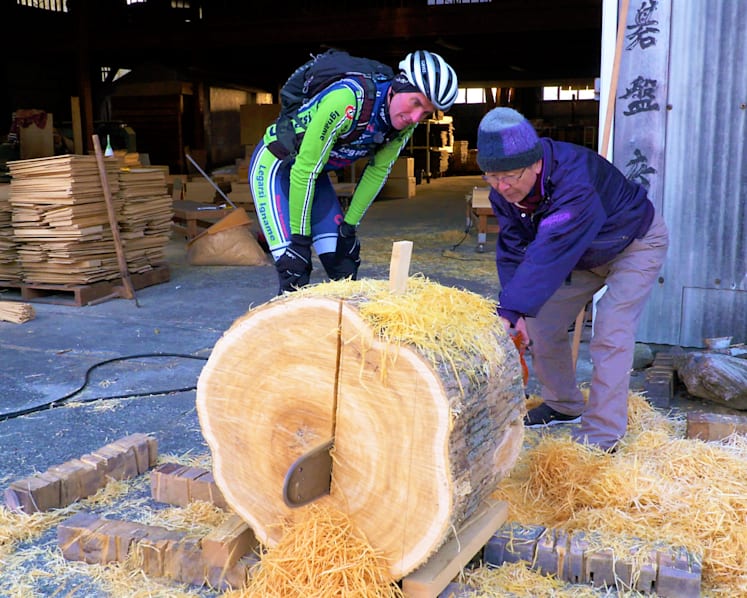
Heading north, Paul enters Aya, a town surrounded by ancient forests. He meets master craftsman Ken-ichi Kumasu, who has been making go boards for fifty years. Using timber from the rare hyugakaya tree, Kumasu carefully examines the logs. “What kind of wood is this?” Paul asks. “We call the tree hyugakaya,” Kumasu replies. “It grows deep in the mountains. This one is about 300 years old.” Cutting through the trunk, he reveals fine rings. “Perfect. Beautiful tree rings, eh?” he says with quiet pride.
Kumasu explains that trees from the wild have the best grain. “It’s like fish. Farmed fish don’t taste the same as those that spent their lives battling the sea.” Each board, he adds, must be cut with care: “You can’t handle a 300-year-old tree roughly. You must be very careful as you work on it.”
From the craftsman’s workshop, Paul rides into Aya’s primeval forest, where local guide Kozo Kawano leads him beneath a canopy that stays green all year. “This forest of broad-leaved trees stays green all year round,” Kawano says. He points out a hyugakaya growing for 200 years and explains that the people of Aya have lived with this forest for over 10,000 years. “If our forest disappeared,” he says, “Aya would feel like it had lost its heart.”
On the final day, the route descends into Kunitomi’s flatlands, where farmers spread thinly sliced daikon radish on nets to dry in the sun. “This is sengiri daikon,” explains farmer Masaru Fukuda. “It’s very healthy. Very nutritious. Full of fibre and lots of iron.” The cold, dry Kirishima Oroshi wind that blows from the mountains dries the radish in a single day. As Paul helps spread the nets, Fukuda laughs, “Cycle touring must be fun.” Paul nods, “Even in winter you have all this sunshine.”
Riding north again, he spots a hillside covered with hundreds of stone statues and stops at Takanabe Daishi Temple. Local guide Masaru Kurogi tells him that these were carved by one man, Yasukichi Iwaoka, nearly a century ago. “He made these to pray for everyone’s happiness,” Kurogi says. One statue of a blind woman has wide, kind eyes; Kurogi explains, “He gave her big eyes out of compassion.”
The journey ends in the sacred mountains of Takachiho, where legend says the Shinto gods first descended to earth. At the foot of a 1,300-year-old zelkova tree, water springs from its roots. Resident Kazue Tajiri tends the site daily, saying, “Everyone around here looks after Suijin-sama, the god of water. We feel it’s close and part of our lives.”
Standing at Takachiho Gorge, where waterfalls plunge between basalt cliffs, Paul reflects, “How close the gods are residing to the people who live here. It’s a very spiritual, very magical place.” Looking back on his three-day ride, he calls it “a journey of the heart,” adding, “I feel quite fortunate to have met so many wonderful people and learned so many great things from the way in which they’re able to live in harmony with nature.”
Miyazaki, he realises, is more than a land of endless sunshine. It is a place where light, sea and spirit intertwine — and where life still follows the gentle rhythm of the natural world.




