







Cycle Around Japan: Nagano - Life Deep in the Mountains
An Australian rider cycles 330 kilometres across Nagano, meeting wasabi growers, weavers and bamboo artisans, tasting local food and discovering lived traditions sustained in the highlands.

This audio is generated by an AI tool.
A cyclist rides Nagano’s high passes, meeting makers, farmers and singers who keep mountain life alive.
This episode launches the second ride in our cycling series, which seeks out rural Japan by pedal power, lingering long enough to hear local voices and try local crafts.
Paul Salisbury, an Australian who has made his home in Nagano since 2001, sets off from the leafy resort town of Karuizawa and spends three days climbing, descending and crossing high passes through the Japanese Alps. The trip is 330 kilometres in total, and it becomes a succession of sharp ascents and wide valley views, encounters with craftspeople and farmers, and small revelations about how mountain communities turn harsh geography into ways of life.
Paul begins in Karuizawa, a summer retreat with century-old hotels, and rides into hills that quickly close in. He describes Nagano as “a place that’s really dear to my heart,” and after a relentless 27 kilometre climb he reaches the first pass, Utsukushigahara.





The name is apt, because the highland is known for “over 200 varieties of alpine flowers,” and the view from the 2,000 metre ridge feels like a reward for every steep pedal stroke. From there, the route drops to Matsumoto, a city of about 240,000 people that sits in a basin, and Paul visits its black-lacquered castle, a national treasure with original beams and pillars that date back to its construction 400 years ago.
At the castle, he joins a group of volunteers polishing wooden floors using walnuts wrapped in cloth. The process is hands on and old fashioned, the walnut oil solidifying on contact with air to protect the wood, and Paul learns that preserving heritage is a daily, physical task. That sense of community care follows him through the journey, whether it is a village that polishes a castle floor every month, or a mountain hamlet that shares its weaving skills.
On day two the rhythm is different. The lowlands give way to Azumino’s fields, where spring rice paddies mirror the mountains, and where Paul discovers Japan’s best known wasabi growing area. Wasabi thrives here because of abundant spring water that stays around 12 degrees Celsius year round, filtered slowly from melted mountain snow, rich in oxygen and minerals. Paul tries harvesting and grating the stem into a paste, and later, at a local suggestion, samples wasabi on vanilla ice cream. He says, “This is really good,” and the reaction is more than novelty, it is an encounter with a living taste that binds cuisine to landscape.
The ascent resumes, this time across Mt Koguma at about 1,300 metres, with long descents to lakeside resorts such as Lake Kizaki. In remote valleys Paul finds Otari, a village where houses have steep roofs so heavy snow slides off rather than accumulating and destroying roofs. There he meets Harumi Aizawa, who practises boro-ori weaving, a tradition born of scarcity that reuses old cotton clothes as yarn to create thick, warm fabric. Aizawa has moved to the village under a prefectural revitalisation scheme, learned techniques from older women, and turned that knowledge into a workshop producing modern bags and accessories. Her story is an anecdote about renewal, about how a tradition saved from near-extinction can be reimagined by newcomers and sustained by local support.
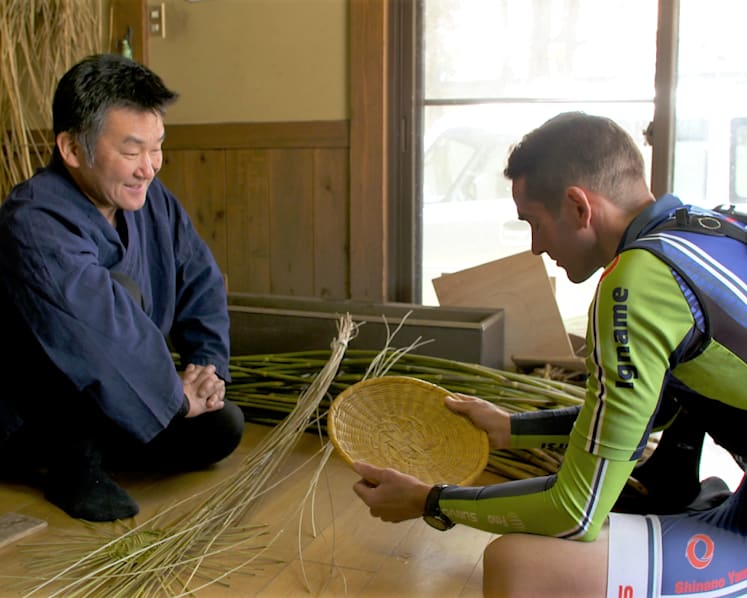
Togakushi offers another strain of continuity, around the shrine and the bamboo workshops, where togakushi takezaiku weaving produces the fine zaru strainers used for soba noodles. Paul tries his hand at splitting, shaving and weaving bamboo, discovering the muscular precision that artisans still rely on. The craft lives because it is practical and prized, but the makers are ageing, and Harayama, the youngest artisan featured, is 57. The episode uses this detail as a soft alarm, showing how high-quality handicraft depends on passing skills from one generation to the next.
The final climb to Shibu Pass reaches 2,172 metres, the highest road in Japan. Paul arrives breathless and elated, taking in a panorama that stretches from snowy peaks to rivers and villages far below. “It’s the highest road in Japan,” he says, and later, reflecting on the trip, he offers lines that arrive like the moral of a journey, “The culture is a lived experience,” and “that the real national treasure of Japan are its people.” Those statements are not hyperbole, they are the throughline of the ride: this is a place where craft, food and custom continue because men and women tend them day after day.
What emerges across the three days is not a museum of objects, but an argument for sustained practice: walnut-oiled floors that survive centuries, wasabi fields that need pure water, boro-ori woven from salvaged cloth, bamboo strainers hand-split and bound, and ryokan and onsens kept up for centuries.
The episode shows how geography shapes necessity, and how fragile traditions survive when they are woven into everyday work. For viewers who follow the series, the format is becoming familiar: a bicycle is the frame, and people are the story. Here in Nagano, every pass crossed reveals a small community holding on to a piece of Japan that remains very much alive.




