


Advertisement
Advertisement

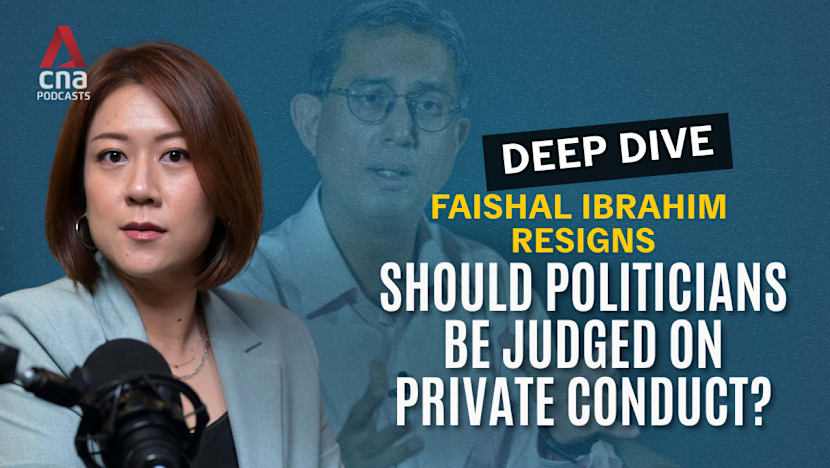
Deep Dive - Faishal Ibrahim’s resignation: How far should politicians be judged on their private conduct?

The resignation of former Minister-in-charge of Muslim Affairs Associate Professor Faishal Ibrahim, after Prime Minister Lawrence Wong said his interactions with a woman fell short of standards expected of a political office holder, shocked many Singaporeans. What do these standards look like in Singapore's political system? How do they shape expectations and what impact could this have on attracting the next generation of political leaders? Tiffany Ang speaks with Dr Norshahril Saat, principal fellow at the ISEAS–Yusof Ishak Institute and Nicholas Fang, managing director of strategic consultancy Black Dot and former nominated member of parliament, on what the resignation reveals about political accountability and public trust.

Steven Chia

Steven Chia

Tiffany Ang

Tiffany Ang

Resume Pause 32 min

Deep Dive - Buying food from livestreamers: Can you trust what sellers claim?

A convincing livestreamer, thousands of reviews or professional-looking packaging may make an online food purchase feel safe to buy. But none of these can tell you whether the food itself is safe. With more of our shopping moving online, have we become better - or worse - at assessing the risks? Tiffany Ang and Steven Chia speak with Dr Vinayak Ghate from the department of food science and technology at NUS and Dexter Tay, executive director at the Consumers Association of Singapore, about what consumers can and cannot tell from food labels, seller claims and customer reviews.

Resume Pause 29 mins

Deep Dive - Roxy Square incident: Have the rules changed on patting a child's head?

A pat on a child's head by an elderly man at Roxy Square, which led to a shoving incident, has ignited debate about how a gesture can be seen as friendly affection by one person but viewed as an unwanted touch by another. As social norms shift, how should adults respond when they feel that children's boundaries are crossed? Steven Chia and Tiffany Ang speak with Tey Beng Huan, psychologist at Temasek Polytechnic Centre for Applied Behavioural Sciences, and Kelly Tay, CEO of Juicy Parenting (@juicy.parenting), parent educator and author.

Resume Pause 25 mins

Deep Dive - Will more childcare leave and cash move Singaporeans to have more kids?

This year’s National Day Rally brought welcome news for parents. From additional childcare leave and lower childcare centre costs to increased financial support under the new Singapore Child Support Package, the measures signal a push by the Government to provide families with more sustained support. But will these measures be enough to persuade parents who are already juggling full-time jobs and family life to have another child? How can those with no children not feel left behind? In this week’s Deep Dive, Steven Chia and Tiffany Ang speak with Acting Minister for Manpower Jasmin Lau and working parents Rachael Cheong and Yuvaraj Uthaman about their lived realities and whether the new initiatives can truly move the needle when it comes to family planning.

Resume Pause 35 mins

Deep Dive - Will AI replace musicians, artists and filmmakers?

Two AI-generated local films released over the National Day weekend sparked an uproar, with viewers calling them "AI slop". But in the age of generative AI when music, films and images can be created in minutes, what happens to the creatives who have spent years perfecting their technical skills? Is AI democratising creativity or devaluing the creative craft? Are we hurtling towards a future where the audience expects infinite content made with little creative input from humans? In this week’s episode of Deep Dive, Steven Chia and Tiffany Ang sit down with two people who are on the opposite ends of this creative process for a debate – Playbox Studios founder Basil Yeo who doesn’t use AI in his media agency's works and Matthew Lee, co-creator of Recess Remix, a TikTok account that used AI to remix school songs.

Resume Pause 30 mins

Deep Dive - Should we be rewarded for doing what's good for us?

From getting Healthpoints for donating blood to being paid for reading, Singaporeans are increasingly being incentivised to do what's beneficial for themselves and society. But when the rewards stop, will the good behaviour stop too? And could all these incentives make us a more transactional society? Steven Chia and Tiffany Ang speak with Dr Serene Koh from the Behavioural Insights Team and assistant professor Lawrence Jin from the Lee Kuan Yew School of Public Policy on the intentions of putting incentives at work, when they backfire, and whether rewards produce long-term benefits.

Resume Pause 24 mins

