







Mystery grows with key suspect in Haiti president killing
Mystery grows with key suspect in Haiti president killing
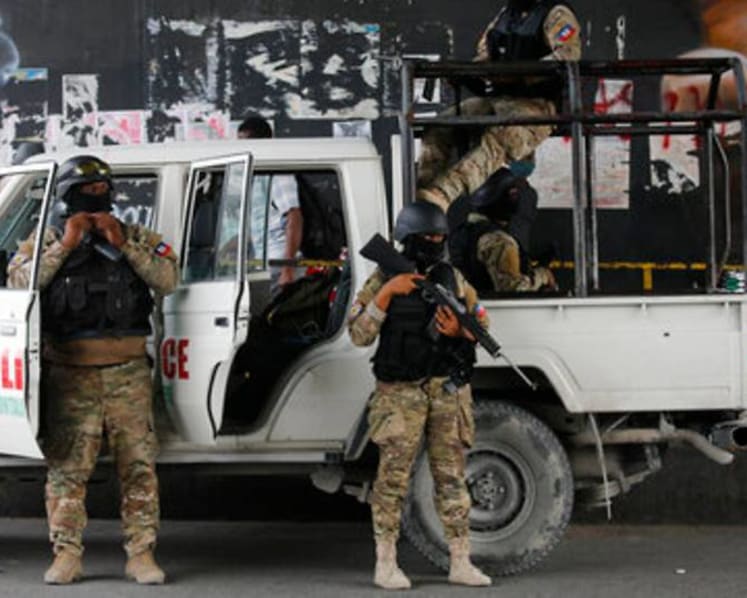
Police stand guard under an overpass in Port-au-Prince, Haiti, on Jul 12, 2021. President Jovenel Moise was assassinated on Jul 7. (File photo: AP/Fernando Llano)
PORT-AU-PRINCE, Haiti: A physician. A church pastor. A failed Florida businessman who filed for bankruptcy.
New details that have emerged about a man considered a key player in the killing of Haiti's president deepened the mystery over the assassination that shocked the nation of more than 11 million people as it faces an uncertain future.
Local authorities identified the suspect as Christian Emmanuel Sanon, 62, a Haitian who once expressed a desire to lead his country in a YouTube video.
However, he is unknown in Haitian political circles, and associates suggested that he was duped by those really behind the slaying of President Jovenel Moise in an attack last week that critically wounded his wife, Martine.





A Florida friend of Sanon told the Associated Press that the suspect is an evangelical Christian pastor and is also a licensed physician in Haiti, but not in the United States.
The associate, who spoke on condition of anonymity out of safety concerns, said Sanon told him that he was approached by people claiming to represent the US State and Justice departments who wanted to install him as president.
He said the plan was only for Moise to be arrested, and that Sanon would not have participated if he knew Moise would be killed.
“I guarantee you that,” the associate said. “This was supposed to be a mission to save Haiti from hell, with support from the US government.”
READ: Haitian police arrest Moise assassination suspect with 'political' aim
Echoing those sentiments was the Reverend Larry Caldwell, a Florida pastor, who said he had worked with Sanon setting up churches and medical clinics in Haiti from 2000 to 2010.
He doesn’t believe that Sanon would have been involved in violence.
“I know the character of the man,” Caldwell said. “You take a man like that and you’re then going to say he participated in a brutal crime of murder, knowing that being associated with that would send him to the pits of hell? ... If there was one man who would be willing to stand in the breach to help his country, it would be Christian.”
Haiti’s National Police chief, Leon Charles, said that Moise’s killers were protecting Sanon, whom he accused of working with those who plotted the assassination.
Charles said that officers found a hat with the logo of the US Drug Enforcement Administration (DEA), 20 boxes of bullets, gun parts, four licence plates from the Dominican Republic, two cars and correspondence, among other things, in Sanon’s house in Haiti.
Twenty-six former Colombian soldiers are suspected in the killing, and 23 have been arrested, along with three Haitians. Charles said that five suspects are still at large and at least three have been killed.
READ: Leaked testimony from Haiti suspects says plan was to arrest, not kill president
A DEA official told AP that one of the suspects in Moise’s assassination was at times a confidential source to the agency, and that the suspect had reached out to his contacts at the DEA after the killing and was urged to surrender.
The official said that the DEA and a US State Department official provided information to Haiti’s government that led to the surrender and arrest of one suspect and one other individual, whom it didn’t identify.
Meanwhile, Colombia’s national police chief, General Jorge Luis Vargas, said that a Florida-based enterprise, CTU Security, used its company credit card to buy 19 plane tickets from Bogota to Santo Domingo for Colombian suspects. Most arrived in the Dominican Republic in June and moved into Haiti within weeks, Vargas said.
He said that Dimitri Herard, head of general security at Haiti’s National Palace, flew to Colombia, Ecuador and Panama in the months before the assassination, and that Colombian police are investigating whether he had any role in recruiting the mercenaries.
In Haiti, prosecutors are seeking to interrogate Herard as part of the assassination investigation.
Charles said that Sanon was in contact with CTU Security and that the company recruited the suspects in the killing. He said that Sanon flew into Haiti in June on a private jet accompanied by several of the alleged gunmen.
The suspects were told that their job was to protect Sanon, but they were later ordered to arrest the president, Charles said.
Charles said that after Moise was killed, one suspect called Sanon, who got in touch with two people believed to be masterminds of the plot. He did not identify the masterminds or say if police know who they are.
READ: US probing American ties to assassination of Haitian president
Sanon’s associate said that he attended a recent meeting in Florida with Sanon and about a dozen other people, including Antonio Enmanuel Intriago Valera, a Venezuelan emigre to Miami who runs CTU Security.
He said that a presentation was made for rebuilding Haiti, including its water system, converting trash into energy and fixing roads.
He said that Sanon asked why the security team accompanying him to Haiti were all Colombians. Sanon was told that Haitians couldn’t be trusted and that the system is corrupt, the associate said. He said that Sanon called him from Haiti a few days before the assassination and said that the Colombians had disappeared.
“I’m all by myself. Who are these people? I don’t know what they are doing,” the associate quoted Sanon as saying.
Sanon “is completely gullible”, the associate added. “He thinks God is going to save everything.”
READ: Pentagon says US team going to Haiti to assess needs
Sanon has lived in Kansas City, Missouri, and in Florida, where he filed for bankruptcy in 2013 and identified himself as a medical doctor in a YouTube video titled Leadership for Haiti in which he denounced the country's leadership as corrupt and accused them of stripping the country's resources.
However, records show that Sanon has never been licensed to practice medicine or any other occupation covered by Florida’s Department of Health.
Sanon said in court papers filed in his 2013 bankruptcy case that he was a physician and a pastor at the Tabarre Evangelical Tabernacle in Haiti.
He said that he had stakes in enterprises including the Organization of Rome Haiti, which he identified as a non-governmental group, a radio station in Haiti and medical facilities in Haiti and the Dominican Republic.
At the time of his bankruptcy, he and his wife reported income of US$5,000 per month, and a home in Brandon, Florida, valued at about US$143,000, with a mortgage of more than US$367,000.
A federal bankruptcy trustee later determined that they hid ownership of about 14ha in Haiti from creditors.
READ: Widow of Haiti's slain leader speaks as political intrigue swirls
Florida records show that Sanon started about a dozen businesses over the last 20 years, all of which failed, including ones that appeared related to medical imaging, physical therapy, fossil fuel trading, real estate and veganism.
Sanon’s arrest comes as a growing number of politicians have challenged interim Prime Minister Claude Joseph, who is currently in charge of Haiti with backing from police and the military.
US officials, including representatives from the US Department of Justice and the Department of Homeland Security, met on Sunday with Joseph, designated Prime Minister Ariel Henry and Joseph Lambert, the head of Haiti’s dismantled Senate, whom supporters have named as provisional president in a challenge to Joseph, according to the White House National Security Council.
The delegation also met with Haiti’s National Police and reviewed the security of critical infrastructure, it said.
READ: Biden tells Haitians to 'come together'
READ: Haiti asks US, UN to send troops as fears of instability grow
White House press secretary Jen Psaki said that the delegation received a request for additional assistance. She said that deployment of US troops remained “under review”, but also suggested that Haiti’s political uncertainty was a complicating factor.
“What was clear from their trip is that there is a lack of clarity about the future of political leadership,” Psaki said.
US President Joe Biden said that he was closely following developments, adding: “The people of Haiti deserve peace and security, and Haiti’s political leaders need to come together for the good of their country.”
Meanwhile, United Nations deputy spokesman Farhan Haq said that Haiti’s request for security assistance is being examined.
The UN has been involved in Haiti on and off since 1990, but the last UN military peacekeepers left the country in 2017.




