







Aetos defends hiring processes, says duo met stringent criteria
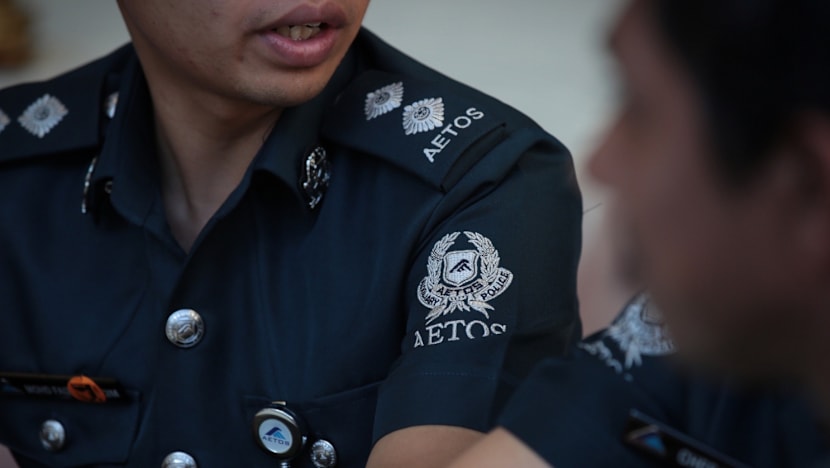
Aetos auxiliary police officers. Photo: Jason Quah/TODAY
SINGAPORE — After two of its staff were found to be radicalised, security firm Aetos yesterday maintained that its existing hiring and vetting processes were “robust”.
There were “no obvious signs of radicalisation” shown by the Singaporean duo, which made such signs difficult to pick up on, the company said in response to media queries.
It added that all hired auxilliary police officers (APOs) must meet a set of stringent selection criteria: On top of physical fitness and education requirements, all APOs are screened to ensure they are suitable for security work. The firm also interviews all the candidates to ensure they have the right attitude and temperament. “However, we recognise that it is neither always easy nor possible to detect signs of radicalisation in every case,” Aetos said.
Yesterday, the Ministry of Home Affairs (MHA) announced that Muhammad Khairul Mohamed, 24, was detained for his intention to undertake armed violence in Syria, while his colleague Mohamad Rizal Wahid, 36, was issued with a Restriction Order for supporting the former’s decisions.





Aetos has sacked both men, after they were arrested in May and issued ISA orders this month.
On whether it is tightening up the hiring and vetting processes of its APOs, the company said it has reminded employees “to report any unusual behaviour among their colleagues, so that help can be rendered to them”. It will also be working closely with the authorities in educating and advising its employees about the threats and risks of self-radicalisation, Aetos said. The firm added that existing operational safeguards are in place to “limit the risk that a few such individuals can pose”, including the rotation of duties and work shifts, and close monitoring by ground commanders and team leaders.
The commanders are also “on the alert for any signs of radicalisation among their officers”, and monthly interviews are conducted to pick up on tell-tale signs of self-radicalisation, or any abnormal behaviour.
Aetos Holdings was established in 2004 through the merger of three auxiliary police forces. It is part of Surbana Jurong Group, which is wholly owned by Temasek Holdings
In the case of Khairul, he joined Aetos in 2015 — three years after he started becoming interested in the sectarian conflict in Syria, and a year after he tried, albeit unsuccessfully, to contact a foreign militant and two others whom he believed to be supporters of the Free Syrian Army.
At the point of his arrest, Khairul was an outrider with the Aetos traffic enforcement division at Woodlands Checkpoint. His duties, which included the checking of entry passes, belongings and vehicles and escorting oversized vehicles, did not require him to be armed.
Duties for Aetos’ officers are rotated, with certain roles requiring officers to bear arms. The firm said that during Khairul’s employment, he was mainly deployed at Woodlands Checkpoint, but it did not specify what other roles he did. TODAY understands that he had previously carried a weapon as part of his job.
Rizal, who had been with Aetos since 2013, was an armed auxiliary police officer at Woodlands Checkpoint performing general security duties. He had been aware of Khairul’s intention to engage in armed violence overseas since 2015. Not only did he fail to bring the matter to the authorities’ attention, he even suggested to Khairul various ways to get to Syria.
Aetos reiterated that there are “strict controls in place for the issuance, wearing and return of firearms”.
The company said that the majority of its APOs are Singaporeans, while the rest are Malaysians, and there are a small number of Taiwanese officers. It was reported by the media last year that private security firms were turning to Taiwan to fill auxiliary police officer positions here.
Yesterday, Home Affairs and Law Minister K Shanmugam noted the difficulty of getting more Singaporeans to become APOs. “Ideally, we want to (fill up these positions with Singaporeans) ... We have been forced to go overseas because we haven’t been able to get Singaporeans,” he said, speaking to reporters following the MHA’s announcement of the latest self-radicalisation cases.




