







After Grand Canyon, Taj Mahal and Venice, Google 'street view trekkers' now head to Singapore's hawker centres
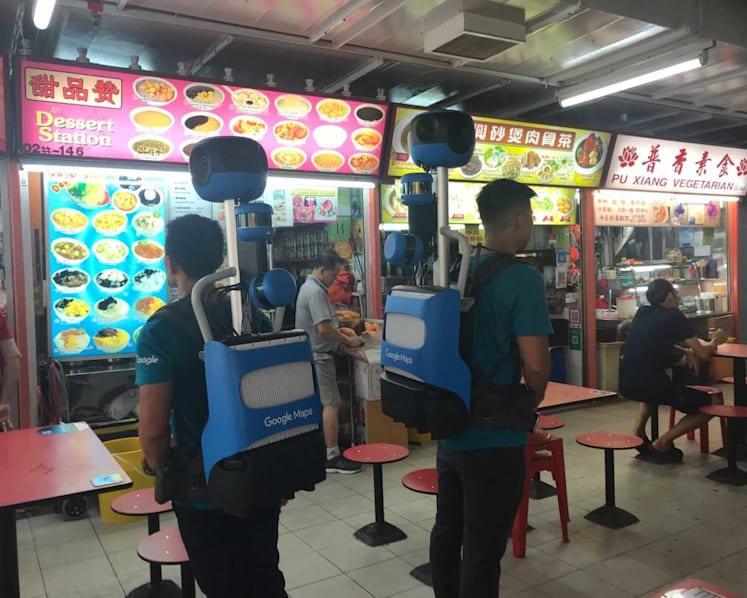
Two Google "street view trekkers" preparing to gather images at Chinatown Market on Tuesday (July 30) to boost the profile of Singapore's hawker centres. Teams of trekkers will visit 114 hawker centres.


SINGAPORE — Teams of Google “street view trekkers” are about to fan out on foot across Singapore to visit its 114 hawker centres.
Carrying backpacks fitted with state-of-the-art 360-degree camera equipment, the trekkers aim to capture imagery that aligns with Singapore’s bid to be accepted onto Unesco's Representative List of the Intangible Cultural Heritage of Humanity.
Google’s street view trekkers operate in teams of about five, capturing images of their surroundings at hawker centres every two seconds. The device has already been used to document Unesco heritage sites such as the Grand Canyon, Taj Mahal and Venice.
On Tuesday (July 30), Google announced the initiative in tandem with organisations that are driving Singapore’s Unesco nomination: The National Heritage Board (NHB), the National Environment Agency (NEA) and the Federation Of Merchants' Associations, Singapore (FMAS). Google said it will start by documenting Chinatown Market, Geylang Serai Market, Tekka Market, Maxwell Food Centre and Golden Mile Food Centre.





The technology giant said the images being captured by the trekkers will be available to view on Google Maps only after the project has been completed, which is estimated to be by early 2020.
As well as the 360-degree images, the project will add useful information to Google Maps, such as a stall’s name, number and photos. Google will also add a pin precisely locating each stall.
Mr Alvin Tan, NHB’s deputy chief executive (policy and community), noted at a media event that plans to nominate Singapore’s hawker culture for the Unesco list had been in the works since August last year.
While the nomination for the bid has already been submitted, Mr Tan said that the Google project is still “useful”, as it “contributes to the ongoing efforts by the different agencies to actually document our (intangible) hawker culture”.
He added: “We wanted to make this data bank accessible and searchable by our locals as well as overseas fans of hawker culture, so that they can… actually find out more information about each of the hawker centre, their stores as well as their offerings from the comfort of their home."
The digital mapping of hawker stalls would mean better accessibility to the stalls’ business information, with its virtual navigation guiding patrons to particular hawker stalls.
“Finding your way through a hawker centre can be confusing, especially for bigger centres, such as Chinatown Market. This project is beneficial to the hawker community as it will help customers to locate hawker stalls with ease,” said Mr Lim Gek Meng, FMAS vice president and Chinatown Complex Hawkers’ Association chairman.
“Also, with an online presence, hawkers are able to reach out to more customers, at no cost and with little effort.”
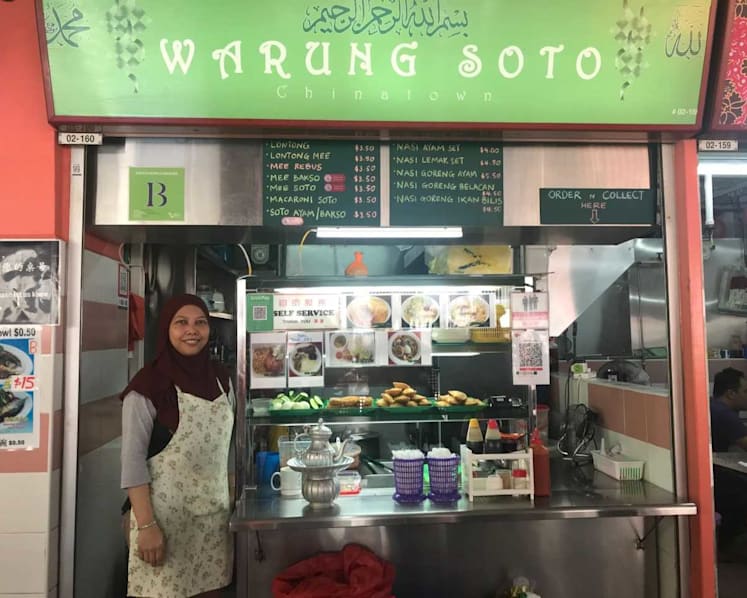
Ms Juliana Suradi at Warung Soto, a Malay hawker stall at Chinatown Market. Photo: Lauren Ong
Ms Juliana Suradi, 44, who owns Warung Soto, a Malay hawker stall in Chinatown Market, said that the documentation of her stall’s location could help patrons find it in a hawker centre which has largely Chinese food and where “not many people know about the existence of (halal food stalls) in here”.
“We have many Indonesian patrons, tourists coming over. But they didn’t know that we are around here,’’ she said.
Sometimes, she sees buses of tourists arriving but nobody visits her upstairs stall, she said.
Ms Connie Chan, 48, who runs Happies Bak Kut Teh at Chinatown Market, had already turned to digital platforms to increase her online presence and appeal to younger patrons.
With about 600 "likes" on Facebook and 200 followers on Instagram, Ms Chan started her social media accounts to make her store better known to tourists seeking local food.
She believes the Google Maps project could help more patrons visit her stall, as well as stalls run by elderly hawkers who may not be familiar with social media.
She said: “They do not have the outreach base on social media and I think they will be on the losing end. So with Google coming in to help fill in the gaps, I think it will help everyone in that sense.”




