







After injury, a faster return to the driver’s seat
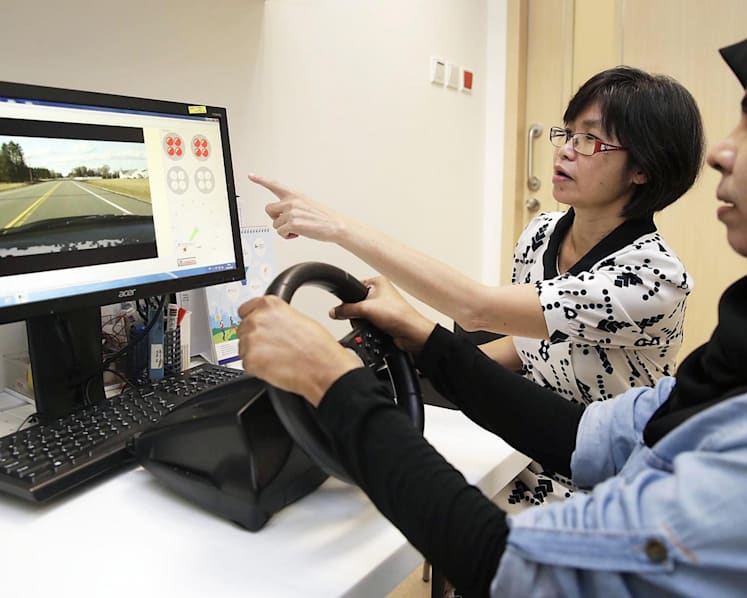
The DriveFast tool helps healthcare professionals better understand when patients recovering from ankle fractures can resume driving. PHOTO: Wee Teck Hian
SINGAPORE — Using the foot to toggle between the brake and accelerator is an essential part of driving. But if you have recently suffered an ankle fracture, when is it safe to be back on the road?
Doctors typically assess patients’ readiness to resume driving after an injury by referring to the Singapore Medical Association’s medical guidelines on fitness to drive, which was crafted by an expert committee of doctors from multiple disciplines and representatives from various organisations.
There is currently no definitive timeframe as to when patients with ankle fractures can safely return to driving, said Dr Sean Ho from the Department of Orthopaedic Surgery at National Healthcare Group’s Tan Tock Seng Hospital (TTSH).
Research suggests it may be safest at least nine weeks post-surgery, such as one 2003 study published in The Journal of Bone and Joint Surgery. Some doctors may suggest doing so only after the fracture fully heals, which can take up to six months, said Dr Ho.





A new assessment tool developed by TTSH is now available to help healthcare professionals in Singapore better understand when recovering patients can safely resume driving. The DriveFast tool has allowed some automatic car drivers with right ankle fractures to be cleared to drive six weeks post-surgery.
In a pilot DriveFast study conducted by TTSH from 2013 to 2015, 21 of 23 patients passed the on-road driving test at six weeks, before their ankle fractures fully healed.
The other two did not successfully clear the programme at six weeks due to factors such as excessive ankle pain and the inability to transfer in and out of the vehicle unaided, which limited their ability to drive, said Dr Ho, the study’s principal investigator.
They later passed the assessment test at 12 weeks. TTSH’s Department of Orthopaedic Surgery performed 179 surgeries for ankle fractures from 2013 to 2015, the majority of which were due to sports injuries, falls and road traffic accidents.
In recent years, the team has observed a growing number of ankle-fracture patients enquiring about post-surgery driving.
“They are often keen to resume driving quickly due to the impact on their independence and occupational considerations,” said Dr Ho.
After undergoing surgery for an ankle fracture, it typically takes more than six weeks for patients to be able to bear weight on the ankle without an aid and achieve a reasonable range of motion of the ankle, said Dr Ho.
“Full healing of an ankle fracture may take up to six months although some patients may be able to return to normal activities like driving and normal walking before that,” said Dr Ho.
Dr Ho said the findings from the DriveFast pilot study would provide doctors with a “more definitive timeframe” as to when patients with right ankle fractures may safely return to driving after surgery.
“In the past, doctors may tell patients,‘Let’s talk about driving when you’re completely healed’. But now we know that the majority of patients can pass the driving assessment tests at six weeks,” said Dr Ho.
“So if ankle-fracture patients ask me when they can possibly return to driving after surgery, I can tell them that they may be able to be assessed at five or six weeks and, if they pass the assessment tests, they have a better chance of returning to driving.”
Mr See Shi Chang, 35, was among the patients given the green light to drive six weeks after surgery.
In the bid to speed up recovery, the bunker trader diligently did stretching and ankle exercises at home, as instructed by his physiotherapist.
“On average, I spend about 30 to 40 per cent of my day behind the wheel. My job requires me to meet clients frequently and I also have to ferry my daughter to and from school, so I was glad to be given the green light to drive again,” said Mr See, who fractured his right ankle playing football.
An occupational therapist looked at his pain levels, the range of motion of his ankle and his ability to independently get in and out of the vehicle. His brake reaction time was also reviewed using a driving simulator.
Patients also undergo a practical assessment by a licensed driving instructor that comprises carpark driving and on-road driving.
The assessment tool does not mean every patient with an ankle fracture can resume driving at six weeks, as how well a fracture heals after surgery varies from patient to patient, said Dr Ho.
Patients with right ankle fractures do not need to seek clearance from a government body such as the Traffic Police to resume on-road driving.
However, those who wish to return to driving after a leg or ankle fracture should always seek medical advice from their doctor before they do so, said Dr Chan Mei Leng, principal occupational therapist at TTSH and a co-investigator of the DriveFast study.
“If the doctor is unsure of the patient’s ability to drive (after an injury), he or she may refer the patient to TTSH to be assessed on functional fitness. Patients may resume driving after they pass the assessment test conducted by an occupational therapist and have the report counter-signed by their doctor,” said Dr Chan.
Besides assessing ankle fracture patients’ fitness to drive, TTSH also offers a specialised driving assessment programme for people with medical conditions and/or disabilities, such as limb weakness, spinal cord injuries, amputations and congenital deformities, to learn or safely return to driving.
The Driving Assessment and Rehabilitation Programme, which saw 678 cases last year, advises clients on applying for a driving licence or modifying their vehicles in response to their medical condition.




