







All he had was a persistent sore throat, and it turned out to be cancer
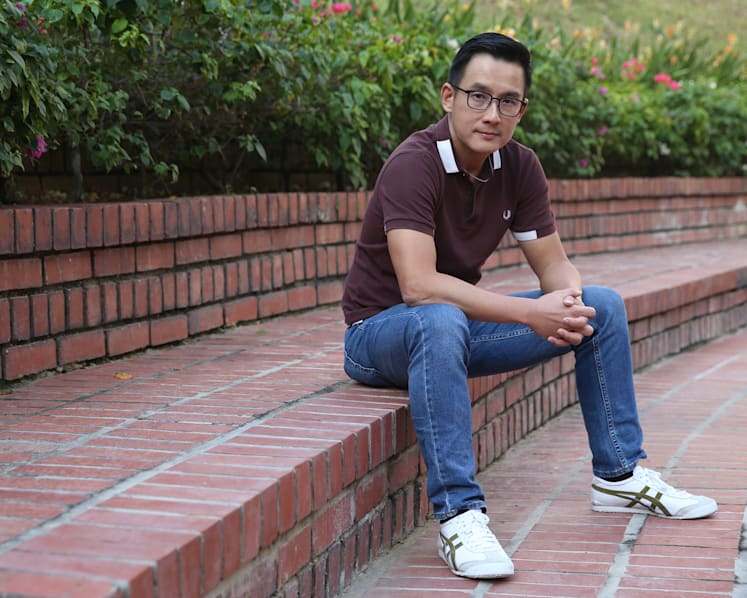
Nasopharyngeal cancer is the ninth most common cancer among Singapore men and typically affects adults in the prime of their lives. Mr Choy Chan Hong (pictured) suffered from the cancer at its late stage when he was 41.
SINGAPORE — When Mr Choy Chan Hong lost his father to nasopharyngeal cancer 20 years ago, he never thought that he would get the same disease later in life.
Two years ago, at the age of 41, the civil servant was diagnosed with stage four nasopharyngeal cancer, a type of head and neck cancer that starts in the cells lining the nasopharynx, which is the upper part of the throat behind the nose and below the brain.
He was fit and otherwise healthy at the time, and the only symptom he had was a persistent sore throat. When the sore throat did not improve despite seeing a general practitioner twice, Mr Choy asked for a referral to see an ear, nose and throat specialist at the National University Hospital (NUH).
There, the specialist found that the cancer had already invaded the surrounding lymph nodes and bone separating the nasopharynx from the brain.





Mr Choy, whose sons were aged 10 and 14 then, said that the late-stage diagnosis hit him hard.
“Until then, my life had been so normal. All I had was a sore throat. I could not accept (the diagnosis),” he recalled, adding that he was in denial and even told the specialist, “Can you not call it stage four?”.
The bad news also brought back memories of his late father whose cancer had spread rapidly in his final days. His father died at the age of 55.
“I recalled being at my father’s bedside when he passed on. Knowing that it is because of the disease — it was scary,” Mr Choy said.
THE 'CANTONESE CANCER'
The ninth most common cancer among Singapore men, nasopharyngeal cancer typically affects adults in the prime of their lives between the ages of 35 and 55.
Dr Ng Li Shia, a consultant at NUH’s department of otolaryngology- head and neck surgery, said that about 250 to 300 cases are diagnosed in Singapore every year.
Nasopharyngeal cancer is 20 to 30 times more common in the Chinese, particularly those who are Cantonese such as Mr Choy than in other races. This is why it is also called the “Cantonese cancer”.
Men have a greater risk of developing the cancer than women.
It is not known exactly what causes nasopharyngeal cancer but genetic factors play a role. People with first-degree relatives who have nasopharyngeal cancer face a higher risk of getting the cancer than the general population.
Dr Ng said that the cancer has also been linked to a diet early in life that is high in preserved foods, such as salted vegetables, fish and meats. It is also linked to the Epstein Barr virus (EBV).
EBV is a member of the herpes virus family that spreads via bodily fluids such as blood, saliva and semen, the United States Centers for Disease Control and Prevention said.
In June, A*Star’s Genome Institute of Singapore announced that its scientists have identified two new EBV variants associated with an increased risk of cancers, including nasopharyngeal cancer.
The institute’s researchers said that individuals infected by this unique EBV strain carrying these two variants have 11 times higher risk of developing nasopharyngeal cancer than non-carriers.
Presently, about four in five nasopharyngeal cancer cases in the Cantonese dialect group are linked to this high-risk EBV strain.
The discovery of these EBV variants would allow for the development of screening kits to identify high-risk individuals for routine clinical monitoring to detect the cancer early, the institute said.
DIAGNOSIS IN ADVANCED STAGES
With no conspicuous early signs, nasopharyngeal cancer is usually discovered only in the advanced stages.
Dr Ng from NUH said that about two-thirds of cases are diagnosed in the third and fourth stages.
Dr Ng said that the most common symptom is a persistent neck lump in the upper part of the neck due to the spread of cancer to the lymph nodes.
The second and third most common symptoms are blood-stained saliva and persistently blocked ears.
Mr Choy’s symptom of sore throat is not a common nasopharyngeal cancer symptom, although a sore throat that persists for several weeks with other changes such as blood in saliva, voice hoarseness, and pain and difficulty in swallowing is considered abnormal, Dr Ng said.
However, with recent improvements in treatment options, the future is not entirely bleak for advanced-stage nasopharyngeal cancer patients.
When detected early, it is curable, the Singapore Cancer Society said.
Presently, 70 to 90 per cent of patients in the first to third stage usually survive five years or more.
For stage-four patients, the five-year survival rate is around 70 per cent, Dr Ng said.
GETTING TREATMENT
Faced with a stage-four diagnosis, Mr Choy struggled to stay positive in the initial weeks.
“At that time, the (70 per cent five-year survival rate) was meaningless to me. Even if you told me that the survival rate is 90 per cent, it would not assure me that I would survive the cancer,” he said.
However, he perked up once treatment began.
“The thought that I was doing something about my cancer instead of just lying there helped me a lot psychologically. I wanted to believe that it would work,” he said.
Mr Choy underwent aggressive treatment at the National University Cancer Institute, Singapore (NCIS), which consisted of chemotherapy to shrink the tumour in the first phase, and radiation therapy alongside chemotherapy in the next phase.
During the first rounds of treatment, Mr Choy was enrolled in a clinical trial for patients with advanced nasopharyngeal cancer. The trial evaluates the use of combining chemotherapy with a monoclonal antibody drug called bevacizumab on patients with advanced cancer.
Monoclonal antibody drugs work by targeting specific features on cancer cells to stop kill them or stop them from growing.
Dr Chong Wan Qin, an associate consultant at NCIS’ department of haematology-oncology, said that bevacizumab appears to modulate the immune system, and NCIS is now offering a clinical trial evaluating the combination of the drug and immunotherapy (a treatment that uses the body's immune system to help fight cancer).
UNBEARABLE SIDE EFFECTS
Despite Mr Choy’s optimism, nothing prepared him for the brutal side effects of the cancer treatments.
While he found side effects of hair loss, nausea and lethargy from the chemotherapy tolerable, the second rounds of treatments involving radiation therapy made his life miserable.
They left him with a burnt “barbecued” throat, as well as damaged taste buds and salivary glands.
“My taste buds went haywire. For example, sweet foods would taste bitter to me while salty foods were sour. Imagine eating meat for 40 years and suddenly, it tastes like alien food,” he said.
Eating was a painful process. His mother prepared homecooked meals, but Mr Choy still lost 15kg within a month.
“Even if I managed to get past one mouthful of porridge that tasted odd, I couldn’t get the food through my burnt throat. And if I managed to swallow it, there was the nausea and vomiting. Just finishing a bowl of porridge sometimes took two hours.”
At that stage, Mr Choy was so weak that he could barely walk. But not one to give up easily, he forced himself to eat and move around.
When asked what kept him going, Mr Choy said: “I wanted to live.”
He added: “I knew that if I didn’t continue fighting the side effects, I won’t recover. So even if it took me two hours to finish my porridge, I made myself eat. Although I walked slower than all the elderly ‘aunties’ at the park, I made sure I got up and walked.”
GIVING HOPE TO OTHER PATIENTS
Today, scans show no trace of the cancer that killed Mr Choy’s father.
While he fears a relapse — Dr Ng said that there is a 20 per cent chance it might recur — Mr Choy is grateful for every cancer-free scan at his six-monthly check-ups.
Surviving cancer spurred Mr Choy to change his lifestyle and perspective on life. For example, he is now very disciplined about exercising and eating healthier food, and he feels good about it.
“It is not hard to switch to a healthier lifestyle and diet when you barely escaped death,” he said.
Mr Choy hopes to put his new lease of life to good use by doing more meaningful things for people around him.
He said: “If you asked me to do (a media interview) five years ago, I probably won’t. To be frank, it’s not like I had gain anything from this. There’s no money or fame in it for me.
“The ‘old’ me would think like that but today, I find it meaningful because my experience may help other patients.”
Having experienced bouts of hopelessness while battling cancer, Mr Choy now wants to help other nasopharyngeal cancer patients find hope.
Besides sharing his experiences at an NUH public forum recently, he is also in a befriender programme in a support group, which introduces newly diagnosed nasopharyngeal cancer patients to cancer survivors.
“When I was very ill, the medical staff gave me medical support. My mum supported me by cooking for me. But I couldn’t find hope. I didn’t know if I could survive it until I got to know some cancer survivors and saw them doing well,” he recalled.
“Now, I want to show other patients that while cancer is scary, it is not necessarily fatal.”




