







Allowing employees to work from home will help the rest of the economy open up faster: Chan Chun Sing
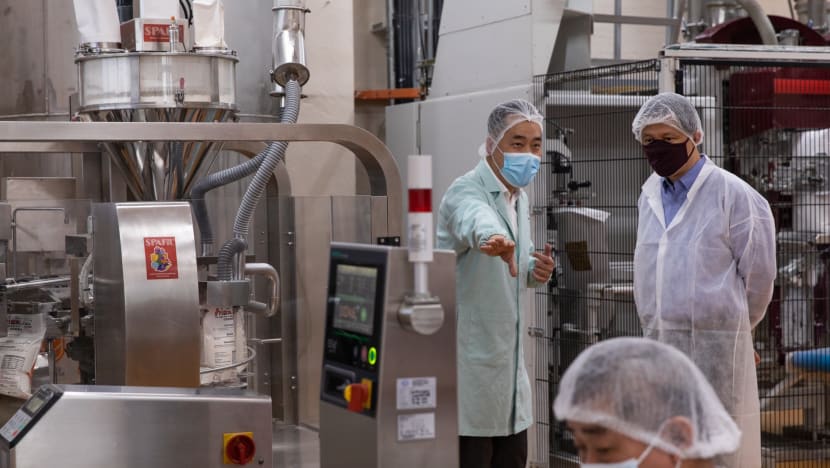
Prima Limited deputy plant manager Steve Ang and Minister for Trade and Industry Chan Chun Sing during a flour mill tour on June 5, 2020.
SINGAPORE — If more employers are "enlightened" and allow their employees to continue working from home, this would help more sectors of the economy to open up faster, Trade and Industry Minister Chan Chun Sing said on Friday (June 5).
“What we need Singaporeans to understand is that, the more our people work from home, the greater the scope for us to resume business for the rest of the other companies that have not started yet. We have to do this collectively and cannot be selfish,” said Mr Chan, who gave the example of retail shops as businesses that have yet to reopen.
Mr Chan, who was speaking to reporters on the sidelines of a visit to flour mill Prima Limited to observe their safe management measures, added that when employers send their workers back to work, they are also “cluttering up the transport system”.
He was responding to a question by reporters on employers who are forcing employees to return to work after circuit breaker measures were eased on June 2.
“If everybody is just thinking about it from their own perspective, then actually they are doing a disservice to the other people who are not able to restart their operations yet,” he said.
Despite the Ministry of Manpower (MOM) saying that working from home should be a default option for all companies — even those resuming operations after June 2 — a number of companies have still insisted on employees returning to work.
As of 5pm on Wednesday, the MOM said it had inspected over 200 workplaces islandwide following the easing of circuit breaker measures on Tuesday.
Three workplaces were forced to stop operations by MOM for failing to implement adequate safe management measures, including instructing employees to return to the office instead of allowing them to work from home.
A total of 14 composition fines were also issued to employers for breaching various safe management measures.
Mr Chan said that bosses with more “enlightened” practices will be able to attract better employees over time.
“In Singapore, notwithstanding the short-term problems, we generally have a tight labour market. So it is in the interest of the bosses to adopt more progressive work practices to attract fellow Singaporeans to work for them,” he said.
IN COMPANIES' INTEREST TO ADOPT SAFETY MEASURES: CHAN
When it comes to adopting safe management practices in the workplace, Mr Chan said that companies should not adapt to these changes just to “meet somebody else's rules and regulations”.
“Even if the government doesn't say anything, I think it's in the enlightened interest of the companies to make sure that they cohort their workers and they practise safe distancing in order for them to have the business continuity for themselves with the help of the workers,” he said.
“They know that the more they minimise the risk to their own workers, the better they are able to have business continuity. So it's for their own reasons. And this is also the philosophy we hope that our people will understand,” he said.
While he acknowledged that the cost of putting these measures in place can be high, Mr Chan said that companies will have a cost advantage if they are able to maintain business continuity.
“When they can provide a continuity of services to their overseas markets, for example, especially in times like this where many supply chains are disruptive, it becomes a cost advantage. Not a cost disadvantage. They will also be able to command a premium because people believe in the quality of their products,” he said.
FOOD PRICES CONTINUE TO FLUCTUATE
When asked about the price increase of food products and when Singaporeans can expect prices to return to normal, Mr Chan said people must expect that there will be some fluctuations or volatility of the prices, especially for this period but it has “nothing to do with what's happening in Singapore but the whole world”.
“I will say that we have been quite fortunate that the fluctuations have not been much more. And that's because we have been able to diversify early enough,” he added.
Mr Chan said that it is important for the Government to forecast disruptions in the regional supply chains “three to four months out” so that it can then order from alternative supply sources.
“So by the time those alternative supply sources come in at a time where you are a bit short on the traditional supply, then you can help to moderate the prices,” he said.




