







Amid debate about telemedicine, 4 more providers join MOH regulatory initiative
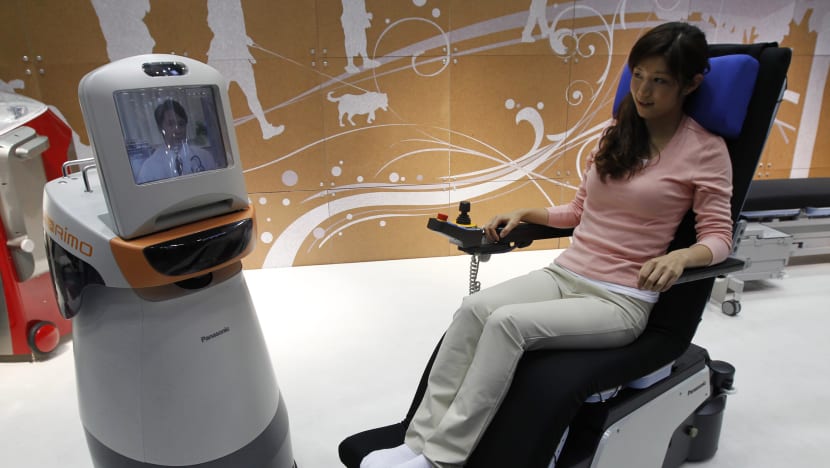
Tele-consultation in action: A demonstrator who is on an electronic wheelchair talks to a doctor, seen on the monitor of a robot. The robot tours wards and allows doctors to talk to patients "face to face".

SINGAPORE — Since May this year, elderly and immobile patients of Thye Hua Kwan Moral Society's Day Rehabilitation Centre no longer have to make troublesome trips to the doctor for minor conditions, injuries, and certification for physiotherapy, after the organisation's tie-up with telemedicine provider Doctor Anywhere.
With this partnership, Thye Hua Kwan's nurses are able to facilitate video consultations for patients with a doctor from the telemedicine firm.
Doctor Anywhere was one of four companies that became part of the Licensing Experimentation and Adaptation Programme (Leap) for telemedicine on Sept 7, after two companies — WhiteCoat and RingMD — joined in April.
The programme by the Ministry of Health (MOH) is a regulatory "sandbox" initiative that allows, for example, healthcare providers to introduce new healthcare models or evolve their models in a safe manner, and to partner MOH to come up with best practices for the new technology.





With virtual platforms offering health consultations and electronic medical certificates (MCs) are on the rise here, industry bodies had previously warned medical practitioners of its potential pitfalls, including the issuance of MCs by doctors after video consultations, and the accuracy of their diagnoses.
Leap will thus allow MOH to work with telemedicine and mobile medicine providers to "better understand their business models and work with them to develop appropriate regulations for telemedicine", under the future Healthcare Services Act. The other three companies that joined this month besides Doctor Anywhere are MaNaDr, MyDoc and Speedoc.
Telemedicine is the first service to come under Leap, and the MOH said that telemedicine "has the potential to enhance productivity and cost-effectiveness, and become an impactful enabler in Singapore's healthcare landscape".
"Our plan is to eventually regulate telemedicine as a licensed healthcare service after the successful completion of the regulatory sandbox," the ministry said in a press release.
For the staff members and patients of Thye Hua Kwan Moral Society's Day Rehabilitation Centre, being able to make use of technology for virtual consultations has helped to ease some of the inconveniences and problems they face.
Nurse Evangelista Dan Jaerald Francisco said: "We have some patients who need to be re-certified (for rehabilitation or physiotherapy), but they usually take quite some time to see an external doctor.
"We have to stop treatment in the interim until they are re-certified, which may result in the client's treatment plan being compromised."
Dr Kevin Kok, Doctor Anywhere's director of medical services, said that patients' caregivers or family members had to take leave from work and arrange for transport in order to get them certified, which he said "would usually take half a day and cost a bomb for the transport".
The hassle meant that many of these patients would default on their certification process, making them ineligible for rehabilitation.
Besides assessing the patient's health records through the National Electronic Health Record system, doctors can also get the healthcare records of their patients from Thye Hua Kwan nurses during the teleconsultation, to ensure that the diagnosis is accurate.
Staff members from Doctor Anywhere's operations and information technology teams also visit clients onsite to ensure that the Internet connectivity and equipment are properly set up, making sure that screen resolution is sharp enough during the teleconsultation, for instance.
In telemedicine cases where electronic MCs are issued, they are restricted to one or two days.
"We feel that if the severity of the symptoms warrants (an MC) more than one or two days, it might require an in-person review by the doctor directly, and generally, (our doctors) stick to this guideline," said Dr Kok.
Plans are afoot to expand Doctor Anywhere's telemedicine services to other social welfare providers in Singapore, including other facilities owned by Thye Hua Kwan Moral Society.
GOOD RECEPTION
Three other telemedicine and mobile medicine providers that were sandboxed on Sept 7 told TODAY that the reception towards the new healthcare model has been positive so far.
Speedoc, a mobile medicine platform for house calls, has treated 612 patients since it started operations in January this year. Its group of 27 doctors are a mix of full-time practitioners working for private clinics, as well as locums.
Ms Serene Cai, head of marketing and communications at Speedoc, said that the doctors are vetted and interviewed face-to-face before they are hired. Background checks are also conducted to access the professionalism of the doctors.
"We make sure that their records as doctors are clean and their certifications are valid," said Ms Cai.
For Singapore-based digital health firm MyDoc, the emphasis is not on the number of doctors on its platform, but their quality, said its chief marketing officer Melisa Teoh.
She said: "We have had bad experiences where we had to let go of some doctors who used to practise on our platforms, because of patient feedback.
"(Telemedicine) is a different experience from face-to-face consultations. Because of the way we train (our doctors), we are pretty strict about following our protocols, because it is important for patient safety."
Telemedicine and mobile medicine provider MaNaDr has more than 500 doctors on its platform in Singapore, and its founder, Dr Siaw Tung Yeng, told TODAY that only doctors of "good standing and repute" are invited to join them.
Using the MaNaDr mobile application, doctors can respond to telemedicine requests from their regular patients, or see new patients.
The company, which was officially launched in October last year and has close to a million patients, has also branched into other areas such as pharmaceutical and lab services.
WhiteCoat, one of the first two telemedicine providers that joined the MOH initiative in April, said that it has identified safety standards in relation to clinical processes, medication delivery, data protection policies, and other best practices.
Mr Bryan Koh, WhiteCoat's chief executive officer and co-founder, said that having "clear demarcations of safety, good governance, and best practices" under the new Healthcare Services Act would minimise the risks for patients, as well as weed out "rogue operators hindering the development of the nascent telemedicine landscape".
"With clear regulations in place, doctors licensed in Singapore, as well as patients, would also have more assurance to delve into the telemedicine space," said Mr Koh.




