







Analysts divided over merits of NCMP changes
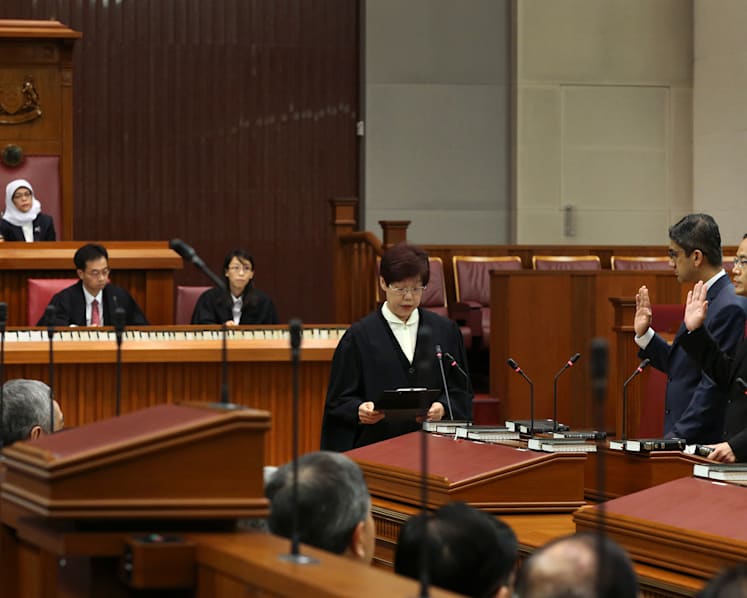
Mr Leon Perera and Mr Dennis Tan at the swearing in of Non-Constituency Members of Parliament. Photo: MCI




SINGAPORE — A day after changes to the Non-Consituency Member of Parliament (NCMP) scheme were announced, analysts remained split today (Jan 28) over whether they were a step forward for the political system.
The move to give NCMPs full voting rights is perhaps the most controversial, noted Institute of Policy Studies’ deputy research director Gillian Koh. Still, National University of Singapore political scientist Bilveer Singh called it a “win-win, progressive way of changing the political system without wrecking it”. “In a way, it is also a useful way to ensure the People’s Action Party’s (PAP) continued hegemony as the PAP seems to have drawn a red line on the ground, beyond which they do not want to see more opposition presence; roughly 10 per cent of the Parliament’s strength,” he said. But Opposition numbers in the House will ultimately be the choice of voters, and depend on factors such as the state of the ruling party and Opposition, national and local issues and the general regional and global climate, said Associate Professor Singh.
Singapore Management University law don Eugene Tan felt the move to be “wrong on the fundamental issue of democratic accountability”, as NCMPs have not earned the right to be given full voting rights but would be put on par with elected MPs. “While you may want to differentiate them from the Nominated MPs, I’m not so sure you have to give them full voting rights,” said Assoc Prof Tan. “I feel that more fundamentally we should always maintain that full suite of voting rights should be reserved for elected MPs.”
The higher number of Opposition members guaranteed in Parliament is assurance to voters that they can have their cake and eat it too, said Dr Koh. In a General Election like last year’s where the PAP won about 70 per cent of the vote, Singaporeans still want someone to question the government, added former PAP MP Inderjit Singh.
Dr Koh did not feel there would be room for opposition politicians to be complacent, although opportunists could possibly get into Parliament for airtime and have consequent impact on the quality of debate. “But each politician will have to calculate if his or her action is going to improve support for the causes represented and improve his or her political capital and standing,” she said.
NUS law professor Walter Woon said PAP should be given credit for the move. “This means that we are guaranteed 12 members of the opposition, no matter what. It isn’t unprecedented,” he said. In Germany, there is a mixed system of directly-elected candidates and those chosen from a party list. Minor parties (Free Democrats and Greens) win very few direct mandates, but have members in Parliament chosen from the party list in proportion to the party’s share of the votes, he said.
Instead of considering the NCMPs as second-class, Prof Woon said they should be seen as “a valued addition to parliament ensuring that the people who voted for the opposition still have representation”. “Otherwise, the 30 per cent or so who did not vote for the government will be denied a conduit for their concerns.”




