







New anti-scam portal to be launched; MHA calls out Meta for 'consistently pushing back' on efforts to tackle scams



SINGAPORE — A one-stop portal for all scam-related resources will be launched as the Government studies further measures to better protect unwitting members of the public, including those who refuse to believe that they are being duped.
Announcing the latest measures to combat scams on Thursday (Feb 29), Ms Sun Xueling, Minister of State for Home Affairs, said that the Government cannot fight the battle alone and would need to count on the cooperation of industry stakeholders.
This would include technology companies, which own digital channels and platforms that are being exploited by scammers.
Yet some of these companies such as Meta — which own Facebook and Instagram that are among the most exploited — are refusing to cooperate and have "consistently pushed back" against the recommendations of the Ministry of Home Affairs (MHA).





Noting that Facebook contributed close to half of e-commerce scam cases last year, Ms Sun said: “I urge Meta to step up and do right by your users.”
‘OLD-FASHIONED FRAUD’ DRIVING SCAM NUMBERS
Ms Sun’s announcement during a parliamentary debate on MHA's ministry’s budget came as scams continue to be a concern globally, including in Singapore.
In Australia, losses due to scams shot up 80 per cent in from 2021 to 2022.
In the United States, the losses jumped 72 per cent between 2021 and 2023.
Here, the number of scams and cybercrime cases soared by 49.6 per cent to 50,376 last year.
“The increase in scam numbers was largely driven by scams using social engineering and deception to manipulate victims into transferring monies,” Ms Sun said, noting that such cases account for 92 per cent of scam losses in 2023.
Examples included job scams, e-commerce or fake friend call scams, where victims believe in the offers promoted to them or were convinced that the person on the other end of the line is a friend.
“Such scams rely more on social engineering rather than technological sophistication. In fact, one could say this is old-fashioned fraud conducted through online means,” Ms Sun added.
Thus, public education continues to be a key pillar in the fight against scams, so that people may remain vigilant and discerning.
HELPING VICTIMS IN DENIAL
To tackle this problem, the Government plans to enhance public education efforts by setting up a one-stop portal that consolidates anti-scam resources to make such information more easily accessible.
Set to be launched later this year, the site will advise people on what to do if they think they have been cheated, how to protect themselves from getting tricked in the first place and to be alert to the latest types of scams that emerge.
“It will also provide information for victims of scams on where to seek support,” Ms Sun said.
As for the segment of people who refuse to believe that they have fallen prey to a scam, Ms Sun said: “They could be victims of love scams or investment scams where they have invested affection or significant amounts of money, making it difficult for them to extract themselves from the situation.”
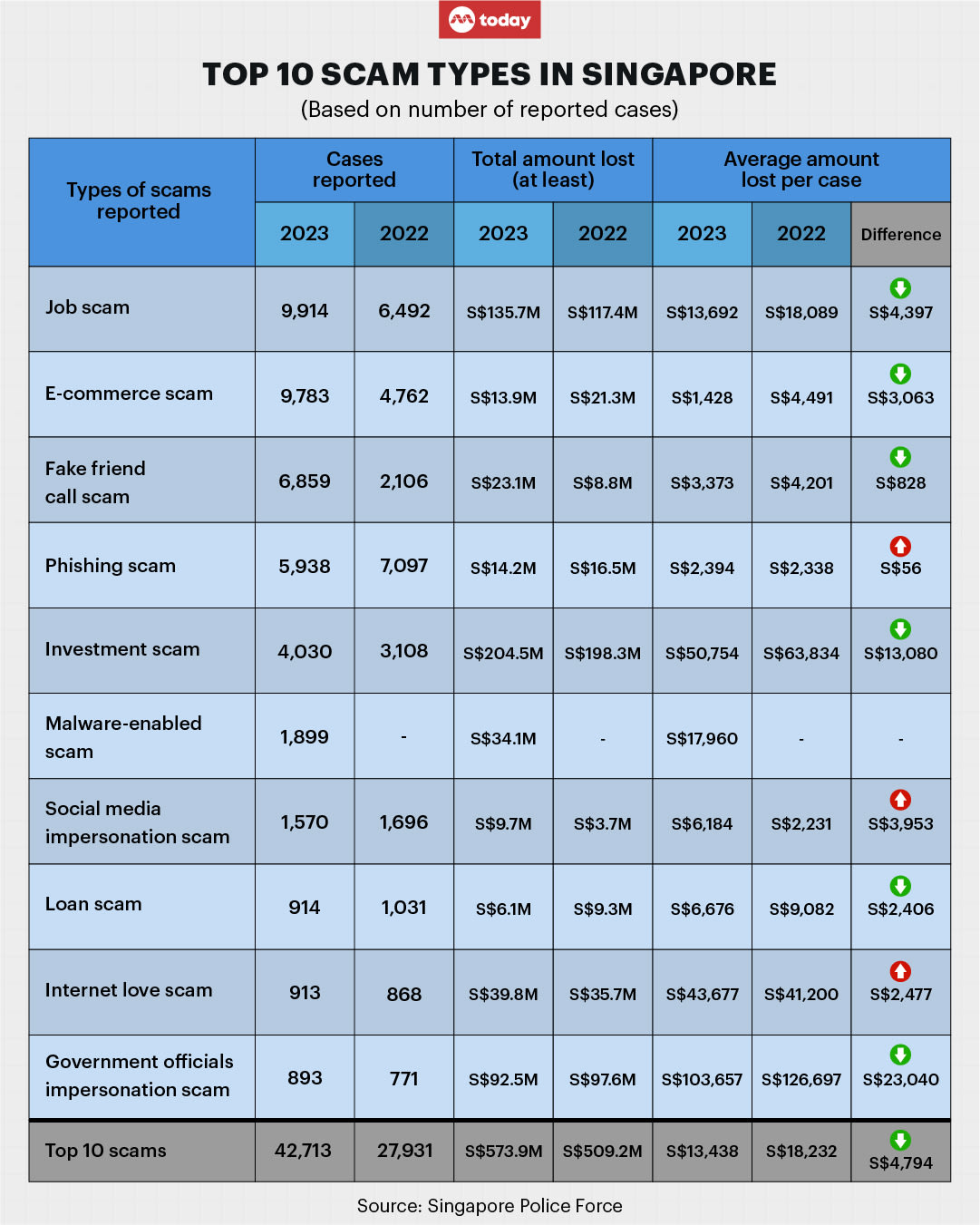
Job scams (9,900 cases), investment scams (4,000) and internet love scams (900) are among the top 10 scams in 2023, out of almost 43,000 scams.
UNCOOPERATIVE ONLINE PLATFORM
Ms Sun noted that measures to block scam calls and SMSes have been implemented, but scammers have instead turned to social media and messaging platforms to target victims.
Some platforms have worked well with the authorities to better protect users.
“Some like Shopee and Carousell have been willing, and are working closely with MHA and the Police, such as by strengthening their user verification processes,” said Ms Sun.
For Shopee, it saw a 71 per cent drop in e-commerce scams on its platform between 2021 and 2023.
However, not all platforms are playing ball.
“For instance, Meta has consistently pushed back against MHA’s recommendations for them to put in place safeguards to combat e-commerce scams on Facebook, such as verifying users against Government-issued ID and offering a secured payment option for Marketplace users,” said Ms Sun.
This is despite the fact that its platforms, namely Facebook, WhatsApp and Instagram, were among the top few exploited by scammers, accounting for almost half of the cases in 2023 and about 43 per cent of total losses that year.
Ms Sun said that the Online Criminal Harms Act will give the police legal powers to issue directions to online platforms to prevent scam accounts and content from reaching Singapore users. The law was passed last July and took effect this month.
Other steps have been taken to combat scams.
These include enhancements to ScamShield to improve its accuracy and make it easier for users to report scams.
MHA also intends to introduce offences that deter the misuse of SIM cards in Singapore for scams and other criminal activities.
Criminals have adapted their methods to bypass the blocking of overseas calls by using Singapore SIM cards, Ms Sun said.
The police and Infocomm Media Development Authority earlier this month announced that from April 15, a limit of 10 post-paid SIM cards a person will be imposed on subscribers of telecommunications companies.
This is after they have observed signs indicating that post-paid SIM cards predominantly bought by residents here are increasingly being misused for scams.




