





Singapore to host new ASEAN office to exchange jobs data, better track labour market shifts
AI-related changes, platform work and green jobs are some key areas the ASEAN Labour Statistics Office will study.

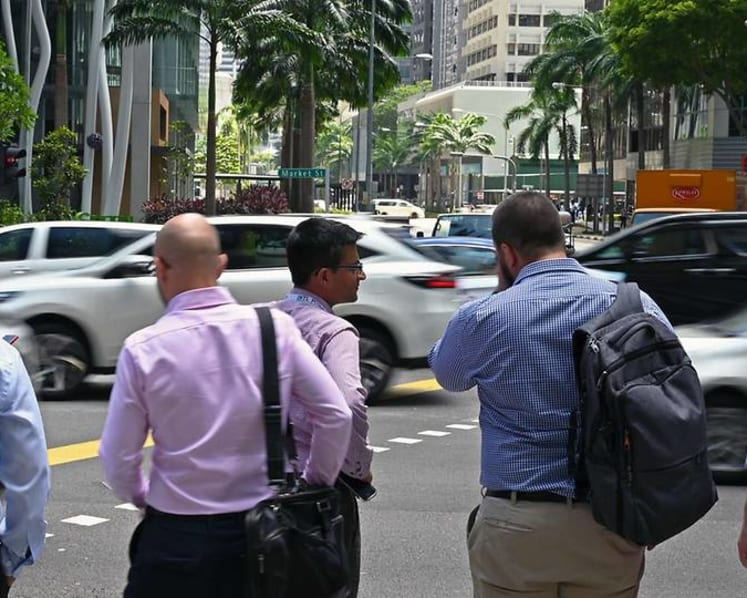
Office workers walk out from the OCBC Tower in the Central Business District, Oct 19, 2026. (Photo: CNA/Wallace Woon)

This audio is generated by an AI tool.


SINGAPORE: Singapore will host a new office for labour statistics collaboration under the Association of Southeast Asian Nations (ASEAN), in a bid to strengthen regional exchanges of jobs and skills data.
The Ministry of Manpower (MOM) announced the ASEAN Labour Statistics Office on Tuesday (Oct 27) as it launched the ASEAN Labour Statisticians Network.
The partnership, proposed by Singapore, will allow ASEAN member states to develop ways to identify labour market shifts earlier and respond more effectively, said Mr Stanley Loh, permanent secretary for manpower.
“The world of work is changing quickly, and we need better ways to understand what those changes mean for employment, skills and workers. No country can build that understanding alone,” he said.





The network will support ASEAN member states to better anticipate the labour market impact of artificial intelligence (AI), the green transition, and digital and platform work, said MOM.
Singapore, which is preparing to take on the ASEAN chairmanship in 2027, will serve as the network's convenor until 2030.
The ASEAN Labour Statistics Office in Singapore will coordinate programmes and advance work agreed on by ASEAN member states.
It will be accompanied by the launch of an ASEAN Labour Market Knowledge Portal where member states can share research, methodologies and experiences to support evidence-based policymaking.
Mr San Lwin, deputy secretary-general for the ASEAN Socio-Cultural Community, said these efforts would contribute to more resilient labour markets, more competitive businesses, and better outcomes for workers across the region.
AI AND PLATFORM WORK
Speaking at the network’s inaugural expert forum, Mr Loh noted that Singapore’s studies of platform work informed the development of stronger protections in the Platform Workers Act.
He said MOM is now applying the same focus to study AI and what the technology means for jobs.
MOM highlighted AI and platform work as areas where the ASEAN Labour Statisticians Network can help countries to better understand how work is changing and support workers.
“As AI changes everyday tasks, workers may need new skills and employers may need to redesign jobs,” said the ministry.
“The growth of platform work, such as delivery and private-hire driving, also means traditional employment statistics may not fully capture how some people earn a living or the challenges they face.”
Some data-based projects are already being incubated under the network.
One project analyses online job listings to identify emerging roles, such as AI governance analysts and agentic AI engineers, that may not yet appear in existing occupational classifications.
This can help countries more quickly identify new areas where there is labour demand and new skills that employers seek, said MOM.
Another project is an “AI exposure index” that looks at how AI is changing the way tasks are performed in different jobs.

GREEN JOBS
MOM also highlighted the green transition as an area where the network can improve understanding of workforce shifts.
An ASEAN Green Jobs Report launched on Tuesday provided insights into the supply and demand of green jobs, to inform how workers can be supported to take up these opportunities.
The report found that “green potential” – jobs with tasks that can be done in an environmentally sustainable fashion with the right training and equipment – reaches 22.3 per cent of total employment across ASEAN.
But less than 6 per cent of this is currently realised as “green employment”. The report recommended that “green potential” be used to guide workforce and skills planning.
The report also cited a 2023 study that estimated the number of renewable energy sector jobs in Singapore by 2050 to be between 5,400 and 127,300, depending on different policy scenarios.
Yet, the report said that structural issues in the region remain, particularly in skills mismatches, the transition out of fossil fuels, the male-dominated nature of the renewable energy sector and job quality in the bio-energy sector.
Governments should consider workforce planning measures to support renewable energy development, the report recommended.