







To avoid being caught in superpower rivalry, Asean will stay true to its principles: Dr Balakrishnan
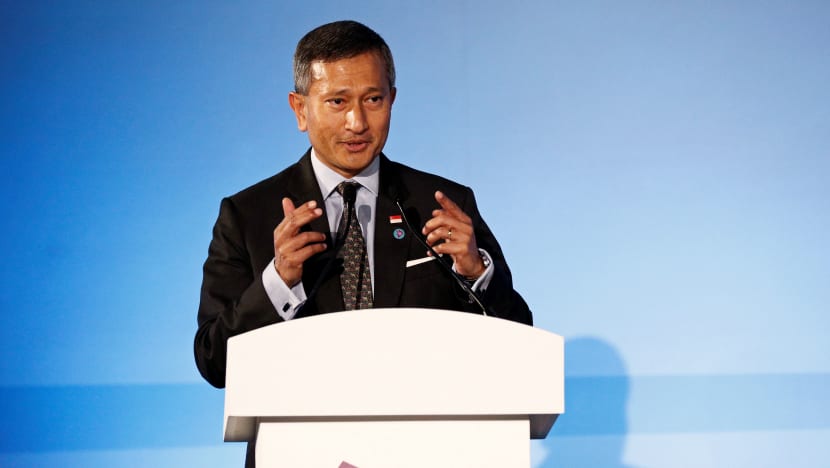
Singapore's Foreign Minister Vivian Balakrishnan reiterated that Asean believes in free trade and welcomes investments from all parties. It also believes in interdependence, and integration.


SINGAPORE — As global superpowers train their sights on the region, the Association of South-east Asian Nations (Asean) member states will remain united and maintain its "centrality" principle, so as to not to be entangled in exchanges between larger nations, said Foreign Affairs Minister Vivian Balakrishnan on Saturday (Aug 4).
Speaking at a press conference to wrap up the 51st Asean Foreign Ministers’ Meeting and related meetings, Dr Balakrishnan was responding to a reporter's question on whether the regional grouping was at risk of becoming an arena for big power rivalry to play out.
Addressing the reporter, he said: “What you are really alluding to is the question of whether there will be a resumption of the old Cold War, and whether we will end up being proxy states… in the diplomatic, strategic and defence entanglements of the superpowers.”
“And our answer is we have no intention of allowing that to happen… Hence we will be united, we will be relevant, we will maintain centrality and we will continue to convene these regional and extra-regional platforms,” he added.





Dr Balakrishnan reiterated that Asean believes in free trade and welcomes investments from all parties. It also believes in interdependence, and integration, he added.
Earlier on Saturday, the United States announced a US$300 million (S$409 million) fund for security cooperation in the region — less than a week after it pledged to invest US$113 million in new technology, energy and infrastructure initiatives in the region.
On the same day, China, which has been pumping billions of dollars in investments into the region, also said that its military buildup in the South China Sea was in response to the security pressure posed by external powers.
“Rather than looking at this as a competitive situation where we all just become proxies, our concept of being united, being central, open and inclusive, and welcoming investments and trade with all parties in fact is precisely the right response,” Dr Balakrishnan said.
This was “communicated unequivocally” to all Asean's external partners, and they appreciated its position, he added.
Dr Balakrishnan was also asked about Singapore’s experience dealing with the escalating trade war between China and the US. In response, he said Singapore has, in its usual way, “courteously but directly expressed our position”.
“We don’t control their agenda or their decisions, but for what it is worth, we have conveyed our concerns,” he added.
NO CYBER SECURITY DEAL WITH RUSSIA
Responding to a journalist's question, Dr Balakrishnan also dismissed reports of a cyber security agreement between Asean and Russia.
The draft of a communique, seen by Reuters before the meetings started on Thursday, touched on strengthening cooperation with Russia on this front. However, the wording was dropped in the final communique issued on Thursday evening.
Asked about the proposed agreement, Dr Balakrishnan said: “We didn’t get down to settling it."
He added: “We are not looking for exclusive agreements with any one country or any region. We are looking at building, expanding that reservoir of knowledge and skills, exchanging and enhancing capabilities."
Cyber security was one of the major issues discussed within Asean and with their external partners, said Dr Balakrishnan, who reiterated that it is an example of a transboundary issue that no one country can solve.
Summing up the meetings which took place over the past week, Dr Balakrishnan said it has been the "smoothest, least contentious and most constructive" so far.
There were frank and open discussions during the meetings, where the superpowers shared their views without pulling any punches, he added.
A defining project was the Asean Smart Cities Network, which he expects to see more private sector and foreign partners involved over time.
Given the present global circumstances – an emerging multi-polar world, the pushback against free trade and an ongoing digital revolution – Asean members have acknowledged that they need to double down on the multilateral trading system. To that end, there are also plans to redouble efforts to settle the Regional Comprehensive Economic Partnership by the end of the year, he said.
Dr Balakrishnan cited the working text for a code of conduct in the South China Sea as a “significant milestone”. It builds confidence that the continuing engagement will lower tension, and encourage all claimant states to seek a solution, he said.
The meetings also covered issues surrounding the Korean Peninsula. Noting the the North Korea-US summit in Singapore held in June had helped change the tone of the conversation, Dr Balakrishnan said he hoped that it will set the stage for the peaceful resolution of the outstanding issues.
“We will have to wait, (be) supportive in every way that we can, whilst at the same time complying with our international commitments to fulfil all the resolutions of the UN Security Council,” he added.




