







Bones cut and pulled apart, in the quest to be taller
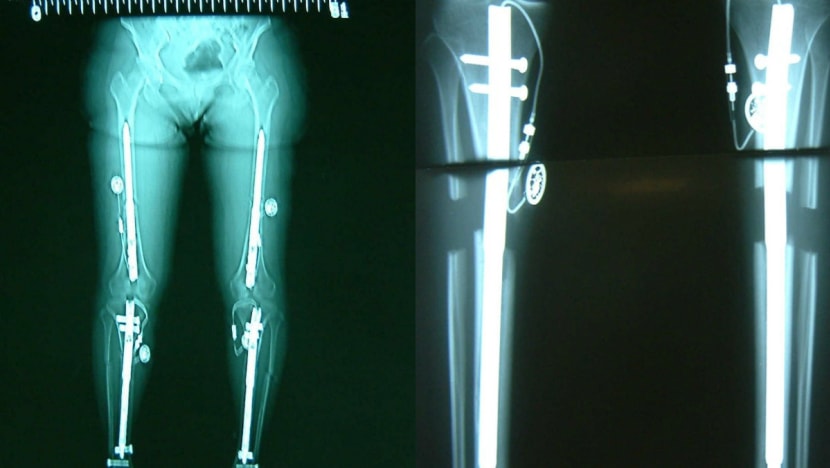
(Left) An X-ray of femur and tibia lengthening using internal lengthening rods and (right) an X-ray of tibia (shin bone) extension using an internal lengthening rod.
SINGAPORE — When basketball, hanging upside down daily and growth tonics from dodgy online stores did not help Kevin Tan (not his real name) become taller, he turned to a controversial surgery that boosted his height from 150cm to 162cm.
The limb-lengthening procedure, which took place at intervals over two years in his mid-20s, involved cutting the bones in his legs and gradually pulling them apart – 1mm each day – through a motorised rod implanted in the bone.
“I researched the surgery for years, from the time I stopped growing to the time I decided to go ahead with it. I felt that if I did not do the surgery, I might regret when I’m older,” said Mr Tan, now 34.
The Web designer spent the first few weeks post-surgery in a wheelchair and used crutches over one-and-a-half years before he regained full mobility. He took painkillers to cope with the post-surgery pain and underwent physiotherapy.





Mr Tan, who paid about S$50,000 for the procedure, does not consider his experience “a big deal”.
“It was inconvenient but not as painful and scary as most people think it is, especially if you know exactly what’s going on. Most of my discomfort during the recovery period came from the muscles and nerves having to adapt to the increased height – like really bad muscle aches after a particularly hard workout,” he said.
Mr Tan is among a small group of individuals here who have undergone limb-lengthening surgery in a bid to become taller.
Public hospitals here generally do not perform the procedure on individuals without functional difficulties arising from their short stature; private doctors take on cases after careful assessment of potential candidates.
Dr Sarbjit Singh, a senior consultant orthopaedic surgeon from Mount Elizabeth Hospital, has observed a 20 per cent increase in both local and overseas patients undergoing limb extension surgery at his practice in the past decade.
Three in four cases are for constitutional short stature and dwarfism while the rest are due to post-accident trauma.
Limb-lengthening surgery was originally used for medical indications such as congenital deformity, bone defects from polio and trauma to the lower limbs, but there have been reports of it being used for height gain since the late 1990s, said Dr Singh, who operated on Mr Tan.
Dr S S Sathappan, a specialist in orthopaedic surgery at Farrer Park Hospital, receives about one to two enquiries on limb-lengthening surgery per month from post-trauma patients experiencing loss of limb length as well as those with genetic or hormonal short stature. He performs two to three of such surgeries per year for post-trauma cases.
Dr Singh’s patients tend to be males below 165cm and females below 155cm, who are aged between 18 and 25. Men make up 70 per cent of his patients undergoing limb-lengthening and seem to be more bothered by their short stature, he said.
“Most are young individuals whom I find to be highly intelligent but are psychologically disturbed by their short stature, to the extent that it affects their social life and, sometimes, career. Most patients request height gain of between 5 and 8cm although some request for more,” said Dr Singh, whose oldest patient was a 54-year-old man.
INTERNAL RODS NOW USED
Newer methods using internal lengthening rods, devices that are implanted into the bone, have made the procedure “more comfortable and safer” than older methods using an external fixator, said Dr Singh.
For example, the Precice intramedullary limb-lengthening system, which uses a magnetic extension nail with a portable hand-held external remote controller, allows for precise control and has the ability to reverse the lengthening if necessary, he said.
With the older methods, an external scaffold is fitted into the patient’s leg using pins that are pierced through the skin, muscles and bones for a duration of about six to 12 months. This can cause significant pain and limitation of joint motion, and complications like pin-site infection are common, said Dr Singh.
A newer version of the magnetic extension nail that allows for early full weight bearing using crutches after surgery will soon be available, and research into a made-in-Singapore internal limb-lengthening rod is in progress, said Dr Singh, who was the first surgeon in Asia to carry out the procedure using internal lengthening rods.
While the techniques may differ, the principle for limb lengthening is the same: Bone is cut and gradually pulled apart at 1mm per day for new bone, nerves, vessels and muscles to form.
IT SHOULD TREAT A FUNCTIONAL PROBLEM, SAY PUBLIC HOSPITALS
Several public hospitals here including Changi General Hospital (CGH), Tan Tock Seng Hospital, Khoo Teck Puat Hospital and National University Hospital (NUH) told TODAY that they do not offer the surgery for purely cosmetic reasons.
“Although (the newer) devices may have advantage of being internalised, they come (with) increased costs and a different set of complications. My opinion on limb-lengthening surgery is that it should be used to treat a functional problem,” said Adjunct Assistant Professor Andy Yeo, a consultant in orthopaedic surgery at CGH, which uses limb-lengthening surgery as one of the limb salvage techniques, usually for patients who have sustained severe injury to the limbs from accidents.
The NUH offers limb-lengthening for patients with very short stature, dwarfism or significant limb-length discrepancy which affects walking.
Occasionally, patients with normal stature may enquire about limb-lengthening, said Dr Andrew Lim, consultant at NUH’s department of orthopaedic surgery.
“We tend to discourage this as there can be complications associated with the procedure, such as infection, fracture of bone and deformities of the joint,” said Dr Lim.
Based on data from the Health Promotion Board’s Anthropometric Study on School Children in Singapore, 2002, the range in height from the 3rd to 97th percentile for males at the age of 18 is about 159cm to 185cm. For females, it is about 148cm to 170cm.
Although rarer, severe complications may even result in the loss of the limb, said Adj Asst Prof Yeo.
For patients with very short stature, the benefits of a functional gain in height and appearance, such as the ability to reach for objects and longer stride length when walking, outweigh the risks involved in the procedure, said Dr Lim.
“But if a person with short stature has no functional difficulties, embarking on the surgery with its risks and possible complications would not be wise... There are also non-surgical options such as orthotics, which may solve the problem for the patient without putting him or her through unnecessary risks,” said Adj Asst Prof Yeo.
Growth hormones may also be able to improve height but they are useful only before the patient’s growth spurt ends, said Dr Ng Siew Weng, consultant plastic surgeon at Farrer Park Hospital.
For safety reasons, doctors generally do not extend beyond 25 per cent of the bone’s original length to avoid complications, said Dr Singh.
The recommended safe lengthening limits are 6cm for the shin bones, and 7cm to 8 cm for the thigh bones, he said.
The surgery cannot be done on children who are still growing, or osteoporotic patients, he added.
Patients who request for the surgery due to constitutional short stature are routinely referred to a psychiatrist for an assessment prior to surgery, said Dr Singh.
In addition to a well-trained surgeon and good post-surgery care, pre-surgery assessment and detailed discussion are important as the procedure involves significant time (about nine to 12 months) and cost (around S$65,000 to S$85,000), he said.
“Patients also need determination as it involves a certain amount of psychological stress of having to use the wheelchair, crutches, and work and studies may be temporarily affected. Some patients are declined if they are unable to understand the psychological stress during the recovery process or have poor family support,” said Dr Singh.
Dr Low Bee Lee, a psychiatrist at Mount Elizabeth Novena Hospital who has evaluated fewer than 10 of such patients, looks out for several things when assessing surgery candidates. These include diagnosable psychiatric disorders such as body dysmorphic disorder and psychotic conditions, issues that may affect their ability to give informed consent and the risks of psychological issues during post-op recovery and rehabilitation.
“Unsuitable patients are those who are overtly psychotic or depressed, which may affect their decision-making process... and those who may harbour highly unrealistic expectations which they might not have told the surgeon. Thus far, I have not found any unsuitable,” said Dr Low.
Although Mr Tan is “happier” after gaining 12 cm in height, he still wishes he could be taller.
“My only regret is not being able to gain even more height as my doctor advised against it. If I could reach 180cm, that would be even better. Who doesn’t wish to be taller and more handsome?” he said with a laugh.




