







Changes to Elected Presidency scheme: Call to tighten selection of advisers too
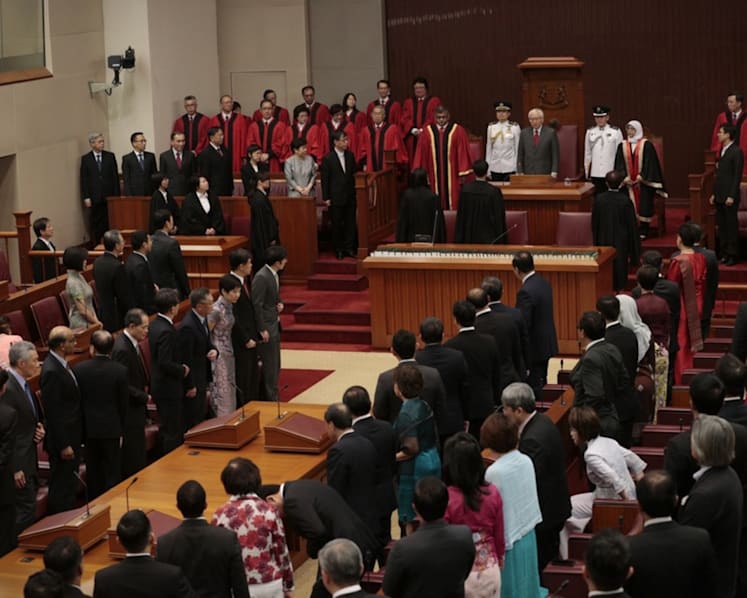
Members of Parliament rise as President Tony Tan enters at the Opening of the 13th Parliament of Singapore on Jan 15, 2016. Photo: Jason Quah


SINGAPORE — Constitutional law experts weighed in on the proposed changes to the Elected Presidency scheme yesterday, saying there is a need to spell out clearly how the tightened criteria for prospective candidates is determined.
They also suggested beefing up the selection process for the Council of Presidential Advisers (CPA), whose say will be given more weight under proposed changes announced by Prime Minister Lee Hsien Loong on Wednesday.
On the review to ensure that the Republic will have a President from a minority race, periodically, experts agree it bears out the longstanding emphasis on multiracialism, but cautioned it will have to be finely balanced to prevent it from devolving into an “affirmative action” type of move that could erode the authority of the office and, worse, set back the purely meritocratic ideals that have served Singapore well this far.
Noting, for example, that one of the current requirements is that a prospective candidate must have led a company with a paid-up capital of at least S$100 million, the experts said the thinking behind the benchmark figure was not expressly set out when Parliament deliberated on the scheme in the late 1980s.





“Presumably, it was thought at the time that the chairman or chief executive of a company with at least this paid-up capital would possess the financial nous for the office of the President,” said Assistant Professor Jack Lee, from the Singapore Management University (SMU) School of Law.
If the sum is raised by the Constitutional Commission, they said, there needs to be clarity about how the number was derived. Too high a bar will limit the pool of eligible candidates and, in terms of absolute numbers, make it harder for members of minority communities to qualify, said Asst Prof Lee.
Given the intent to give the CPA’s advice to the President more weight, the process of selecting members sitting on it should also be relooked and made more transparent, said the experts.
The current qualifying criteria is “very basic”, said SMU law don Eugene Tan. “I think there is certainly a case to significantly enhance it. They could be pegged to, or perhaps made as demanding as that of the elected president,” he said.
Strengthening the CPA’s powers may diminish the President’s role and discretion, said National University of Singapore (NUS) adjunct law professor Dr Kevin Tan, adding that it “defeats the purpose of having a highly-qualified President”.
He suggested tightening the qualifying criteria for prospective CPA members, so that the President can return to its symbolic and non-executive role. “Then we make the President more accountable to the CPA, we don’t worry about his or her qualifications.”
Echoing these views in Parliament yesterday, Member of Parliament for Marine Parade GRC Edwin Tong suggested enhancing the CPA with experts across diverse fields, including civil society. To ensure transparency and accountability, the council should also be required to outline the grounds on which they give their advice, he added.
While acknowledging that the Republic’s multiracial fabric should be reflected in the nation’s institutions of governance, the experts cautioned that this must not come at the expense of compromising the authority wielded, or competence of the office.
If the electorate has to choose from a slate of minority candidates by design, resentment could surface, said former Attorney-General Walter Woon, now teaching at NUS. “The President has to represent Singapore. His mandate comes from the people, not just his own community ... A minority candidate may have to work a little harder, but we have to trust the electorate,” he said.
An election is necessarily competitive, said Dr Tan, who questioned how the President can be elected based on both merits and race.
“If you are lucky and you see an alignment of the stars, the best man for the job is also an ethnic minority ... but that is not institutionally manageable, nor is it possible to engineer,” he said.




