







Changes to national inter-school games unveiled for primary school students
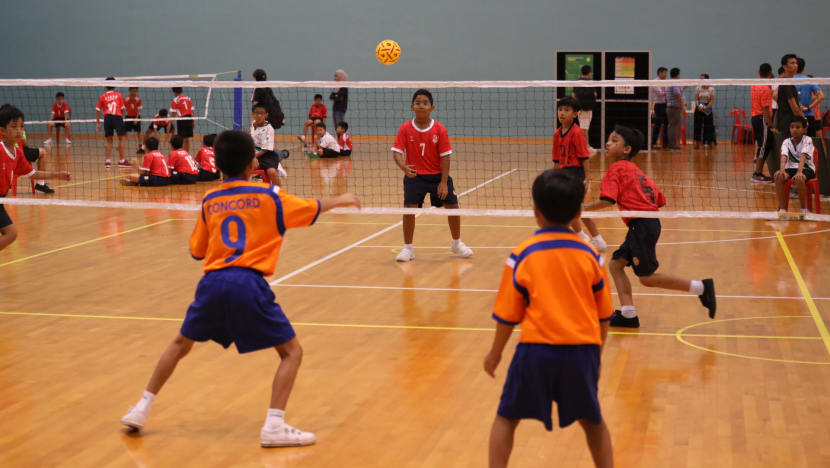
As part of the changes to the national inter-school games, some sports such as sepak takraw and basketball will see adjustments made to the number of players.
SINGAPORE — During basketball matches and training, Lianhua Primary School student Ang Robert Lee would “only sometimes” be passed the ball.
The 11-year-old, who has been playing the sport for the past two years, said that this was because he was perceived to be “not as good” when compared with his team-mates.
With a suite of enhancements that the Ministry of Education (MOE) announced on Wednesday (Jan 23), student athletes in Primary 3 to 5, such as Robert, will get more opportunities to play and gain game experience.
Wednesday’s announcement came on the back of last year’s completion of the National School Games’ Junior Division Review, which covers inter-school competitions for students in Primary 3 to 5.





As part of the changes, some games such as sepak takraw and basketball will see adjustments made to the number of players. For instance, basketball will now be played in a three-on-three format, instead of a five-on-five format.
“It is easier to understand now,” Robert said of the new changes. “(Previously) when we attacked, I didn't know where to run. When we defended I didn't know who to guard. In (three-on-three), for example, when you defend, it is just following a player.”
THE CHANGES IN A NUTSHELL
1. Award and recognition systems
Position-based systems will be expanded, from the current top four positions to top eight positions, and will be calibrated according to the number of participants.
Criterion-based systems will be introduced for relevant sports. Examples include: Timing-based recognition for track-and-field, as well as number of pin-falls for tenpin bowling.
Why is it important? It will reduce the emphasis on comparing oneself with others, and shift the focus to self-improvement, the MOE said.
2. Competition formats
Current elimination model for match-based sports will be changed to a tiered format.
All teams will play in a classification round, where they are sorted according to their level of ability before progressing to a tiered competition, where they play other teams of similar ability.
All teams will play at least six to 10 matches, nearly double the number played presently.
Why is it important? The increase in the number of matches played can help hone students’ skills in their respective sports.
3. Age-group divisions
Depending on the sport, student athletes aged 11 can either play in senior or junior divisions. Right now, students compete in age-group divisions based on their chronological age.
Why is it important? Chronological age is only a crude indicator of readiness to play a sport, given the difference in growth rates of children, the MOE said. The change will allow students to compete safely and according to their level of readiness.
4. Game formats
Changes will be made to the technicalities of certain sports.
PLAYER NUMBERS: Some games such as sepak takraw and basketball will see adjustments made to the number of players. For instance, basketball will now be played three-on-three, instead of the earlier five-on-five format.
PLAY AREA: Modifications will be made to the playing area for certain sports. For example, floorball courts will be halved in size, with two goalposts for each side. This is to allow players to use the maximum width of the court to play.
GAME FORMAT: Students will be encouraged to play different positions. For example, in volleyball, fewer players will allow for each player to practise receiving, setting and spiking.
SUBSTITUTION: Most, if not all, substitutes are to be fielded for matches. This will offer more opportunities for play.
5. Equipment
“Developmentally appropriate” equipment will be used in some sports. For example, in tennis, balls with less speed and bounce will be used for younger players.
Why is it important? This will help younger players to develop proper technique.
WHAT THEY SAID
Mr Chee Hong Tat, Senior Minister of State for Education, speaking at the opening ceremony of the National School Games, said: “These enhancements will enable our young athletes to enjoy their sporting experiences, have more opportunities to participate in competitions, and develop character and values through sports.”
On whether or not the changes will reduce competitiveness among students, Mrs Tan Chen Kee, director of MOE’s student development curriculum division, said: “We want to strike that delicate balance because, on the one hand, the change in the competition structure will provide more playing opportunities, but on the other hand, we provide more recognition and award structures so that they are able to taste a bit more success.”
She added: “(The review and changes are) consistent with the direction towards which MOE is heading. We really wanted to strengthen the idea of holistic education, and to promote the platform of sports as an opportunity for them to develop a lot of the soft skills, a lot of the character that’s consistent with what we want to do.”
How Track and Field will be run for the D Division (nine- to 10-year-olds)
HOW IT USED TO BE |
WHAT IT IS NOW |
Up to nine different specialised technical events, such as the 100m, 300m runs |
A single multi-skill event that comprises a 12m sprint, hurdle jump and beanbag throw |
Awards presented based on position attained in competition |
Awards presented based on set criteria. Points will be awarded based on the timing of the run and the distance of the beanbag throws |




