







China, Singapore ink deals to start talks on upgrading FTA, kickstart Chongqing bilateral project
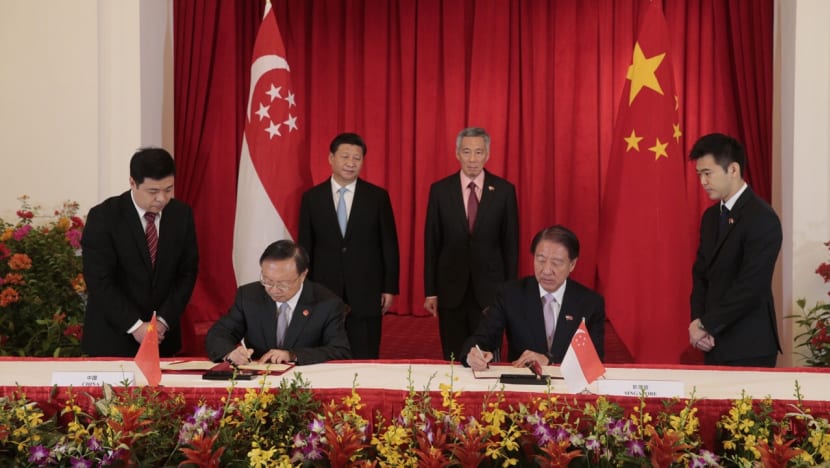
Photo: Jason Quah
SINGAPORE — China and Singapore signed a raft of agreements today (Nov 7) to further expand bilateral economic, social governance and educational ties, as part of Chinese President Xi Jinping’s first state visit to Singapore.
Key among the documents signed today (Nov 7) were agreements laying out the framework for the third Government-to-Government (G-to-G) project — also known as the Development of the China-Singapore (Chongqing) Demonstration Initiative on Strategic Connectivity.
The project in the southwestern city of Chongqing would be in line with Mr Xi’s vision to make the project “‘a priority demonstration’ project for China’s One Belt, One Road initiative”, said Deputy Prime Minister Teo Chee Hean in his introductory remarks before a speech by Mr Xi at the National University of Singapore earlier today (Nov 7).
Mr Teo represented Singapore while Chinese State Councillor Yang Jiechi represented China in the signing at the Istana, which took place after a meeting between Mr Xi and Prime Minister Lee Hsien Loong.





China’s One Belt, One Road initiative is aimed at rejuvenating two ancient trade routes and knitting Eurasia into a single vast market.
According to a 2014 article in The Economist magazine, goods can be delivered from Chongqing in south-west China to Germany via an overland route in only 14 days. In comparison, it takes 60 days to transport the goods from Chongqing to a Chinese coastal port, where they are then shipped to Europe.
First proposed by China in 2013, the third G-to-G project will focus on “strategic connectivity”, and in particular, four sectors of collaboration – financial, aviation, logistics, and ICT.
This follows the existing G-to-G projects of Suzhou Industrial Park set up in 1994, and Tianjin Eco City in 2008.
“The third G-to-G project reflects our mutual commitment to take bilateral relations to a higher level. We will explore innovative measures and policy breakthroughs to catalyse the development of Western China,” said Minister in the Prime Minister’s Office Chan Chun Sing.
“Given Western China’s strong potential for development in modern connectivity and modern services, this is an opportunity for Singapore companies to share their expertise and expand their presence in China.”
Today’s (Nov 7) signing ceremony, which was witnessed by Mr Lee and Mr Xi, also saw an agreement to launch negotiations on the upgrade of the China-Singapore Free Trade Agreement (CSFTA) signed in 2009 and to conclude the negotiations by 2016.
“The upgraded CSFTA will provide our businesses with enhanced trade facilitation and greater investment protection in China, as well as address investment barriers. Both sides will also explore greater cooperation in areas such as legal services and financial services,” said the Ministry of Trade and Industry in a press statement, which added that the trade pact will also be enhanced with new generation elements such as E-commerce and environment.
“A forwardlooking, substantive and comprehensive upgrade of the CSFTA will enhance
support for on-going and future collaborations between Singapore and China,” said Minister for Trade and Industry (Trade) Lim Hng Kiang.
MTI said the launch of the CSFTA upgrade negotiations and the third G-to-G project in Western China signal the strong commitment by both countries to strengthen bilateral economic relations.
“These milestone collaborations will serve to break new ground and chart the direction of our relations in the years ahead,” the Ministry added.
Beyond economic ties, Beijing and Singapore also took steps today (Nov 7) to further their collaboration in the areas of customs clearance for goods, social governance and education.
On customs, both countries agreed to mutually recognise companies under each other’s Authorised Economic Operator (AEO) programme as being of lower security risk, and hence, goods exported to or imported from such companies will enjoy a higher level of facilitation during customs clearance in Singapore and China.
In the area of social governance, the Ministry of National Development signed a Memorandum of Understanding (MOU) with China’s National Development and Reform Commission (NDRC) to facilitate knowledge-sharing between both countries in the fields of urban and social governance, sustainability and liveability. In addition, both sides will collaborate on capability development and advisory programmes to suit China’s policy and development needs.
At the same time, the Ministry of Education also signed an MOU with China to allow for the attachment of 15 senior educators from each country to technical and vocational institutions in the other country. Under the MOU, 30 Singaporean Chinese Language teachers each year will have an overseas study-cum-immersion programme in China. Additionally, the National Institute of Education will also provide professional development through the Master of Arts (Applied Linguistics) programme to 20 English Language teachers from China.




