







PARF cuts may have spooked luxury car buyers, dragging down high-end COE premiums: Analysts
Analysts say the Budget's rebate changes had little overall impact on this round of bidding, but buyers of more expensive cars felt the pinch first.

This audio is generated by an AI tool.


SINGAPORE: Certificate of Entitlement (COE) prices on Friday (Feb 20) were largely unmoved by the sweeping cuts to car scrapping rebates announced in Budget 2026, with one notable exception - luxury car buyers.
Mr Ng Lee Kwang, director at Octagon Motors Group, said he heard that some buyers had already cancelled orders ahead of the exercise. "Especially those who are buying (BMW) 7 series, (Toyota) Vellfires," he said.
For most other buyers, however, it was simply too late to react.
Many buyers would have already committed to orders and paid deposits before Prime Minister Lawrence Wong announced the changes during his Budget 2026 speech on Feb 12, leaving little room to walk away.





The standard practice in Singapore is for buyers to sign a sales contract with a substantial deposit before a dealer bids for COEs over the next few auctions. Most of those contracts were already in place before the Budget announcement
"Forfeiting a deposit may not make financial sense," said Mr Jake Ler, chief marketing officer at Motorist Singapore.
The timing was compounded by the Chinese New Year holiday, noted Mr Ng Lee Kwang, director at Octagon Motors Group. Some dealers had already closed for the festive break and had yet to reopen when the COE bidding exercise ended.
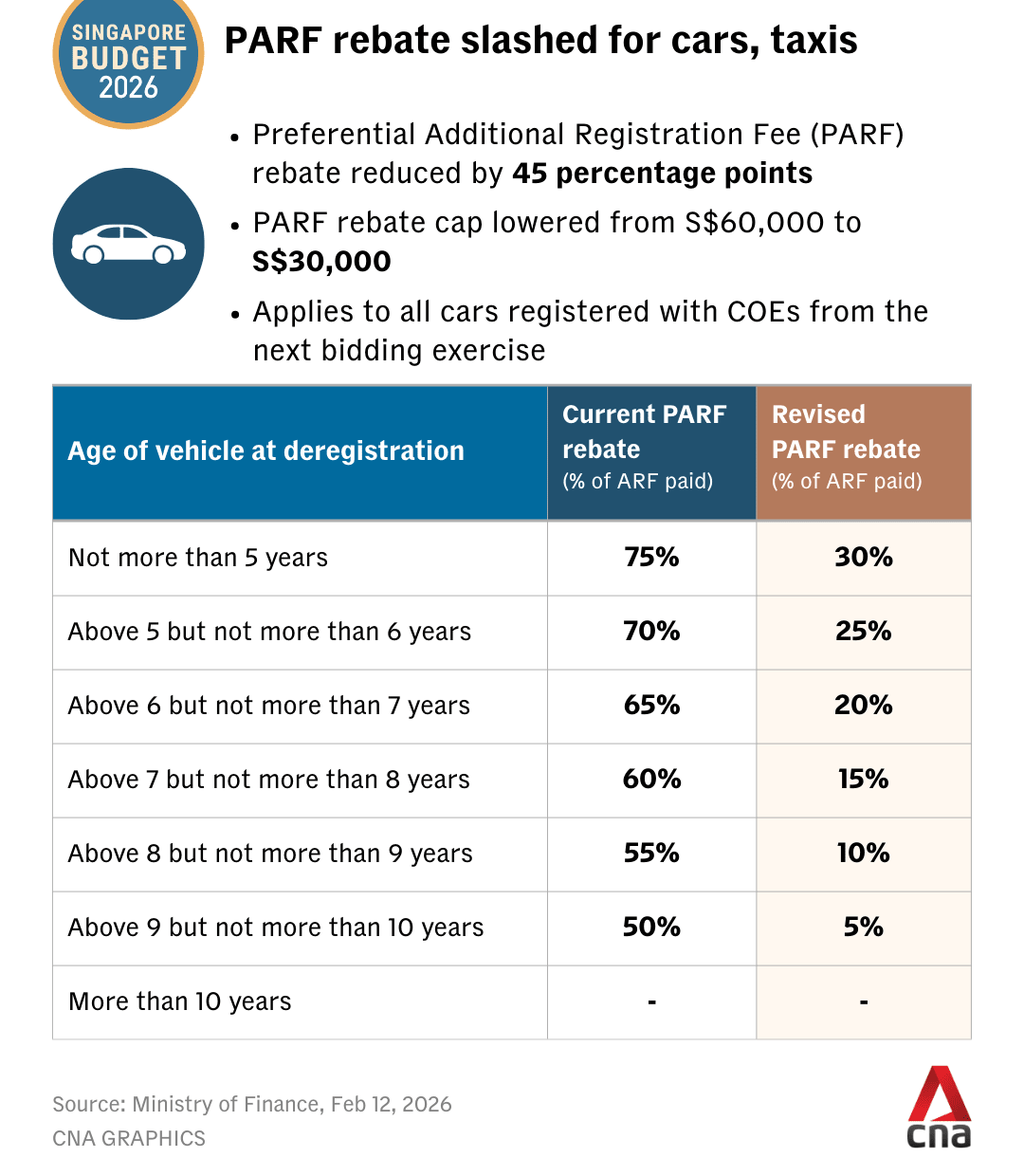
Under changes to the Preferential Additional Registration Fee (PARF) scheme, rebates for scrapping a car before its 10-year COE expires will be reduced by 45 percentage points and capped at S$30,000 (US$24,000).
Previously, car owners who deregistered their vehicles before the 10-year COE expired could receive rebates of between 50 and 75 per cent of the Additional Registration Fee (ARF) paid, capped at S$60,000.
"We will only see the effects of the PARF change in the next few auctions as buyers and dealers have a chance to respond," said Associate Professor Walter Theseira of the Singapore University of Social Sciences' business school.
WHY LUXURY CARS FELT IT FIRST
The PARF rebate is calculated based on the ARF paid by a car owner, which is in turn pegged to the vehicle's open market value. That means the rebate for a more expensive car is higher in absolute dollar terms, and the loss under the new cap is correspondingly larger.
Premiums for more powerful cars in Category B fell 5.3 per cent in this exercise to S$105,001, dipping below the S$106,501 for smaller cars in Category A for the first time in recent years.
The financial impact may feel larger for buyers of more expensive cars, said Mr Ler. "Given that, it’s natural for some Cat B buyers to pause and reassess their options."
Assoc Prof Theseira, however, cautioned against reading too much into the Cat A and Cat B gap. He argued that the market tends to self-correct - if Category B demand drops and premiums fall, the lower prices will eventually offset the steeper depreciation costs and draw buyers back.
"For example, if Cat B demand falls due to the ARF changes disproportionately making Cat B cars more expensive in depreciation, then the falling Cat B COE prices will offset those ARF changes and boost the attractiveness of Cat B cars again," he said.
WHAT COMES NEXT
Analysts were reluctant to predict near-term COE price movements, pointing instead to longer-term supply and demand for COEs.
Assoc Prof Theseira noted that COE supply follows a 10-year cycle, and that supply is set to increase over the next few years – a consequence of the high volumes issued in the late 2010s.
"High COE supply is almost perfectly correlated with lower COE premiums," he said.
Mr Ler said the recent policy changes signal that car ownership costs are heading "structurally higher", regardless of short-term fluctuations. He added that PARF changes could slow new orders if buyers take a wait-and-see approach.
"The real test will come after these existing (orders) are cleared," he said. "If order books start to thin out, we may then see some downward pressure on COE premiums in subsequent rounds."




