







Commemorating Sungei Road Market, through tours and art
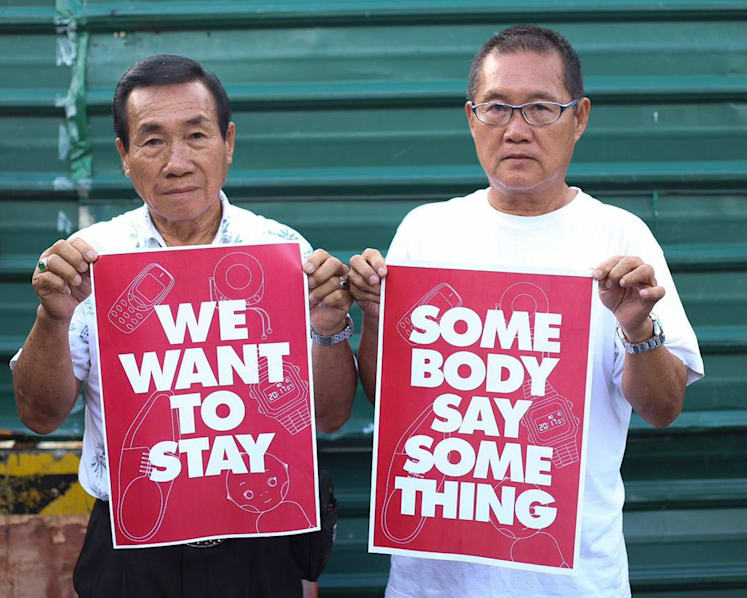
Koh Eng Khoon (left), president of the Association for the Recycling of Second Hand Goods at the Sungei Road flea market, seen in a photo shot for Save Sungei Road Market. Photo: Save Sungei Road Market/Facebook


SINGAPORE — As a teenager, landscape architect Faiz Bin Zohri would visit Sungei Road Thieves’ Market once a month.
Located between Jalan Besar and Rochor Canal Road, the large flea market was a treasure trove for the then-student, who was specialising in industrial design at Nanyang Polytechnic.
Foraging through peddled second-hand bric-a-brac, he would find cheap hair dryers, discarded hand-drills and other small machine parts. He used his finds as material for school projects.
So when Faiz, 33, and his group of friends, also regular visitors of the market, got wind of the announcement of its closure in February, the “diverse group of different professionals” banded together to set up a Facebook page called Save Sungei Road Market.





Come July 10, Singapore’s oldest and largest flea market — which sprung up in the 1930s and which has a colourful history and a reputation as a spot for trading smuggled and stolen wares — will close due to ground preparation works for future residential development use. In 2011, the unique hawking zone had already shrunk to make way for the construction of the new Sungei Road MRT Station.
Now, the Save Sungei Road Market group is running activities such as hosting an hour-long tour on Saturdays. The free tour, which kicks off at 3pm, touches upon the heritage and cultural aspects of Thieves’ Market. Two to three people, including Faiz, take turns to conduct the tours in pairs.
“All of us have different ‘attractions’ we speak on. A fellow ‘tour leader’ may be more into the history; I am more interested in the living street and market culture, so we complement each other (during the tour),” said Faiz.
An average of 10 participants sign up each week for a tour.
Nuggets of information include facts on the market’s name, for instance. In the 1980s and 1990s, some of the older generation knew the market as “the one next to the Frozen Bridge”, as the now-defunct Singapore Ice Works was once located at the junction of Sungei Road and Pitt Street.
The group plans to conduct tours until the market closes for good.
It has also submitted a public petition to Parliament, calling for the relocation of the market. Submitted on May 5, it contained 937 signatures.
Ultimately, Faiz hopes both the tours and petition will help vendors find alternative and sustainable re-locations — essentially, to keep the spirit of the market alive.
As of May 12, 44 out of almost 200 vendors at the market have accepted various assistance options — including employment and financial help, and facilitation of applications for hawker stalls — offered by the authorities.
“I always say in my tours, if we can have it for 20 years or more, it will be 100 years old and it’s a very unique thing for Singapore. It’s something we can celebrate,” Faiz said.
COMMUNITY ROPES IN USING ART
Faiz and his friends are just one group in the community trying to raise awareness of the market.
Cultural and social enterprise Post-Museum recently organised a poster competition that is set to run till June 30. Like the Save Sungei Road group, their aim is to urge authorities to relocate the market, instead of destroying it.
The rules are simple: Design a poster, include the words “Save Sungei Road Market” and post it on public Facebook group People’s Voice on Sungei Road with the hashtag #sungeipostercomp. Winners will be rewarded with “treasures” bought from the market.
The response has been positive so far, said Jennifer Teo, in her 40s, director of Post-Museum and administrator of People’s Voice. She described the market as a “valuable place in Singapore” with an “active community” and “a unique shopping experience”.
On Saturday, Kult Studio & Gallery will also be conducting an artwalk through the market with 15 artists, ranging from 20 to 40 years old, in attendance.
These artists will be provided with newspaper and cardboard materials to create pieces of art onsite, and are free to use any medium, including items purchased at the market.
Leading the artwalk is Tulika Ahuja, 24, assistant curator at Kult Gallery. The creative studio and art gallery is big on “observing sub-cultures through art”, she said. They hope to capture the essence of the market before it closes for good.
“Sellers at the Thieves’ Market often find many uses for cardboards and newspapers — they use it to pack their goods when they come and go, they lay their goods out on them, they use it to protect themselves from the sun — and we felt it was thoughtful to use these to create artworks, almost like using a piece from the market itself and leaving your experience of the market on it,” she said.
From June 3 at the Kult Gallery, these art pieces will be put on sale for S$100 each, while scanned images of the works will also be compiled into a zine — with a print-run of 50 copies — which will go on sale for S$5 each.
On June 3 and 4, the public can also catch a collaborative exhibition with content production outfit Our Grandfather Story (OGS) commemorating Thieve’s Market. The exhibition will showcase 100 postcards taken of the market at the gallery.
“We are both aligned in our interests to help the public remember the market for the little things that make it unique — the sellers, the goods they sell, the value they place on the goods they sell, their hierarchy of displaying the goods and so forth,” said Tulika.




