







Communications lockdown during sensitive police ops ‘makes sense’ but hard to enforce
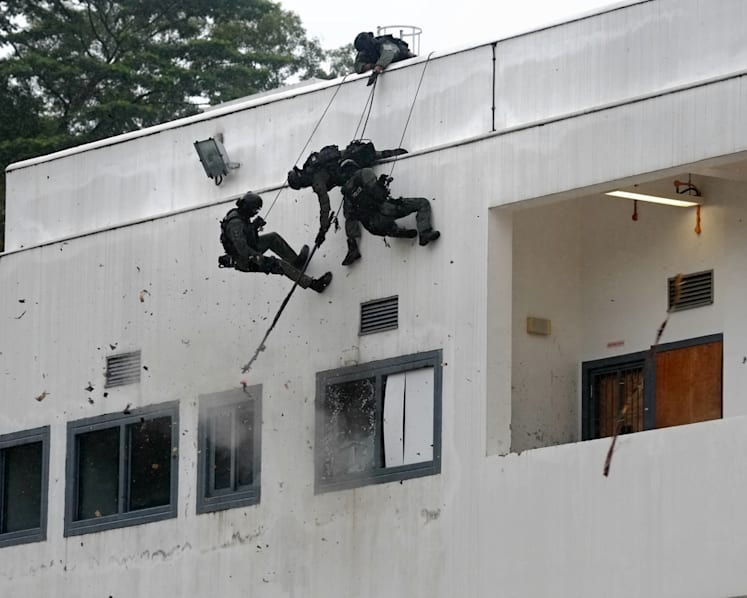
Special Tactics & Rescue (STAR) Unit using explosives to breach a window during a demonstration of a joint counter-terrorism exercise by the Singapore Police Force and the Singapore Civil Defence Force at the Home Team Tactical Centre on Feb 2, 2018. Photo: Nuria Ling/TODAY


SINGAPORE — While academics and lawyers interviewed by TODAY welcomed the proposal to expand the police’s powers during serious security incidents, including the authority to stop all forms of communication that may compromise operations, they said that putting these new laws into practice would be tricky.
Under the new Public Order and Safety (Special Powers) Bill introduced in Parliament on Tuesday (Feb 27), failing to comply with such a “communications stop order” is an offence that may warrant up to two years’ jail and/or a fine of S$20,000.
Dr Kumar Ramakrishna, who specialises in counter-terrorism strategy at the S Rajaratnam School of International Studies (RSIS), pointed to how social media posts had interfered with security operations in cases such as the siege at Lindt Cafe in Australia in December 2014. Speculation was rife on Twitter then and online users were sharing videos of hostages held inside the Sydney cafe. Hostages had also used social media to communicate the demands of their hostage-taker.
Dr Ramakrishna, who coordinates the school’s National Security Studies Programme, agreed that the communications stop order “makes sense” to give security forces more powers to ensure successful operations, and their work can be adversely affected if “just two or three people” post footage of tactical operations online.





On the other hand, he said, the authorities here have, in recent years, been encouraging Singaporeans to share information of suspicious activity, such as through the SGSecure mobile application. Users of the app may send photos and videos to the police, or call and text the police and the Singapore Civil Defence Force through the app. “So they have to make clear what the relationship between these new proposed laws and things like the mobile app is,” he added.
Media professor Ang Peng Hwa from the Nanyang Technological University cautioned that such legislation may cause members of the public to “err on the side of caution” and hold back from giving relevant information to the authorities.
“This could be one of the unexpected consequences for Singaporeans who don’t wish to incur a penalty,” Prof Ang said. “I think established media outlets should be able to draw from past experiences and not do live reports during such situations. In Singapore’s case, the news outlets are quite well-regulated, so I don’t see that as an issue.”
He suggested that the authorities also work with technological and social media platforms to halt communications when security may be compromised. Facebook, for instance, has established standards to remove posts related to terrorism, violence or graphic content as and when these are reported. Its spokesperson told TODAY: “As outlined in our law enforcement guidelines, we do work with the police in emergency situations when we believe that there is a genuine risk of physical harm or direct threats to public safety.”
To the question of whether any other jurisdiction has or is mooting a similar law to bar communications, Dr Ramakrishna said that he is not aware of any.
Experts and law enforcers worldwide have recognised that live broadcasts and public social media posts during highly volatile situations, such as hostage crises, can be a hindrance. However, social media has also helped tactical teams locate suspects, such as in the case of the manhunt in Watertown, Massachusetts following the 2013 Boston marathon bombing in the United States.
Describing the power to invoke communications stop orders as a “delicate legislative exercise”, criminal lawyer Josephus Tan said: “As long as such expanded powers are confined within very strict perimeters vis-a-vis its usage, it’s a good thing as far as public security and safety is concerned.”
It would be ideal for legislators to give more information on the types of situation where the order could apply, to “avoid the impression that (Singapore) is becoming like a ‘police state’,” he added.
Mr Sunil Sudheesan, president of the Association of Criminal Lawyers of Singapore, said that it could be a challenge to enforce the order, as alleged offenders may claim that they do not know about it.
Still, he welcomed the Bill, noting that it will help to create awareness among Singaporeans: “To me, the main aim of this law is to let the public know that they can be helping the bad guys through their social media engagements during security situations.”
Among other things, the Bill, if passed, will also allow police officers to direct premise owners to take certain actions during such situations and rope civilians in to help in their operations. It will also empower the police to take down unmanned aircraft and autonomous vehicles, regardless of their intention or activity.




