







Govt changing Constitution in order to be 'upfront, transparent' about president's international roles: DPM Wong
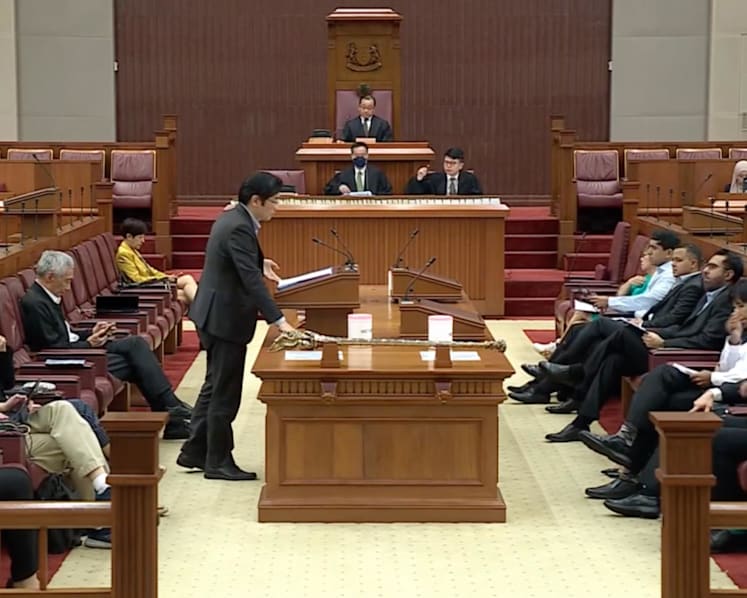
Parliament debated for about 2.5 hours on a Bill to change the Constitution before passing it on Nov 22, 2023.

SINGAPORE — The law here does not prohibit Singapore's president from expressing his private views while holding positions in international organisations in his official capacity. However, the Government has chosen to amend the Constitution in order to be “upfront and transparent” instead of operating in ambiguity, Deputy Prime Minister Lawrence Wong said.
Mr Wong, who is also Finance Minister, said this on Wednesday (Nov 22) at the end of a parliamentary debate that saw the House approving a Bill to change the Constitution so that the president and government ministers can accept appointments in foreign and international organisations in their personal capacities, if it is in the national interest for them to do so.
A total of 10 Members of Parliament (MPs) — from both sides of the aisle and including a Nominated Member of Parliament — spoke up to debate the Bill at a session that lasted about 2.5 hours.
Among the key concerns raised were whether there was even a need to make the changes and what this would mean for President Tharman Shanmugaratnam’s current appointments, whether he or any minister would have the capacity to juggle their domestic duties and those for international organisations, and the need to backdate the amendments.





The changes passed on Wednesday were retrospectively made effective on Sept 14, when Mr Tharman was sworn-in as Singapore’s ninth president.
Mr Tharman presently holds appointments in four international bodies in his official capacity.
WHY THE CHANGE NOW?
One question raised was whether past presidents have held international appointments in their private capacity while in office.
This was from Aljunied Group Representation Constituency (GRC) MP Gerald Giam from the Workers’ Party, as well as Non-Constituency MP Leong Mun Wai from Progress Singapore Party (PSP).
Mr Leong also asked whether President Tharman’s current international appointments are unconstitutional.
Mr Wong said that this was the first of such cases for a president, but not for government ministers. Ministers have served in organisations, in their private capacity, with the approval of the prime minister.
“The prime minister cannot authorise the president to do likewise.
"The Attorney-General’s Chambers (AGC) has advised that this is an area the Constitution does not clearly provide for and that's why we debated, we thought about it,” Mr Wong explained.
One possible option was for the Government to allow the president to continue holding international appointments in his official capacity and possibly “give him latitude to express some independent views” while on board these organisations, Mr Wong said, adding that the AGC had said that this was “not expressly prohibited by law”.
However, the Government decided that this approach would neither be ideal for Singapore nor the international organisations.
“Why? Because the nature and parameters of the president's involvement would be unclear: Is he speaking for Singapore or speaking for himself? We will essentially be operating in a new novel and grey zone,” Mr Wong said.
The Government instead opted to pass a proper and principled framework in Parliament and work within the framework moving forward because it was the “proper thing to do”.
He said that the notion of the Amendment Bill being unconstitutional or not proper as suggested by members of the Opposition was “completely unfounded”.
“Let's not use (such) technical language to camouflage political grandstanding. Let's come back to the substance of what this is about,” Mr Wong added.
"And from the Government's point of view, the provisions are very clear. This will enable our little red dot to shine brightly on the international stage. It's a plus for Singapore."
Mr Wong also said that “out of an abundance of caution”, President Tharman has not attended any formal meetings of the four international bodies in which he holds positions, since he was appointed president on Sept 14.
PRIVATE VIEWS VS PRIVATE INTEREST
Mr Wong said that allowing the president or ministers to share their personal or private views is not tantamount to furthering their private interest.
This was in response to what he described as a “confusion” between the two that came up during the debate.
For example, Chua Chu Kang GRC MP Don Wee asked how can Parliament be assured that the views raised by the president and any minister at international bodies will be in Singapore’s national interest.
Mr Wong replied: “A lot of the comments suggest that when the president serves in his private capacity, he is serving in his private interests. That's not the case.
"We are allowing him, when he serves under this new clause, to serve in a way that allows him to contribute his private views, subject to safeguards.”
The safeguards will only ensure that the president is unable to comment on domestic policies and politics.
“Beyond that, we allow him to contribute independently to these organisations in his private capacity, but when he does so, he does so in the national interest. So he is not serving in his private interest, he is serving the national interest.”
Mr Wong also stressed again the point that the president or ministers, when taking up roles in their private capacity, will not be able to make any commitment on behalf of the Government of Singapore.
WHO FUNDS SUCH INTERNATIONAL TRIPS?
Several MPs, including Mr Wee and Jalan Besar GRC MP Denise Phua, asked about the administrative support and resources available to the president or a minister when they fulfil their duties at international organisations in their personal capacity.
Mr Wong said that since such roles serve the national interest, resourcing support would be “no different” from how the Government supports these officials when they undertake official trips.
In the case of the president, this would include manpower support as well as funding of travel costs for him and his delegation.
“In other words, this is like a working trip, no different from any other working trips the president or the minister undertakes in the national interest,” Mr Wong added.
HOW DOES THE GOVERNMENT ASSESS THE APPOINTMENTS?
Mr Wong said that the critical criterion when assessing whether or not the president or a minister should take up an international appointment is “national interest”, in reply to concerns raised by some MPs.
“In general, the president's or minister's participation should be helpful in advancing Singapore's standing and interest on the international stage,” he added, meaning that there should be direct or indirect benefits to Singapore.
“For example, the president's or the minister's participation could help advance views that are aligned to Singapore's outlook and approach on issues that help shape the global agenda in areas that are critical to Singapore.”
Other benefits would include ensuring that the nation stays plugged into important global discussions.
SPLITTING DUTIES, MANAGING TIME
Several MPs, including those from the Opposition, questioned whether the president or a minister would have the “bandwidth” to take up international appointments in their private capacity while discharging domestic duties.
For example, Ms Phua asked what would be the “tipping point” that determines when overseas engagements are “excessive”.
WP’s Dennis Tan, MP for Hougang, said that serving international organisations can be fruitful for the president or the nation, but the time spent there “equates to time not spent on his presidential responsibilities”.
Mr Christopher de Souza, MP for Holland-Bukit Timah GRC, said in response to such concerns that he does not see a case of “binary duties” since the president is the top diplomat for Singapore.
In his wrap-up speech, Mr Wong reiterated that the president’s roles cover both the domestic and international arenas.
“But I suppose there will be questions asked about emphasis and bandwidth, and how do you spend the time — and these are legitimate questions.”
He said that in assessing invitations for the president to serve on international organisations, the Cabinet would consider the meeting load and travel demands, among other things.
“So this will ensure that the president's holding of these roles remains to Singapore's benefit and will not in any way affect his ability to exercise the rest of his constitutional duties.”
The prime minister would likewise do the same for roles involving ministers.
“At the end of the day, it will not be in the national interest for the president or a minister to take on external appointments that affect their ability to perform their official duties.”
WHY THE NEED TO BACKDATE LAW?
The Bill passed on Wednesday was backdated to take effect on Sept 14, the date when President Tharman was sworn into office.
Associate Professor Jamus Lim, Workers' Party MP for Sengkang GRC, questioned the need to apply the law retrospectively, arguing that to routinely amend laws and apply them after the fact would “erode the stability of the rule of law”.
Mr Wong said that he agreed with Assoc Prof Lim that such a move should be done “sparingly”.
“And we do it very, very rarely. Why so? Because backdating upsets expectations and prejudices individuals who rely on existing law.”
In this case, no one is prejudiced by this backdating of the law, he added.
Mr Wong stressed that the constitutional change was done “out of an abundance of caution”.
In closing, he said that opportunities to take up office in respected international institutions where Singapore can "actively contribute to shaping global norms" do not come by often, and these should be treasured.
"They are invaluable for Singapore and this is indeed how we have built strong relationships with other countries, while safeguarding our interest and ensuring that our voices be heard on the global stage."




