







Constructive US-China engagement is in Singapore’s interests, says Vivian
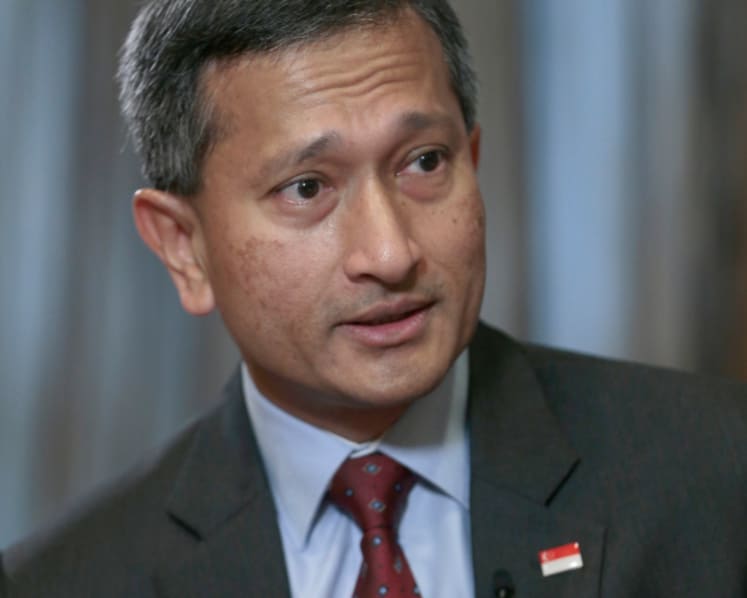
Minister Vivian Balakrishnan speaks during a media interview on Dec 4, 2015. TODAY file photo


SINGAPORE — The state of Sino-America ties is the key variable for regional stability and small countries like Singapore will benefit when the two super powers focus on constructive engagement, Minister for Foreign Affairs Vivian Balakrishnan told Parliament on Thursday (April 7).
Speaking at the Committee of Supply debate for the Ministry of Foreign Affairs (MFA), Dr Balakrishnan said there will always be elements of cooperation and competition between the United States and China.
“There will always be some degree of competition, if not outright rivalry between the US and China,” he said, noting that China’s emergence as a rising power has shifted the strategic balance in the region.
Despite their differences, there is an unprecedented level of economic interdependence between the two powers and both are aware that their fates are intertwined, Dr Balakrishnan noted.





This means that they cannot embark on an all-out confrontation because the economic impact on them, on both states, will be too high. In addition, the threat of mutually assured destruction will also ensure that both these nuclear powers have a very powerful incentive to avoid direct confrontation.
The minister expressed Singapore’s hopes that Washington and Beijing will continue to cooperate effectively on global and regional challenges such as nuclear security, climate change, piracy and cybersecurity among others.
While Washington-Beijing ties are buttressed by economic linkages and common positions on key challenges like climate change, they stand apart on several issues such as the South China Sea territorial dispute and North Korea’s nuclear ambitions.
US President Barack Obama has been pressing his Chinese counterpart Xi Jinping on China’s construction of military facilities in the South China Sea, actions that the White House said belied a pledge that the Chinese president made last fall not to militarise those waters.
China’s neighbours dispute its claims to reefs and shoals, and fear that it is colonising one of the world’s most strategic waterways. Manila has taken Beijing to an international court in the Hague in a bid to resolve the overlapping claims, but China has refused to take part in the arbitration. The US has dispatched navy ships to guarantee that the sea lanes remain unobstructed, but that has raised the risk of confrontation with Chinese warships.
Dr Balakrishnan noted that China has become far more assertive and this can be seen, for instance, by its construction of artificial islands in the South China Sea.
He stressed that Singapore is not a claimant state and takes no position on the merits of specific territorial claims in the South China Sea.
“But as a small state, we do have a vital interest in and we have to strongly support the maintenance of a rules-based international order and to support the peaceful resolution of disputes, with full respect for legal and diplomatic processes,” he said, adding that international agreements such as the United Nations Convention on the Law of the Sea should not be undermined.
“We cannot accept that ‘might is right’,” said Dr Balakrishnan, who also stressed Singaporeans must have a realistic, coherent and collective appreciation of our place in the world.
“Singapore’s fundamental realities have not changed. We are a tiny island in a tough neighbourhood,” he said.
“What this means is that we must have no illusions about our significance in the world or our ability to influence global events,” he added.
“Our survival as an independent sovereign city state and our economic viability cannot be taken for granted. And if we ever become disunited or unable to defend ourselves or become an economic failure — we would rapidly become irrelevant.”
Noting that there are many challenges on the economic front for Singapore, Dr Balakrishnan said that it is important for the Republic to continue to be plugged into the regional and international trade groupings — including the Trans-Pacific Partnership and the European Union-Singapore Free Trade Agreement — that will open doors for businesses.
Commenting on relations with Malaysia and Indonesia, the minister said that while problems will arise from time to time, it is important to take a long term perspective.
He highlighted that boosting connectivity and easing congestion at the borders are some issues that Singapore and Kuala Lumpur are working together on. But he said that replacing the Causeway is not the solution.
“We have conducted a joint study with the Malaysians. We have also done our own projections. The Causeway actually has sufficient capacity,” he said.
“Rather, the key is to continually enhance checkpoint efficiency and operations, through measures like the use of technology and ongoing infrastructural upgrading works at the checkpoints.”
He also said that more should be done to tackle the problem of transboundary haze, noting that regional leaders have endorsed the vision of a haze-free Association of South-east Asian Nations by 2020.
“Frankly, as former Minister for the Environment and Water Resources, I do not see why we have to wait for 2020 to see clear skies,” he said.




