







Covid-19: People from virus-hit South Korea, Italy, Iran living in S’pore fret about loved ones back home

Former flight cabin crew Kim Ye Sing, a South Korean passport holder who is now a Singapore permanent resident, on a visit to Barcelona, Spain.


SINGAPORE — As Singapore steps up the battle against Covid-19, with the outbreak still largely contained, some people living here are worried about their relatives in corners of the globe that are suffering the worst death tolls from the virus outside China.
These people — originally from Italy, Iran and South Korea — are glued to their television and mobile phone screens, constantly refreshing their social media feeds for the latest news back home, where the death toll has risen alarmingly in recent weeks.
For some of them, the anxiety of being so far from loved ones at such a difficult time has been made harder by insensitive humour over Covid-19 on social media.
Italy has more than 2,000 Covid-19 cases, with a death toll of 52. In Iran, 66 people have died, with reported infections topping 1,500. And in South Korea, 28 people have died with more than 5,000 cases reported.





The Ministry of Health said on Tuesday (March 3) that all new visitors who have travelled to Iran, northern Italy or South Korea within the last 14 days will not be allowed to enter Singapore from 11:59pm on Wednesday, after the World Health Organization named these three countries, alongside Japan, as the ones of greatest concern in the fight against Covid-19.
Ms Hayedeh, 50, who declined to give her family name, moved to Singapore from Iran more than 30 years ago. She feels “helpless” about the situation in Iran.
“When the virus started in Singapore, I took it a lot better because I saw how Singapore handled Sars (severe acute respiratory syndrome in 2003). I don’t feel worried because I know I am in good hands. The Government is taking care of everything in an amazing way,” the home chef, who is a permanent resident, said.
“But I’m worried for them (in Iran) because it’s a huge country. The number of people and awareness is different.”
Mr Mohammad Jafari, 56, a businessman who moved to Singapore from Iran in 1993 shares the same sentiments.
“When the virus started spreading here, my brother (in Iran) told me to be careful. They were worried because Singapore is close to China and many Chinese people visit Singapore. I told them not to worry because Singapore has the situation under control, implementing effective quarantine measures,” Mr Jafari, who has been a Singapore citizen for more than 15 years, said.
Ms Hayedeh remains worried about her friends and family who are avoiding social gatherings and staying home, but she refrains from calling them “more than usual” because she does not want to “give them stress or anxiety.”
A sense of excitement that should be felt with the Iranian New Year, or Nowruz, being just around the corner on March 20, is replaced by largely empty roads and even emptier stores there.
Ms Hayedeh said: “No one has the mood to go out to shop. Like Chinese New Year, before Nowruz, everybody goes out to shop, buy new clothes, food, sweets and house decorations. Businesses are very affected.”
Researcher Alireza Javadian, 34, who is here on an employment pass, said: “Many travel agencies that sold tour packages to visitors hoping to go to Iran to celebrate the new year received a lot of cancellations.”
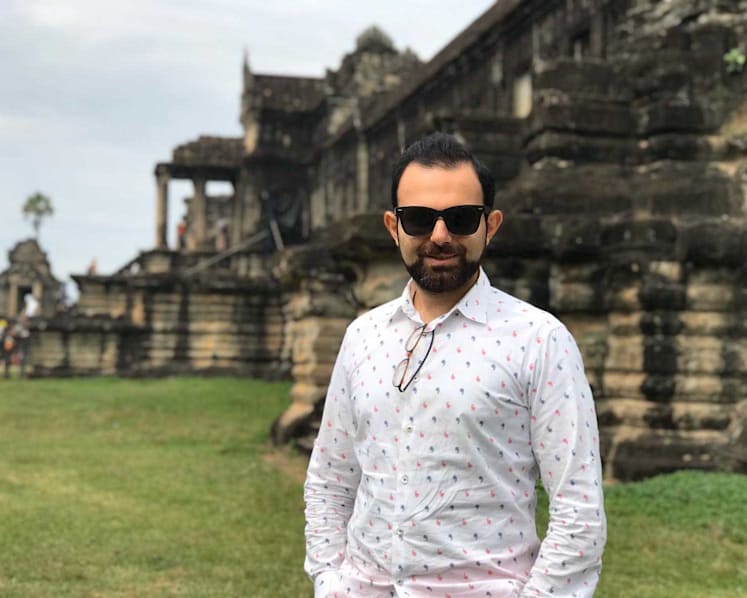
Mr Alireza Javadian, an Iranian who is a researcher on an employment pass in Singapore, during a visit to Cambodia. Photo: Alireza Javadian
Ms Hayedeh thinks that Nowruz will be celebrated “in a different manner” this year. “Usually on Nowruz, we gather and hug and kiss but this year, they cannot even do that anymore,” she said.
'SAD FOR PEOPLE IN SOUTH KOREA'
Ms Kim Ye Sing, 24, who is a Singaporean permanent resident, said that both the Singaporean and South Korean authorities are handling the outbreak well. She also said that living here made her realise "how ready Singapore is to fight and protect its people”.
She used to work as a flight cabin crew and is moving to the banking field.
“I’m very sure the government in South Korea also did the best it could to contain the virus but it was already spreading so quickly,” she said.
“The official in charge of managing Covid-19 even commited suicide. It just shows how troubled the official was.”
She added: “I feel really worried and sad for my people in (South Korea). I hope things will get better soon.”
Two weeks ago, a South Korean undergraduate, Ms Eunbin Cho, 22, had to cancel her flight to Seoul on March 11 to visit her family there but could not obtain a refund because there were no official travel restrictions at that time.
She said that she is worried about her family being there as the number of infections keep going up.
“Today I saw that there were five new cases at the exact location where my grandparents and parents are living, in Gangnam (a district in Seoul). It’s so bad,” she told TODAY on Monday. “There are confirmed cases everywhere.”
Ms Cho said that she is deeply saddened by the situation in South Korea and was upset to see comments on Facebook making jokes about it.
On a Facebook page of a Singapore media outlet, she found comments that were "very bad", trying to be funny and saying things such as "Train to Daegu", an apparent reference to Train to Busan, a Korean zombie film.
“But it’s not funny at all,” she said. “They keep making fun of it by saying it’s like a Korean drama. It’s quite hurtful for me to read it because they’re taking it as a joke.”
Television producer Christine Park, 25, a Singapore permanent resident, said that more people are avoiding crowded places in Seoul.
“My relatives are scared, they won't leave the house much and won’t eat out. My cousin in fourth grade usually has piano, taekwondo classes but is not going to go for them anymore.”
'BUSINESSES CLOSING EARLY IN ITALY'
Writer Edoardo Liotta, 23, who has been in Singapore since he was a year old, said that he was worried about his family in Italy.
Most of Mr Liotta’s family members live in Rome, but his cousin lives in Milan which is a major hotspot for Covid-19.
“I text my cousin in Milan more often because she is much closer to the outbreak areas. She has had to work from home and all big gatherings have been cancelled,” Mr Liotta said.
He added that the situation is being handled well by the Italian authorities.
“Generally, I think the (Italian government) is doing really well considering they did the most tests compared to any other European country,” he said.
“They were fast to lock down towns that had outbreaks. The city of Milan has been quite empty to reduce transmission and there are roadblocks and many other efforts in place.”
Another Italian on an employment pass who wants to be known only as Mr Francesco, 28, subscribes to the Gov.sg WhatsApp channel and thinks that direct channels of information are a good way to help the Singapore Government coordinate communication to the public.
“The channel helps people to understand the situation better which helps reduce panic,” he said, adding that officials in Italy disseminate information only through the media.
Friends and relatives in Italy tell him that some businesses are closing earlier there as the Covid-19 crisis deepens.
“Some bars are closed after 6pm to avoid crowds, so are theatres and clubs,” he said, adding that restaurants have not closed because only crowded places will be closed in the evening.
Mr Alan Serrecchia, 40, a sales manager on an employment pass here, also said that the Italian government is managing the outbreak well but he hopes that this health crisis will all end quickly.
“I hope that it will be over soon for everyone,” he added “And I hope that we can endure this situation.”




