Covid-19 White Paper: 'Overly elaborate' safe distancing rules, supporting the vulnerable — hits and misses of S'pore's pandemic response
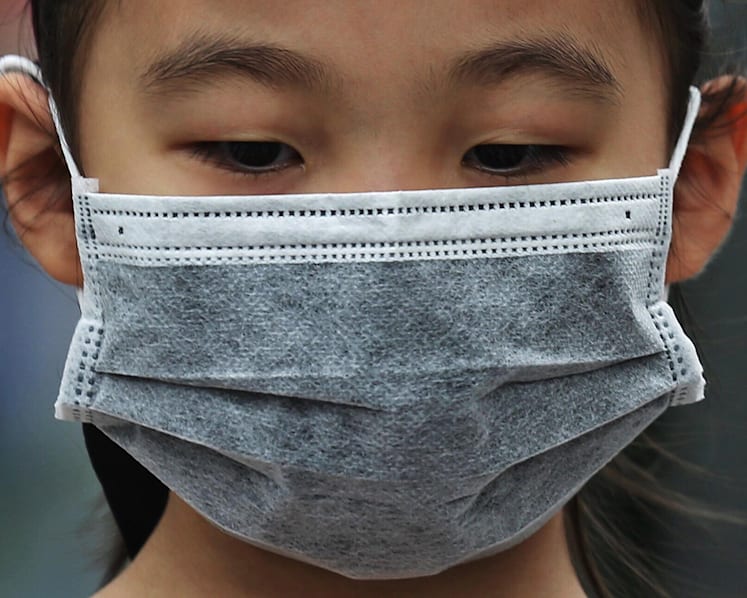
A girl seen wearing a mask in January 2020.


SINGAPORE — A wicked problem on a grand scale with new information and developments unfolding daily. A fog of war posing conditions of incomplete information and uncertain outcomes.
That was how the Government described the early days of the Covid-19 outbreak in its after-action review of Singapore's response to the pandemic, which was released in a White Paper on Wednesday (March 8).
The paper traced how the Covid-19 pandemic unfolded in Singapore from its first imported case in January 2020 until the nation entered a new normal of living with an endemic Covid-19.
Drawing findings from an internal review by former head of civil service Peter Ho and after-action reviews done by various government agencies, the paper also identified key areas in the pandemic response where the Government did well.





Using candid, sometimes blunt language, it also spelled out other areas that could have been better handled, along with important lessons to be learnt to better prepare for future pandemics.
Deputy Prime Minister Lawrence Wong, when asked by TODAY about how much better Singapore would have fared if it had better handled the areas of improvement highlighted in the paper, said: “There will certainly be a lot of (wishing) that things could have been better, and with all the benefit of hindsight.
"But we proceeded with the best judgement we could at that point in time.”
Mr Wong, who co-headed the governmental task force for Covid-19, added that the purpose of the review was “to learn and ask ourselves, from all these experiences, how we can be better prepared when the next pandemic comes”.
The following are some of the key hits and misses identified by the Government over its response to the Covid-19 crisis.
EARLY DAYS OF THE PANDEMIC
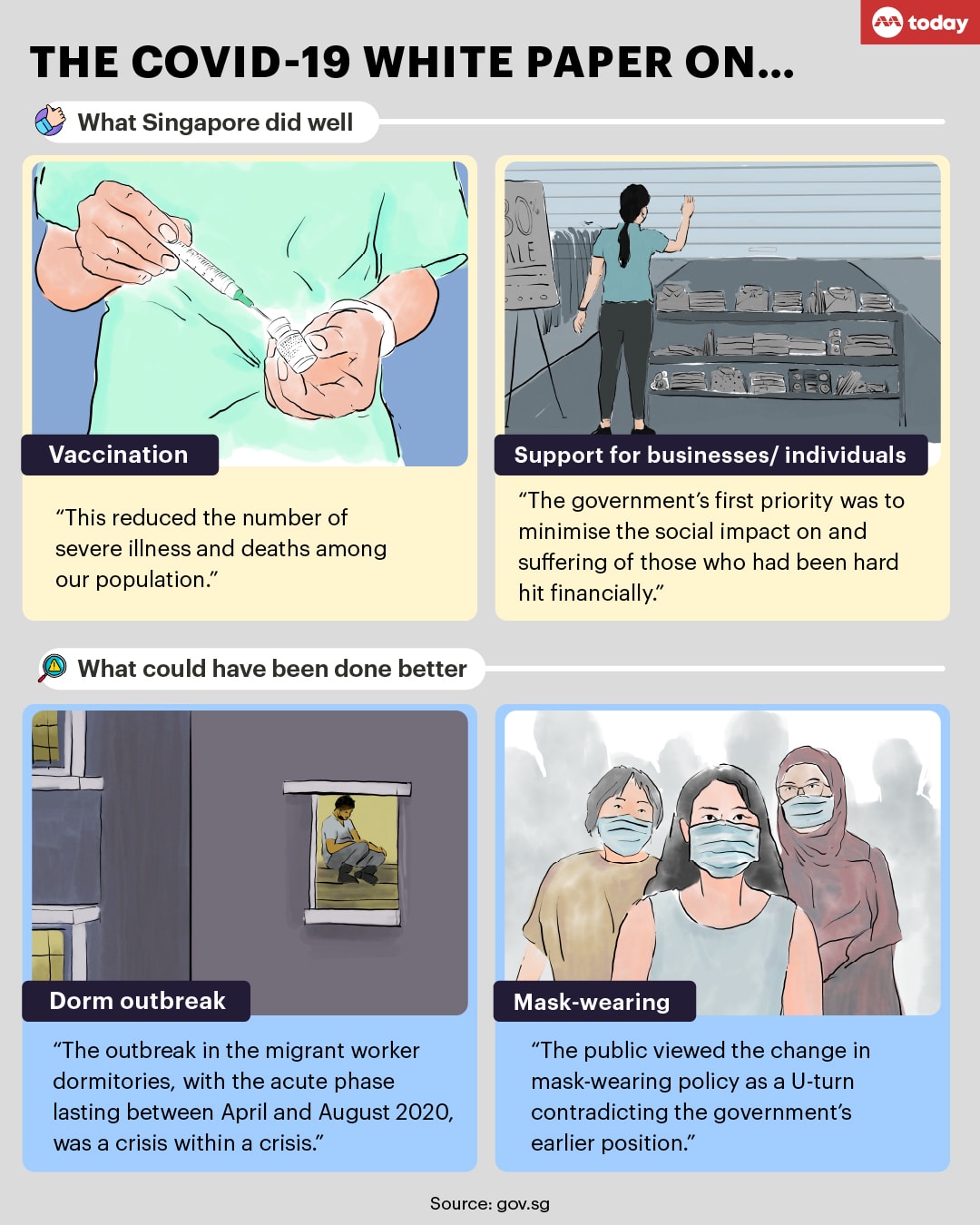
WHAT COULD HAVE BEEN DONE BETTER
1. Mask-wearing policy
At the start of the coronavirus outbreak in early 2020, the Government said that the wearing of masks was unnecessary unless they were feeling unwell, but by mid-April 2020, mask-wearing in public was made mandatory.
By then, Singapore had recorded its first two deaths from the virus on March 21 and its 1,000th case on April 1.
The paper stated: “On hindsight, as the clinical evidence on Covid-19 was still evolving and before we learnt how easily the virus spread, we could have been less definitive in our position on mask-wearing.”
It added that the Government could have also encouraged Singaporeans to make their own masks while manufacturing lines were set up to ramp up production of surgical masks.
2. Outbreak in migrant worker dormitories
The White Paper described the Covid-19 outbreak in migrant worker dormitories as “a crisis within a crisis” and one of “the most dangerous” close calls faced during the pandemic.
- The first infection in a dormitory was detected on Feb 8, 2020
- Two dormitories were locked down on April 5, but infections spread to at least nine more over the next three days
- By the end of that year, almost half of about 300,000 workers in dormitories had contracted Covid-19
"In retrospect, the early precautions we took in the dormitories were insufficient. Given the communal living environment, the dormitory outbreak had every possibility of becoming a major disaster," the paper stated.
In retrospect, the early precautions we took in the dormitories were insufficient. Given the communal living environment, the dormitory outbreak had every possibility of becoming a major disaster.
The “insufficient” initial precautionary steps followed procedures instituted after the severe acute respiratory syndrome (Sars) crisis in 2003, and based on the prevailing view back then that symptom-less disease spread was not possible.
The White Paper said that “better and earlier ground surveillance” could have been done. Some measures on dormitory residents could also have been relaxed earlier given the toll on the workers’ mental health due to extended restrictions.
3. Slow action on border controls
Border restrictions were imposed progressively on visitors from selected countries, before finally being expanded to all countries from March 23, 2020.
Later on, in dealing with imported cases of the Delta strain of the virus, the Government closed Singapore's borders to India when infections shot up there, but it was slower to close off other countries in the Indian sub-continent and countries with high travel volumes from India.
“This created the risk of leakage and indeed, Changi Airport saw a cluster in May 2021,” the paper noted.
"On hindsight, at the beginning, we should have built in a margin of safety and tightened border measures more aggressively the moment there were signs of the virus spreading across borders, even when there might have been some risk of us overreacting to these signals," it added.
4. Panic buying sparked by communication missteps
The Government publicly announced that it was raising the Disease Outbreak Response System Condition (Dorscon) level from yellow to orange in February 2020.
While the move was done in the spirit of transparency “to bolster vigilance”, it sparked public panic and a rush to buy essential items.
Items were wiped clean from supermarket shelves time and again early in the pandemic, such as when Malaysia announced a lockdown in March 2020 and Singapore announced its semi-lockdown in April 2020.
Communications experts previously told TODAY that the panic-buying in Singapore might have been avoided if the information disseminated by the authorities had been clearer.
The report concluded: "We will review how we design and communicate indicators of crisis severity and related public health measures as part of our larger emergency preparation and public communications framework, so as to avoid causing undue public anxiety."
We will review how we design and communicate indicators of crisis severity and related public health measures as part of our larger emergency preparation and public communications framework, so as to avoid causing undue public anxiety.
WHAT SINGAPORE DID RIGHT
The Government was quick to roll out various schemes to businesses and individuals to cushion the economic impact of Covid-19, having announced four successive Budget packages with financial aid and support measures by June 2020.
For businesses, relief measures included rental rebates as well as wage offsets under the Jobs Support Scheme to reduce unemployment and job losses.
Help was also handed directly to individuals such as through the Covid-19 Support Grant financial assistance and various vouchers to defray household costs, with S$539 million disbursed to around 480,000 beneficiaries.
THICK OF THE CRISIS
WHAT COULD HAVE BEEN DONE BETTER
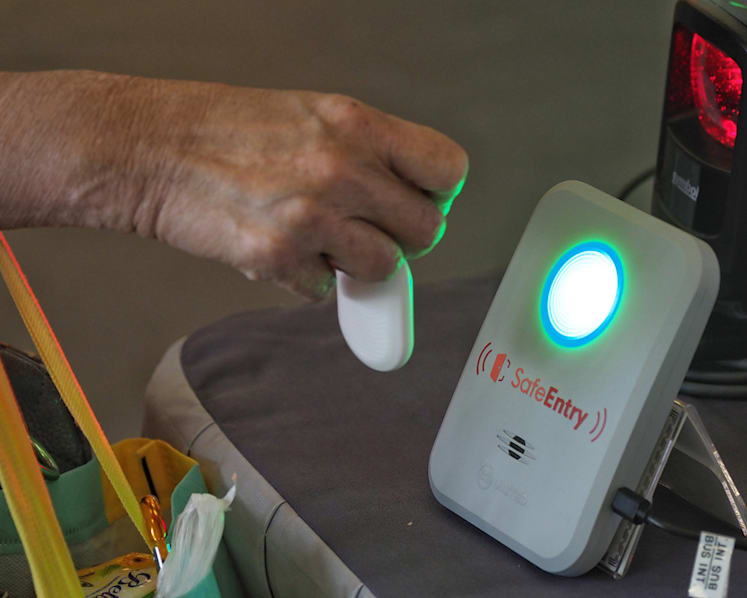
1. Rollout of contact tracing
The scaling up of contact tracing efforts could have kept pace with the infection outbreaks, the Prime Minister’s Office said in a press release on the White Paper on Wednesday.
While the development of the TraceTogether and SafeEntry digital tools helped to cut down the time taken to do contact tracing, it took months before there was a high take-up rate among the population.
One notable setback that the TraceTogether programme faced was when it emerged that the data could be used for criminal investigations. This came after initial assurances that the data would be used only for contact tracing.
“The Government should have been clearer about the use of TraceTogether data from the onset,” the White Paper said.
2. Entry restrictions on long-term pass holders
Entry of long-term pass holders into Singapore was temporarily suspended at various stages when there was a spike in infections here, because the Government was worried about coping with the potential surge of returnees.
The broad movement restrictions had "created significant difficulties" for some of these long-term pass holders, who endured prolonged separation from their family and disruption to their work.
“Singapore incurred reputational cost and lost some goodwill from this segment of the community who also had their homes here,” the review noted.
The White Paper also stated that such pass holders could have been brought back in sooner or given prioritised entry for some groups once the infection situation here had stabilised.
3. Manpower shortage in healthcare
The White Paper found that Singapore had by and large maintained the resilience of its healthcare system, but it also acknowledged the immensely stressful conditions in which healthcare workers operated.
"Despite our best efforts, manpower staffing was extremely challenging," it said, adding that the prolonged crisis led to fatigue and burnout.
In late 2021, Dr Janil Puthucheary, Senior Minister of State for Health, said that resignations among healthcare workers have gone up in the first half of that year under the strain of the Covid-19 pandemic.
In December 2021, despite the number of Covid-19 cases in the community stabilising and the caseload going down, healthcare workers interviewed by TODAY said that the manpower crunch was still keenly felt on the ground.
WHAT SINGAPORE DID RIGHT
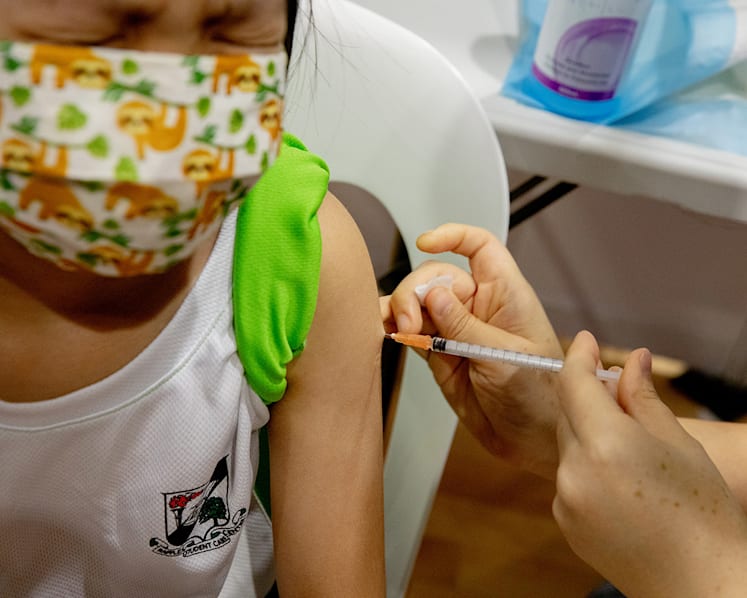
1. Nationwide vaccination campaign
Singapore took “calculated risks” on promising vaccine candidates and signed advance purchase agreements to gain timely access to vaccines.
The Health Sciences Authority approved the vaccine rollout on Dec 14, 2020 and vaccination centres were set up rapidly within weeks.
Due to the various efforts to make the jabs readily available to the public, including the deployment of roving vaccination teams to reach less mobile segments of the community, 80 per cent of the population were fully vaccinated by late August 2021.
Mr Wong described vaccination as a "very important strategy" and Singapore's successful implementation of it "has enabled us to get through this pandemic".
2. Staying open, ensuring supply chain resilience
Difficulties were faced in securing critical medical supplies early in the crisis, in part due to real supply shortages, but also resulting from "nationalistic and protectionist reactions" to the pandemic and hoarding.
The Government successfully maintained the supply of essential goods through various measures including:
- Enhancing pre-emptive stockpiling and securing availability for sea shipping when air cargo capacity was initially restricted
- Having arrangements that minimised transmission of Covid-19 when crews or delivery workers send essential goods and supplies across the border
- Diversifying sources for food and essential goods supplies by tapping "long-standing networks" and establishing new ones
3. Minimising disruption to students' education
By mid-March 2020, more than 100 countries had closed their schools due to the pandemic, the White Paper noted.
The Government averted school closures by “moving early” to halt larger-scale and higher-risk activities, and shifting to home-based learning days before the semi-lockdown or "circuit breaker" was announced.
“We remained reluctant to do so given the negative impact this could have had, not just on learning but also on the mental health and social development of students, especially those from disadvantaged backgrounds,” the paper added.
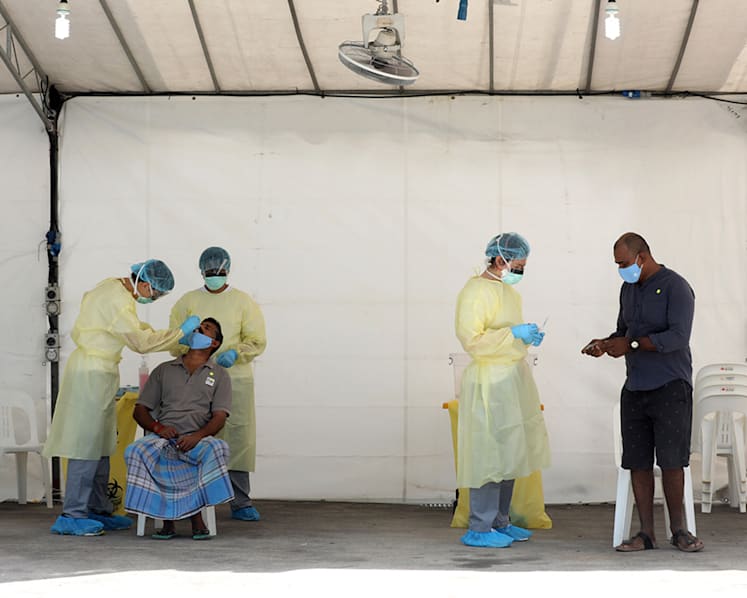
4. Ramping up testing capabilities
The White Paper highlighted how Singapore had successfully ramped up testing "at an unprecedented scale and pace under constantly changing conditions".
- Initially only 10 public sector hospital laboratories had the capability to test for Covid-19, with capacity to process about 100 tests daily
- Within a year, the Ministry of Health had expanded testing capacity and capability to about 60,000 polymerase chain reaction tests daily
This was done by, among other things, training thousands of layperson swabbers and support workers to support nationwide testing operations.
ROCKY TRANSITION OUT OF PANDEMIC
WHAT COULD HAVE BEEN DONE BETTER
1. Covid-19 rules and safe management measures
- Prime Minister Lee Hsien Loong in a televised address in May 2021 told Singaporeans that they would have to learn to live with Covid-19 as an endemic disease such as influenza
- However, breakouts of new Covid-19 clusters driven by the Delta virus variant led to repeated tightening and easing of infection control measures
- The multi-ministry task force announced plans to ease measures in mid-August, only to tighten them again in September as number of cases rose
These compounded the frustrations faced by the public and businesses as well as workers and volunteers on the ground tasked to implement infection controls.
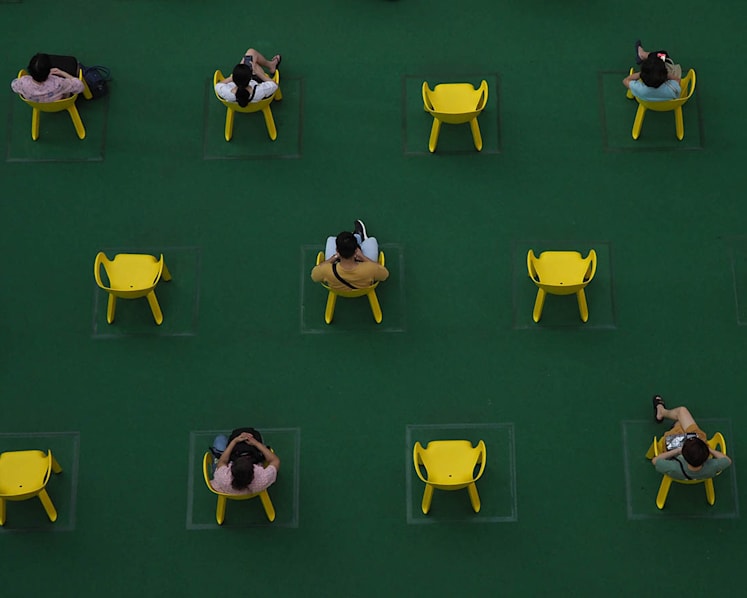
The measures were seen as "overly elaborate, difficult to operationalise and explain" and not seen as consistent.
"All this highlights the need for us to exercise greater flexibility in a crisis, go for broader brush but more implementable measures, and to guard against the instinct to aim for unrealistic standards of perfection," the paper stated.
All this highlights the need for us to exercise greater flexibility in a crisis, go for broader brush but more implementable measures, and to guard against the instinct to aim for unrealistic standards of perfection.
2. Difficulties in transiting to endemic Covid-19
As the nation progressed towards an endemic Covid-19, one of the notable challenges was the rollout of the home recovery programme.
Launched as a pilot, it soon became the default mode of recovery in order to manage the fast-growing number of cases at hospitals, leading to:
- A sense of uncertainty and anxiety among patients, due to the changes happening too quickly
- Phone lines for the public were overwhelmed as families called in with questions because they were unsure about taking care of sick family members at home
"The sudden re-characterisation of Covid-19 as a disease mild enough for one to recuperate at home was too unsettling for many to accept. It caused uncertainty and anxiety among patients and their families," the paper stated.
WHAT SINGAPORE DID RIGHT
Manpower shortages and heavy workloads notwithstanding, the paper highlighted the Government's ability to maintain the resilience of the healthcare system as one of the areas where Singapore performed well.
This was done through various measures, including:
- Involving the broader healthcare ecosystem in the Covid-19 response
- Repurposing and converting of wards into isolation rooms, while beds at intensive care units were added
- Rapidly setting up of community care and recovery facilities to care for patients with mild symptoms
- Working together with public, community and private hospitals as well as the Singapore Armed Forces Medical Corps
"In the end, it was the solid teamwork across the public, private and people sectors that prevented the healthcare system from being overwhelmed," the paper stated.
Speaking to reporters on Tuesday, Mr Wong said that overall, Singapore has achieved positive outcomes in the midst of "very trying circumstances".
"We have one of the lowest Covid death rates in the world. We have safeguarded livelihoods, kept supply chains open and supported the vulnerable and importantly, we have emerged from this crisis more united as a nation than before," he added.
"And we are one of the very few countries in the world that has done so."
CLARIFICATION: A previous version of this article stated that S$593 million had been disbursed to around 480,000 beneficiaries to defray household costs. The Ministry of Communications and Information has clarified that the correct figure is S$539 million.