







Criminal sanctions for malicious actors spreading falsehoods; fines can go as high as S$1 million
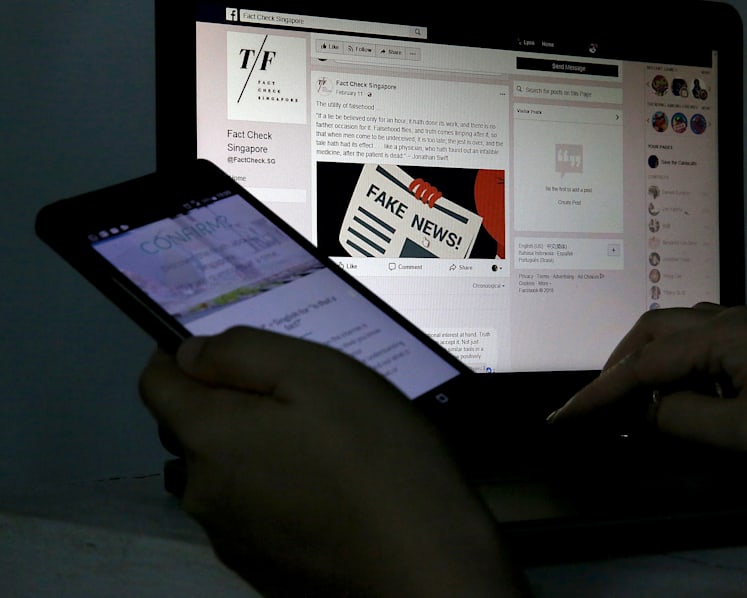


SINGAPORE — Published corrections will be the primary response to online falsehoods under the proposed new laws against fake news, but there will also be criminal sanctions on “malicious actors” who use falsehoods to undermine society.
If found guilty, such perpetrators face fines of as much as S$1 million.
The Protection from Online Falsehoods and Manipulation Bill, tabled in Parliament on Monday (April 1), spells out the penalties for a wide range of offences relating to fake news, from communicating false statements to making or altering bots to circulate falsehoods at a faster rate and providing services for the communication of false statements.
Individuals and companies that do not comply with directions issued by ministers in fake news cases will also face punishment.





The laws will apply to individuals and entities — based here and overseas — who spread fake news in Singapore.
DUE PROCESS
There will be judicial oversight under the new law, but ministers can still issue orders to curb the spread of the falsehoods in the time it takes to file a court application.
Those accused of spreading fake news have the right to appeal to the High Court, but bear the burden of proving that the statements made are not falsehoods.
The appeal, however, can only be made after the individual or organisation has gone to the minister to cancel the order but the minister refused to do so.
For criminal sanctions to be imposed, the statement must first be a falsehood.
Subsequently, the Minister must determine that the falsehood acts against public interest.
That is, the piece of falsehood must be prejudicial to the security of Singapore or any part of the country, to public health, public safety, public tranquillity or public finances and prejudicial to the friendly relations of Singapore with other countries.
The falsehood is also deemed to be against public interest is it is aimed at influencing the outcome of a presidential election, general election, by-election or a referendum and/or to incite feelings of enmity, hatred or ill-will between different groups of people.
It would also be considered to be against public interest if the falsehood is targeted at diminishing public confidence in the performance of any duty or function of, or in the exercise of any power by, the Government, an Organ of State, a statutory board, or a part of the Government, an Organ of State or a statutory board.
KEY OFFENCES YOU NEED TO KNOW
Communication of False Statements
This means a false statement has been made, and the statement is determined by a Minister to have gone against public interest.
Penalties for individuals: A fine of up to S$50,000 or a maximum jail term of five years or both.
Penalties for entities: A fine of up to S$500,000.
Using Inauthentic Account or a Bot
Using an inauthentic online account or a bot to communicate falsehoods and to circulate fake news at a faster speed is also an offence.
Penalties for individuals: A fine of up to S$100,000 or a maximum jail term of 10 years or both.
Penalties for entities: A fine of up to S$1 million.
Making or Altering Bots to Spread Fake News Faster
There are individuals and entities out there that are adept in programming bots to circulate fake news faster. It is an offence to do so under the new laws or to enable any other person to spread fake news using such a bot.
Penalties for individuals: A fine of up to S$30,000 or a maximum jail term of three years or both.
Penalties for entities: A fine of up to S$500,000.
If the actions above are found to be against public interest, a harsher punishment will be meted out.
Penalties for individuals: A fine of up to S$60,000 or a maximum jail term of six years or both.
Penalties for entities: A fine of up to S$1 million.
Providing Services for Communication of False Statements
It is an offence for an individual — based here or overseas — to solicit, receive or agree to receive any financial or other material benefit as an inducement or reward to knowingly provide a service that is or will be used to communicate one or more false statements.
Penalties for individuals: A fine of up to S$30,000 or a maximum jail term of three years or both.
Penalties for entities: A fine of up to S$500,000.
Not Complying with an Access Blocking Order
Under this order, the Minister may direct the Infocomm Media Development Authority (IMDA) to order the Internet service provider to take steps to disable access to an online news source that is spreading fake news.
If it does not comply, the service provider can be fined up to S$20,000 for each day of non-compliance. However, it will not incur any criminal or civil liability.
Not Complying with a General or Targeted Correction Direction or Remedial Order
This will affect internet intermediaries such as Facebook and Twitter as well as mainstream media.
Those who fail to comply without reasonable excuse can be prosecuted.
Penalties for individuals: A fine of up to S$20,000 or a maximum jail term of 12 months or both.
Penalties for entities: A fine of up to S$1 million.
If there is still non-compliance, there will be an extra fine not exceeding S$100,000 for every day or part of a day during which the offence continues after conviction.
Not Complying with the Declaration of Online Locations
It is an offence if the owner or operator of a declared online location fails to comply with the declaration.
Under the proposed laws, the Government has the power to blacklist sites that are found to have repeatedly carried fake news. This could be done through a “declaration of online locations”. Among others, the declaration has to include details such as the universal resource locator (URL) and domain name of the sites, as well as reproduce the relevant orders placed on the sites.
Penalties for individuals: A fine of up to S$40,000 or a maximum jail term of three years or both.
Penalties for entities: A fine of up to S$500,000.




