







Defence ministers ‘reassured’ over US-China affairs at talks: Ng Eng Hen
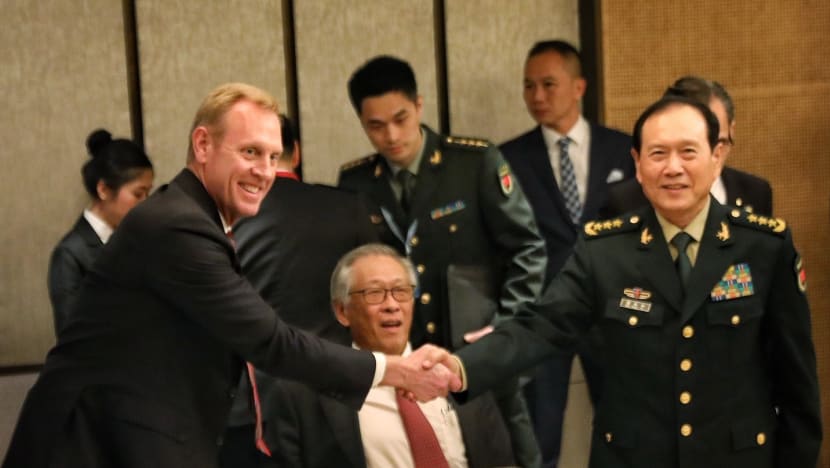
Acting US Defence Secretary Patrick Shanahan shaking hands with China’s Defence Minister Wei Fenghe during a ministerial roundtable discussion at the Shangri-La Dialogue on Saturday (June 1).


SINGAPORE — Defence ministers were “reassured” by the United States and China’s discussions on common goals and ways to improve understanding, Singapore’s Defence Minister Ng Eng Hen said after he hosted his counterparts to lunch on the sidelines of a summit here.
Dr Ng was speaking to reporters on Saturday (June 1) after the roundtable discussion with United States Acting Defence Secretary Patrick Shanahan, Chinese Defence Minister Wei Fenghe, and 20 other ministers and representatives.
The officials are in town for the Shangri-La Dialogue, an annual security summit, amid tensions between the world’s two largest economies.
Dr Ng said that such lunches, which have been a regular feature of the summit since it began in 2002, allow the ministers to speak frankly beyond the speeches they deliver.





“All the ministers wanted to have a first-hand view of the body language and tone of both Secretary Shanahan and Defence Minister Wei,” Dr Ng said.
After they spoke, all the ministers said they were “reassured”, the minister added.
Dr Ng believed that this was because the two men talked about ways to improve understanding and their common goals.
“Despite the disputes, there was common ground in terms of a prosperous region and… policies that benefited all states,” he added.
“I just take the ministers’ reaction as affirmation that dialogue is always good.”
China and the United States are ensnared in a trade feud, with both sides imposing higher tariffs on billions of dollars of each other’s goods.
The two sides are also caught in a technological fallout after the US put Huawei, a Chinese telecommunications firm, on a trade blacklist, effectively barring American firms from doing business with it.
When pressed on the atmosphere of the discussion, Dr Ng said: “If it were a silent movie, you wouldn’t know there was a dispute.”
S’PORE’S ‘TOO SMALL’ TO BE MEDIATOR
When asked if Singapore could mediate the disputes between the US and China, Dr Ng said that the country was “too small”.
“We are the grass. We are just sometimes trying to get out of the way and, other times, trying to make sure that elephants neither fight nor make love too vigorously and, if they do, we’re not part of the grass patch,” said Dr Ng, citing an analogy that Prime Minister Lee Hsien Loong borrowed from founding statesman Lee Kuan Yew.
Earlier on Saturday, Mr Shanahan spoke at a plenary session on the American vision for Indo-Pacific security.
The Indo-Pacific is the maritime zone bordered by the Indian and Pacific Oceans, and includes all states within that spectrum.
Even as the US is pouring defence investments into this region, Mr Shanahan urged its partners and allies in the region to “invest further”, including in defence.
Asked if Singapore was ready to pump more into defence, Dr Ng said that for countries in this region, their “entire lives are invested”.
While Singapore has to invest in defence capabilities, Dr Ng said the defence ministers agreed that their primary objective was to prevent wars, even as they prepare for conflict.
“The cost of conflict is so high, so prohibitive and so punishing on our own citizens that it’s unthinkable and one never wishes it,” said Dr Ng.
“We recognise, at the same time, that strong defence is a good deterrence, but beyond that, the ability to candidly sit down with other countries (caught in) disputes is significant. And to try to resolve the disputes through peaceful means is certainly better than conflicts.”
In a statement, Singapore’s Defence Ministry said that the ministers at the roundtable discussion agreed that the US-China relationship was the most vital to the region.
“They were also reassured that the US and China would work towards a stable and constructive… relationship that is crucial to sustaining peace, stability and prosperity in the region,” the ministry added.
The defence ministers also discussed the instability on the Korean Peninsula, and the threats of nuclear weapons and terrorism, Dr Ng said.




