







Disaster relief efforts should be politics-free
SINGAPORE — There is no place for politics in disaster relief efforts, said one of the co-directors of Exercise Coordinating Response, a military disaster relief planning exercise, in light of bilateral tensions among several countries.
Instead, the focus should be on those who require assistance as a result of a natural disaster, said Colonel Lee Kuan Chung on Wednesday (Jan 25), on the sidelines of the three-day exercise, which began on Jan 23.
Col Lee is director of the Singapore Armed Forces’ (SAF) Changi Regional Humanitarian Assistance and Disaster Relief (HADR) Coordination Centre (RHCC).
His comments came as militaries from 18 countries — including China, the United States, Malaysia, and Russia — came together to participate in the exercise. It was organised jointly by the SAF’s RHCC, Armed Forces of the Philippines, and the US Centre for Excellence in Disaster Management and Humanitarian Assistance.





In this exercise — the first to be organised, as well as the first multinational HADR exercise hosted in the RHCC in Singapore — two fictitious natural disasters had struck the Philippines: A volcanic eruption followed by a typhoon nearly a week later.
Participants then gathered at the Changi Command and Control Centre — which houses the RHCC — to plan for relief efforts. They were split into different groups, or cells, such as logistics, liaison, and operations. The 16 militaries taking part, apart from organisers Philippines and Singapore, were in the liaison cells.
The exercise also included 12 civilian organisations, such as Singapore Red Cross Society, Doctors Without Borders, and the World Food Programme, as observers.
Coordinating the various cells served as good practice for all parties involved, the co-directors noted.
Captain Joe Orbe, from the Armed Forces of the Philippines, told the media that disaster relief efforts “may look simple”, but there were a lot of kinks to be ironed out — such as where planes should land, and which ports to be used for ships to dock.
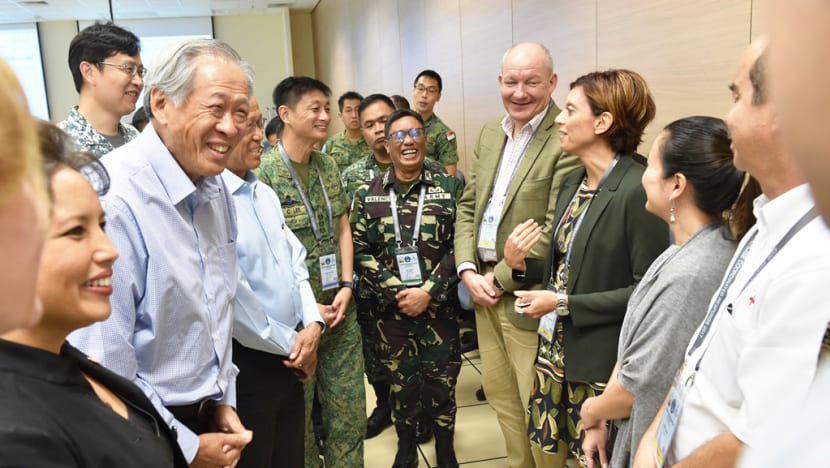
Defence Minister Ng Eng Hen, who visited the Changi Command and Control Centre on Wednesday, the last day of the exercise, said it was important “to have a network of partners, both military and civilian, who were used to working with each other so that you can respond very effectively in the first 48 to 72 hours”.
Accompanying Dr Ng was the Philippines’ National Defence Secretary Delfin Lorenzana, who said the exercise provided opportunities for participants to learn from one from another.
Agreeing, Col Lee said the exercise also provided opportunities for all parties to build working relationships. “We don’t exchange name cards during the operation ... We can exchange name cards right now.”
Meanwhile, one of the participants at the exercise, Major Manoharan Pariasamy from the SAF noted differences in operating procedures among the countries, such as in language and procedures.
Maj Manoharan said the experience that the parties have gained during the exercise will help “quicken processes” should disaster strike.
The Changi RHCC was set up in 2014, to serve as a regional hub for coordination of HADR efforts. It was fully operational in 2015.




